Home Documents Macintosh MPW 3.0A2 Documents
MPW 3.0A2 Documents

MPW 3.0A2 Documents

Macintosh · 1988 · PDF
FilenameMPW_3.0A2_Documents_19880714.pdf
Size32.47 MB
Year1988
Subsection developer / MPW / MPW_3.0
Downloads2
Enjoying MacTrove? Anonymous downloads are free and unlimited. Create a free account to track favorites, contribute metadata corrections, and join the community chat.
Reader
MPW 3.0A2 Documents
/
Loading…
OCR / Text contents
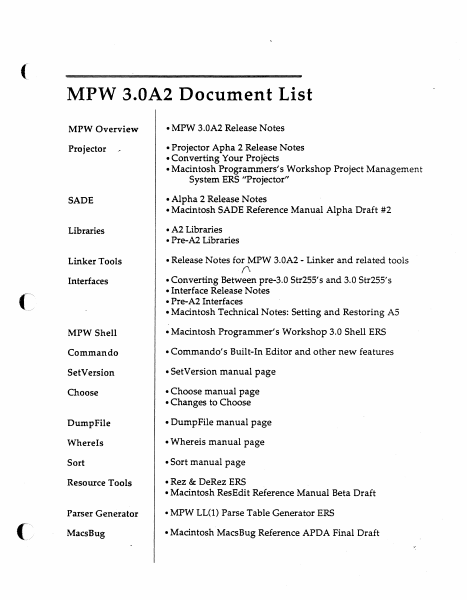
( MPW 3.0A2 Document List MPW Overview • MPW 3.0A2 Release Notes Projector •Projector Apha 2 Release Notes • Converting Your Projects •Macintosh Programmers's Workshop Project Management System ERS ''Projector" SADE •Alpha 2 Release Notes •Macintosh SADE Reference Manual Alpha Draft #2 Libraries • A2 Libraries • Pre-A2 Libraries Linker Tools •Release Notes for MPW 3.0A2 - Linker and related tools Interfaces •Converting Between pre-3.0 Str255's and 3.0 Str25S's •Interface Release Notes • Pre-A2 Interfaces •Macintosh Technical Notes: Setting and Restoring AS MPW Shell •Macintosh Programmer's Workshop 3.0 Shell ERS Commando •Commando's Built-In Editor and other new features SetVersion • SetVersion manual page Choose • Choose manual page • Changes to Choose Dump File • DumpFile manual page Where ls • Whereis manual page Sort •Sort manual page Resource Tools • Rez & DeRez ERS •Macintosh ResEdit Reference Manual Beta Draft Parser Generator • MPW LL(l) Parse Table Generator ERS MacsBug •Macintosh MacsBug Reference APDA Final Draft ('" _/' ('\ / (\ ,. ) / MPW 3.0A2 Release Notes July 14, 1988 Overview This release note pertains to the following MPW products: • MPW Development Environment • MPWPascal •MPWC • MPW Assembler MPW C++ has its own separate release note. This release note, the MPW 3.0 ERS' s, and other tool-specific release notes are the documentation for this release. Differences between the ERS, previous 3.0 development releases, and this release are documented below. If no release note exists for something that has an ERS, assume that the piece has been implemented as documented in the ERS. MPW 3.0A2 highlights include a symbolic debugger, project management system, and new C compiler. All of the C pieces of MPW, were compiled with this new C. Since MPW 2.0, the C header files have three important changes: every function has a function prototype, the capitalization for routines that pass strings and points has changed, and the definition of Str255 has changed. The capitalization and Str255 changes will require changes to your C source. See the section below titled ''Interfaces." ( Another change in MPW 3.0A2 may require a change to your Makefiles. The Pascal compiler no longer uses the Load/Dump mechanism. Instead, the compiled object code for each unit is saved in the unit's resource fork. Therefore, dependency rules (in Makefiles) upon Pascal dump files are obsolete. See the section below titled "Pascal." The A2 C compiler now has function prototype checking turned on. Furthermore, the C compiler is very strict about type compatibility. Be forewarned ... Installation • Installation from floppies - MPW 3.0 now includes an installer disk for installing MPW from a set of floppy disks .. Here are the steps for automatically installing MPW on your disk: 1) drag the ''Installation Folder" onto the hard disk where you want MPWinstalled · 2) launch the MPW Shell found in the ''Installation Folder" App…

Showing first 3,000 characters of 500,000 total. Open the full document →
Home Documents Macintosh MPW 3.2 Toolbox Interfaces And Libraries
MPW 3.2 Toolbox Interfaces And Libraries

MPW 3.2 Toolbox Interfaces And Libraries

Macintosh · 1990 · PDF
FilenameMPW_3.2_Toolbox_Interfaces_and_Libraries_199107.pdf
Size2.97 MB
Year1990
Subsection developer / MPW / MPW_3.2
Downloads2
Enjoying MacTrove? Anonymous downloads are free and unlimited. Create a free account to track favorites, contribute metadata corrections, and join the community chat.
Reader
MPW 3.2 Toolbox Interfaces And Libraries
/
Loading…
OCR / Text contents
® Macintosh®Programmer's Workshop Toolbox Interfaces and Libraries Version 7.0 M0615LUB 030-B0 16-A 030-3622-A MPW 3.2 Libraries/Interfaces Release Notes Libraries Changes to the libraries since MPW 3.0 include the elimination of CInterface.o and CRuntime.o, their functionality having been merged into Interface.o and Runtime.o. The libraries have been resegmented so as to reduce the number of modules in segment "main". The MPW 3.2 C libraries conform to the current ANSI C standard. A number of modifications and additions have been made to the set of library functions, including new C-like string functions for Pascal strings and a C function for setting the type and creator on any file. A new library provides for the creating of applications that use a simple text I/O window to display and read console I/O (SlOW). For details, see the MPW 3.2 Simple Input/Output Window Release Notes. Linking Requirements The library CLib881.0 has a new positioning requirement as a consequence of the elimination of CRuntime.o. CLib881.0 must now not only precede all members of {CLibraries} in the link sequence but must also precede the library Runtime.o. Note that XCMDs for Hypercard require linking into one segment. Because of the new segmentation of the library, this will no longer happen automatically. This requirement can be met by putting the option -sg main on the link: command line to force the library routines and your code into a single segment. MPW 3.2 LibrarieslInterfaces Release Notes 1 Copyright Apple Computer, Inc. 1990-1991. All rights reserved. Segmentation The libraries have been resegmented, moving many of the modules out of the segment "Main". The goal of changing the segmentation is to minimize the number of modules in the segment "Main". This way, if the user needs the space in "Main" for his application or tool, he has it. If he is more concerned about speed, the user can then manipulate his makefile to contain whatever he needs in his "Main" segment. • Segment layout LIBRARY Runtlme.o Se&ment Contents MAIN %A5Init INTENV Initialization and exit procedures, 32 bit math operations A5 initialization code, _DataInit, Module #000 1 Low level IOPort functions and I/O which directly calls those functions - done for pc relative offsets Device drivers <.S.tand Alone Devices) SADEV LIBRARY Pasllb.o SelWlent Contents MAIN INTENV Compiler initializations (the functions call Runtime.o) I/O which directly calls segment INTENV in Runtime.o (may change in the future) Pascal language I/O Heap, strings and math functions SIDIO PASLIB LIBRARY StdCLlb.o Contents SIDIO SIDCLm MPW 3.2 LibrarieslInterfaces Release Notes C language I/O All ANSI functions (except I/O) 2 Copyright Apple Computer, Inc. 1990-1991. All rights reserved. LIBRARY Stubs.o Sewent Contents SADEV Device drivers (stubs out the driver functions) LIBRARY DRVRRuntime.o Se&ment Contents MAIN Driver initialization and exit procedures Changes to C Library…

Showing first 3,000 characters of 48,427 total. Open the full document →

Home Documents Macintosh MPW 3.2 Assembler Release Notes
MPW 3.2 Assembler Release Notes

MPW 3.2 Assembler Release Notes

Macintosh · 1990 · PDF
FilenameMPW_3.2_Assembler_Release_Notes_199104.pdf
Size0.39 MB
Year1990
Subsection developer / MPW / MPW_3.2
Downloads2
Enjoying MacTrove? Anonymous downloads are free and unlimited. Create a free account to track favorites, contribute metadata corrections, and join the community chat.
Reader
MPW 3.2 Assembler Release Notes
/
Loading…
OCR / Text contents
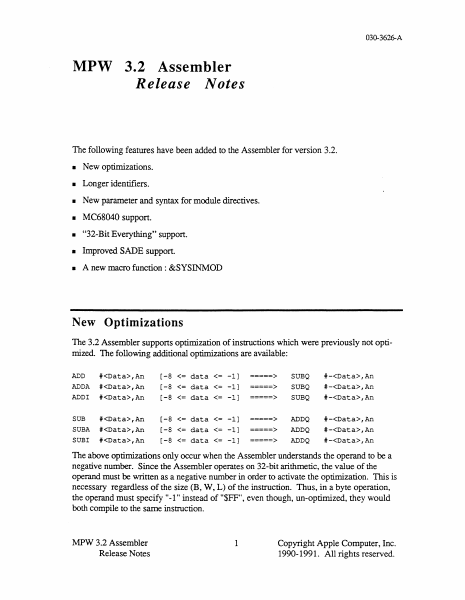
030-3626-A MPW 3.2 Assembler Release Notes The following features have been added to the Assembler for version 3.2. • New optimizations. • Longer identifiers. • New parameter and syntax for module directives. • MC68040 support. • "32-Bit Everything" support. • Improved SADE support. • A new macro function : &SYSINMOD New Optimizations The 3.2 Assembler supports optimization of instructions which were previously not optimized. The following additional optimizations are available: ADD ADDA ADDI #<Data>,An #<Data>,An #<Data>,An [-8 <= data <= -1) [-8 <= data <= -1] [-8 <= data <= -1) =====> =====> =====> SUBQ SUBQ SUBQ #-<Data>,An #-<Data>,An #-<Data>,An SUB SUBA SUBI #<Data>,An #<Data>,An #<Data>,An [-8 <= data <= -1] [-8 <= data <= -1] [-8 <= data <= -1] =====> =====> =====> ADDQ ADDQ ADDQ #-<Data>,An #-<Data>,An #-<Data>,An The above optimizations only occur when the Assembler understands the operand to be a negative number. Since the Assembler operates on 32-bit arithmetic, the value of the operand must be written as a negative number in order to activate the optimization. Tiris is necessary regardless of the size (B, W, L) of the instruction. Thus, in a byte operation, the operand must specify "-1" instead of "$FF". even though, un-optimized, they would both compile to the same instruction. MPW 3.2 Assembler Release Notes 1 Copyright Apple Computer, Inc. 1990-1991. All rights reserved. ADDI #<Data>,<EA3> SUBI #<Data>,<EA3> ADD.I #<data>,An =====> =====> [+l <= data <= +8] [-32767 <= data <= +32767] =====> [+l <= data <= +8] ADDQ SUBQ #<Data>,<EA3> #<Data>,<EA3> LEA <Data>(An),An Longer Identifiers The Assembler now suppons identifiers of lengths up to 251 characters (this was done primarily to support C++ name mangling). On detecting a name that exceeds this maximum, the Assembler issues the warning: ID longer than maximum length ... truncating to maximum length. New Parameter and Syntax for Module Directives A new parameter, ForceActi ve, exists for the ccxie module and data mcxiule directives. A new syntax has been provided and error checking for conflicting parameters is in effect. ForceActive ForceActive causes a ccxie or data module to be included in the final linked output even if the Linker would otherwise strip that code or data module because there were no references to it. Syntax For code module directives: Line ::= [label] CodeDir [KeywordList] CodeDir ::= PROC I FUNC I MAIN KeywordList ::=Keyword I KeywordList, Keyword Keyword::= ENTRY I EXPORT I FORCEACTIVE For data module directives: Line ::= [label] RECORD [KeywordList] KeywordList Keyword I KeywordList, Keyword MPW 3.2 Assembler Release Notes 2 Copyright Apple Computer, Inc. 1990-1991. All rights reserved. Keyword::= ENTRY I EXPORT I INCR[EMENT] MAIN I FORCEACTIVE I DECR[EMENT] + Note: The MPW 3.0 Assembler Manual describes MAIN as a parameter for the RECORD directive, but appears to have inadvertently omitted MAIN from the syntax. 6 Import…

Showing first 3,000 characters of 11,709 total. Open the full document →

Home Documents Macintosh MPW 3.0a2 Release Notes
MPW 3.0a2 Release Notes

MPW 3.0a2 Release Notes

Macintosh · 1988 · PDF
FilenameMPW_3.0a2_Release_Notes_198807.pdf
Size32.61 MB
Year1988
Subsection developer / MPW
Downloads2
Enjoying MacTrove? Anonymous downloads are free and unlimited. Create a free account to track favorites, contribute metadata corrections, and join the community chat.
Reader
MPW 3.0a2 Release Notes
/
Loading…
OCR / Text contents
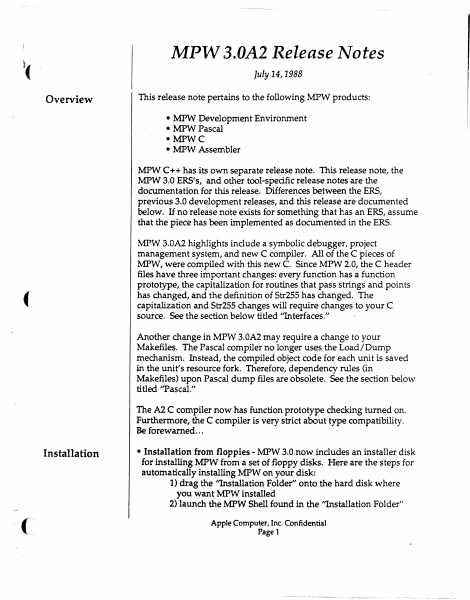
MPW 3.0A2 Release Notes July 14, 1988 Overview This release note pertains to the following MPW products: • MPW Development Environment • MPWPascal •MPWC • MPW Assembler MPW C++ has its own separate release note. This release note, the MPW 3.0 ERS's, and other tool-specific release notes are the documentation for this release. Differences between the ERS, previous 3.0 development releases, and this release are documented below. If no release note exists for something that has an ERS, assume that the piece has been implemented as documented in the ERS. MPW 3.0A2 highlights include a symbolic debugger, project management system, and new C compiler. All of the C pieces of MPW, were compiled with this new C. Since MPW 2.0, the C header files have three important changes: every function has a function prototype, the capitalization for routines that pass strings and points has changed, and the definition of Str255 has changed. The capitalization and Str255 changes will require changes to your C source. See the section below titled ''Interfaces." Another change in MPW 3.0A2 may require a change to your Makefiles. The Pascal compiler no longer uses the Load/Dump mechanism. Instead, the compiled object code for each unit is saved in the unit's resource fork. Therefore, dependency rules (in Makefiles) upon Pascal dump files are obsolete. See the section below titled ''Pascal." The A2 C compiler now has function prototype checking turned on. Furthermore, the C compiler is very strict about type compatibility. Be forewarned ... Installation • Installation horn floppies - MPW 3.0 now includes an installer disk for installing MPW from a set of floppy disks. Here are the steps for automatically installing MPW on your disk: 1) drag the "Installation Folder" onto the hard disk where you want MPW installed 2) launch the MPW Shell found in the ''Installation Folder" Apple Computer, Inc. Confidential Page 1 (the one you just dragged onto your hard disk) 3) the installation script will run and will prompt you to insert a disk in the internal drive. You can insert the MPW disks in any order and it won't hurt to insert a disk more than once. 4) once the installation is complete, throw away the "Installation Folder," and launch the newly installed shell. For those not using the installer script, you will notice that the· configuration of :MPW on the floppies has changed. The files on the disks are in folders that represent their final destination when moved to a hard disk. Pascal, for example, used to be found at the root level of the Pascal disk. Now, however, Pascal will be found in a "Tools" folder on the Pascal disk. This means that there will be duplicate folders across the set of floppies and you won't be able to drag the contents of each floppy onto a hard disk without some conflict. • Installation from Spudsffaters - simply drag the MPW and SADE folders onto your hard disk. Reporting Bugs Please report any bugs you find to the BRC. Please use the latest v…

Showing first 3,000 characters of 500,000 total. Open the full document →
Home Documents Macintosh MPW A5 Driver Runtime Library
MPW A5 Driver Runtime Library

MPW A5 Driver Runtime Library

Macintosh · 1986 · PDF
FilenameMPW_A5_Driver_Runtime_Library_19860612.pdf
Size0.68 MB
Year1986
Subsection developer / MPW
Downloads2
Enjoying MacTrove? Anonymous downloads are free and unlimited. Create a free account to track favorites, contribute metadata corrections, and join the community chat.
Reader
MPW A5 Driver Runtime Library
/
Loading…
OCR / Text contents
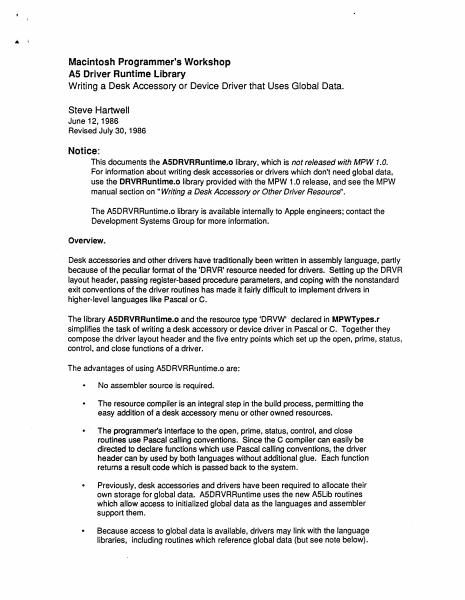
4. '• Macintosh Programmer's Workshop AS Driver Runtime Library Writing a Desk Accessory or Device Driver that Uses Global Data. Steve Hartwell June 12, 1986 Revised July 30, 1986 Notice: This documents the ASDRVRRuntime.o library, which is not released with MPW 1.0. For information about writing desk accessories or drivers which don't need global data, use the DRVRRuntime.o library provided with the MPW 1.0 release, and see the MPW manual section on " Writing a Desk Accessory or Other Driver Resource". The A5DRVRRuntime.o library is available internally to Apple engineers; contact the Development Systems Group for more information. Overview. Desk accessories and other drivers have traditionally been written in assembly language, partly because of the peculiar format of the 'DRVR' resource needed for drivers. Setting up the DRVR layout header, passing register-based procedure parameters, and coping with the nonstandard exit conventions of the driver routines has made it fairly difficult to implement drivers in higher-level languages like Pascal or C. The library ASDRVRRuntime.o and the resource type 'DRVW' declared in MPWTypes.r simplifies the task of writing a desk accessory or device driver in Pascal or C. Together they compose the driver layout header and the five entry points which set up the open, prime, status, control, and close functions of a driver. The advantages of using A5DRVRRuntime.o are: • No assembler source is required. • The resource compiler is an integral step in the build process, permitting the easy addition of a desk accessory menu or other owned resources. • The programmer's interface to the open, prime, status, control, and close routines use Pascal calling conventions. Since the C compiler can easily be directed to declare functions which use Pascal calling conventions, the driver header can by used by both languages without additional glue. Each function returns a result code which is passed back to the system. • Previously, desk accessories and drivers have been required to allocate their own storage for global data. A5DRVRRuntime uses the new A5Lib routines which allow access to initialized global data as the languages and assembler support them. • Because access to global data is available, drivers may link with the language libraries, including routines which reference global data (but see note below}. A5DRVRRuntime Library • Internal Release Only Page 2 Drivers have peculiar exit conventions, requiring immediate calls to exit via an RTS instruction, but non-immediate calls to JMP to the IODone routine. The ASDRVRRuntime glue handles the proper exit conventions. Some programming restrictions still apply to non-application code resources such as drivers. Most notably is the restriction against the use of one variety of global data -- global variables which are initialized to procedure pointers. Unfortunately, the 1/0 portions of the language libraries and the Integrated Environment functions use in…

Showing first 3,000 characters of 18,634 total. Open the full document →
Home Documents Macintosh TokenTalk Programmers Guide
TokenTalk Programmers Guide

TokenTalk Programmers Guide

Macintosh · 1989 · PDF
FilenameTokenTalk_Programmers_Guide_198903.pdf
Size7.30 MB
Year1989
Subsection developer / Networking
Downloads5
Enjoying MacTrove? Anonymous downloads are free and unlimited. Create a free account to track favorites, contribute metadata corrections, and join the community chat.
Reader
TokenTalk Programmers Guide
/
Loading…
OCR / Text contents
( Medusa Programmer's Guide Beta Draft Apple Confidential Medusa Programmer's Guide, Beta Draft S APPLE COMP'Ulll, INC. This manual is cq>yrighted by Apple or by Apple's suppliers, with all rights reserved. Under the cop)'!ight laws, this manual may !10l be copied, in whole or in part, without the written consent of Apple Computer, Inc. This exception does !lC( allow copies to be made for OOiers, whether or ncx sold, but all ci the material purchased may be sold, given, or lent to another person. Under the law, copying includes translating into another language. C Apple Computer, Inc., 1989 20525 Mariani Avenue Cupertino, CA 95014 (~)996-1010 Apple, the Apple logo, and Macintosh are registered trademarks of Apple Computer, Inc. TokenTalk, Macinta;h Coprocessor Platform, and MR-DOS are trademarks of Apple Computer, Inc. NuBus i.5 a trademark of Texas Instruments. Simultaneously publi.shed in the United States and Canada Notice The information in this document rctlects the current state of the product. Every effort has been made to verify the accuracy of this information; however, it is subject to change. Beta Drafts an: rcJe:ased in this form to ptOTlde the deveJopmem community with essendal information In order to work on compatible products. Apple confidential Y21/89 Apple C.Onfidential ( Contents Preface What this document contains I Suggested reading I Possible applications I Conventions used in this manual I 1 Introduction 1 Token Ring Networks I The network layers I A token ring network I Token communication I The Macintosh II token ring interface I SubNetwork Access Protocol (SNAP) I The 802.2 Logical Link Control !PC interface I Macintosh Operating System !PC services I Download and initialization services I iii Apple Confidential 2 Source Routing Support What is source routing? I Hierarchical networks I Mesh networks I How source routing works I Routing information I Source routing implementation I SNAPuse I U.C use I Source route limits I 3 SubNetwork Access Protocol (SNAP) Interface General information I Typical SNAP use I !PC requests to SNAP I SNAPAttach I SNAPGetConfig I SNAPGetHdr I SNAPTransmit I SNAPDetach I SNAPReceive I SNAPC.ancel I SNAPGetParm.s I Functions supporting 802.2 I SNAPSwapHdr I Example program listing I 4 The 802.2 llC I lPC Interface General information I Typi:al rol-2 llC use I !PC requests ID ~2.2 LLC I U.COpenSAP I U.CCloseSAP / iv CONTENTS Apple Confidential ( IlCGetHdr I IlCGetCoofig I LLCOpenStation I LLCClo.seStation I IlCConnectStation I LLCModifyParams I IlCReceive I IlCReceiveC.ancel I IlCTl Transmit I IlCT2Transmit I IlCReset I LLCRetumBuffer I IlCGetStatistics I IlCStatus I IlCSetFunctionalAddr I Functions Supporting 802.2 I LLCSwapHdr I 5 Apple IPC Services I 1 General information I Apple !PC driver I Apple !PC library I Apple !PC managers I Csing Apple !PC I Apple !PC services I C<RQJeue I CopvNuBus I freeMsg / GetCard I GetETick I GetICCTID I GetlPCg I GetMsg I GeL"larn…

Showing first 3,000 characters of 210,592 total. Open the full document →
Home Documents Macintosh MacTCP Administrators Guide
MacTCP Administrators Guide

MacTCP Administrators Guide

Macintosh · 1989 · PDF
FilenameMacTCP_Administrators_Guide_198901.pdf
Size3.99 MB
Year1989
Subsection developer / Networking
Downloads2
Enjoying MacTrove? Anonymous downloads are free and unlimited. Create a free account to track favorites, contribute metadata corrections, and join the community chat.
Reader
MacTCP Administrators Guide
/
Loading…
OCR / Text contents
·~Apple MacTCP Administrator's Guide Product Marketing Networking and Communications Publications AppleTalk Documentation February 1, 1989 Apple Confldeotial ( S APPIJ! CoMPT.Tl'ER, INC. This manual is copyriglted by Apple er by Apple's suppliers, with all rights reserved. Under the copyright laws, th.is manual may not be copied, in whole or in part, without the wrlten c:onselX of Apple (.omputer, Ioc. This exception does ncx allow copies to be made for others, whether or ncx sold, but all of the material purchased may be sold, given, or lent to aoother person. Under the law, copying includes translating into ancxher language. The Apple logo is a regisrered trademark d Apple Computer, Inc. Use of the "keybaard" Apple logo (Opti>n-Shift-K) for commercial purposes without the prior wrillen consent of Apple may c:omtitute trademark infringement and unfair competition in relation 6f federal and state Jaws. ~ Apple Computer, Ioc., 1989 20525 Mariani Avenue Cupertiro, CA 95014 (4~) 996-1010 Apple, the Apple logo, AppleTalk, EtherTalk, LaserWriter, l.oC2II'alk, Macintosh, and MacTCP are regisrered trademarks d Apple Computer, Inc. ii Apple Coofidential C 0 N T E N T S Contents About This Gulde xiii Who should read this guide xiv How to use this guide xiv f Conventions xv ' What yoo need xvi Associated documeIXS xvi Part I Apple Confidential Concepts 1 About MacTCP Overview 2 1 Network environment DDP-IP gateway 4 3 iii .. \ 2 About TCP/IP 5 The family ci protocols 7 Iruernet Protcx:ol (IP) 9 Transmission Control Protocol \I'CP) 10 User Datagram Protocol (UDP) 10 Telnet 11 File Transfer Protcx:ol (FTP) 11 Simple Mail Transfer Protocol (SMTP) 11 3 TCP/IP Addressing Conventions Internet addresses 14 Subnetwork addressing 16 Subnetwork masks 18 The domain name system 19 13 Addres.5 Resolution Prcxocol (ARP) 21 Reverse Address Resolution Protocol (RARP) 22 Boexstrap Protocol (BoolP) 23 4 Routing 25 Gateways 26 Routing tables Z7 Routing protocols 28 Routing Information Protocol (RIP) 28 Iruemet Comd Mwage Protocol OCMP) 28 iv Contents Apple Confidential ( Part II Procedures 5 Installation 29 MacTCP scitware 30 Creating a master cmk 31 user installation in.structm 35 lNlalling Macro> on a fk>ppy disk-based system 35 lNlalling MacTCP en a hard disk 36 6 MacTCP Configuration Configuratioo tools 40 39 The MacTCP Corurol Panel 41 The Administrator dialog box 43 Obtain Address box 43 IP Address box 44 Routing Information box 44 Domain Name Server Information box « Protected button « c:onfiguration scenarias 45 Bringing up the MacTCP Control Panel 47 Entering the IP address in decimal rotation 48 Bringing up the Administrator dialog 49 Setting the IP address SO Setting the address manually 51 Setting the addtcss ~ 51 Settins the subnet mask 53 Selling the IP address (integer format) 53 Entering the net number 54 Enlering the subnet number 54 Entering the node number 54 Having the address set auromatically 56 Setti…

Showing first 3,000 characters of 101,682 total. Open the full document →

Home Documents Macintosh MacApp 2.0b5 UTEView Release Notes
MacApp 2.0b5 UTEView Release Notes

MacApp 2.0b5 UTEView Release Notes

Macintosh · 1988 · PDF
FilenameMacApp_2.0b5_UTEView_Release_Notes.pdf
Size0.94 MB
Year1988
Subsection developer / MacApp_2.0
Downloads2
Enjoying MacTrove? Anonymous downloads are free and unlimited. Create a free account to track favorites, contribute metadata corrections, and join the community chat.
Reader
MacApp 2.0b5 UTEView Release Notes
/
Loading…
OCR / Text contents
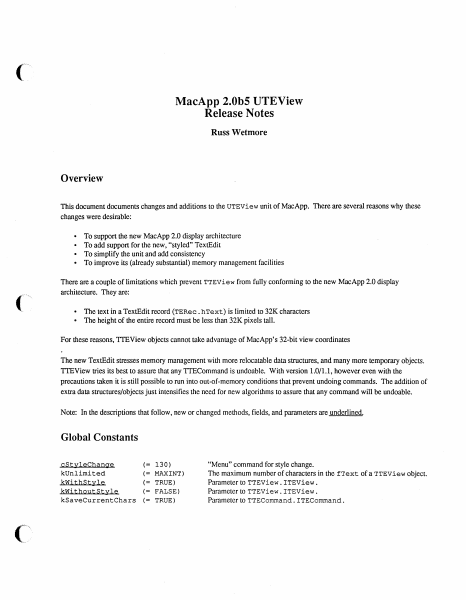
MacApp 2.0b5 UTEView Release Notes Russ Wetmore Overview This document documents changes and additions to the UTEView unit of MacApp. There are several reasons why these changes were desirable: • To support the new MacApp 2.0 display architecture • To add support for the new, "styled" TextEdit • To simplify the unit and add consistency • To improve its (already substantial) memory management facilities There are a couple of limitations which prevent TTEView from fully conforming to the new MacApp 2.0 display architecture. They are: • The text in a TextEdit record (TERec. hText) is limited to 32K characters • The height of the entire record must be less than 32K pixels tall. For these reasons, TTEView objects cannot take advantage of MacApp's 32-bit view coordinates The new TextEdit stresses memory management with more relocatable data structures, and many more temporary objects. TTEView tries its best to assure that any TTECommand is undoable. With version 1.0/1.1, however even with the precautions taken it is still possible to run into out-of-memory conditions that prevent undoing commands. The addition of extra data structures/objects just intensifies the need for new algorithms to assure that any command will be undoable. Note: In the descriptions that follow, new or changed methods, fields, and parameters are underlined. Global Constants cStyleChange kUnlimited kWithStyle kWithoutStyle kSaveCurrentChars 130) MAXINT) (= TRUE) (= FALSE) (= TRUE) (= (= "Menu" command for style change. The maximum number of characters in the fText of a TTEView object. Parameter to TTEView. ITEView. Parameter to TTEView. ITEView. Parameter to TTECommand. ITECommand. The TTEView Class The following changes have been made for TTEView: • fFont, fSize and fStyle have been replaced by a single fTextStyle record of type TextStyle. TextStyle is a data structure used by the new TextEdit, and is defined as TextStyle RECORD tsFont tsFace tsSize tsColor END; INTEGER; Style; INTEGER; RGBColor; • TTEView. ITEView has been simplified. Some rarely used parameters have been removed (such as itsKeyCmd.Number and itsMaxChars) and others have been bunched together. A new parameter itsStyleType signifies whether the TERecord is "styled" or not. • TTEView. Inspect and TTEView. ShowDebuginfo have been replaced by the new Inspector-supported TTEView. Fields. Fields fHTE fText fSavedTEHandle Unset fKeyCmd.Number fMaxChars fTypingCommand· fTextStyle fJustification fAcceptsChanges fStyleTyQe fAutoWrap fFreeText fSQecsChanged fLastHeight fScroller fLastPageBreak fLastLine Wed, Aug 3, 1988 Handle to the actual TextEdit object. The text in the TEHandle. Saved handle from TENew. A rectangle defining the amount of pixels to inset the TERecord's viewRect from view's extent. Thus, finset defines margins around the edges of the view. Views whose text autowraps should have a bottom margin of zero. Will be used as the string number for "Undo Typing." Maximum number of chars to accept…

Showing first 3,000 characters of 22,976 total. Open the full document →

Home Documents Macintosh MacApp 2.0b5 Feature Overview
MacApp 2.0b5 Feature Overview

MacApp 2.0b5 Feature Overview

Macintosh · 1988 · PDF
FilenameMacApp_2.0b5_Feature_Overview_19880803.pdf
Size1.52 MB
Year1988
Subsection developer / MacApp_2.0
Downloads2
Enjoying MacTrove? Anonymous downloads are free and unlimited. Create a free account to track favorites, contribute metadata corrections, and join the community chat.
Reader
MacApp 2.0b5 Feature Overview
/
Loading…
OCR / Text contents
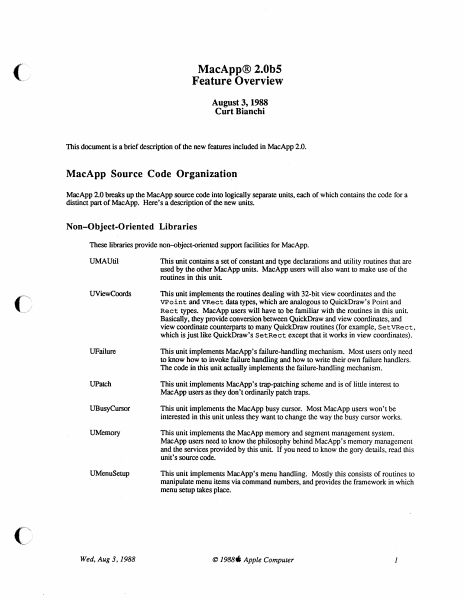
MacApp® 2.0b5 Feature Overview August 3, 1988 Curt Bianchi This document is a brief description of the new features included in MacApp 2.0. MacApp Source Code Organizatio_n MacApp 2.0 breaks up the MacApp source code into logically separate units, each of which contains the code for a distinct part of MacApp. Here's a description of the new units. Non-Object-Oriented Libraries These libraries provide non-object-oriented support facilities for MacApp. c UMAUtil This unit contains a set of constant and type declarations and utility routines that are used by the other MacApp units. MacApp users will also want to make use of the routines in this unit UViewCoords This unit implements the routines dealing with 32-bit view coordinates and the VPoint and VRect data types, which are analogous to QuickDraw's Point and Rect types. MacApp users will have to be familiar with the routines in this unit. Basically, they provide conversion between QuickDraw and view coordinates, and view coordinate counterparts to many QuickDraw routines (for example, SetVRect, which is just like QuickDraw's SetRect except that it works in view coordinates). UFailure This unit implements MacApp's failure-handling mechanism. Most users only need to know how to invoke failure handling and how to write their own failure handlers. The code in this unit actually implements the failure-handling mechanism. UPat.ch This unit implements MacApp's trap-patching scheme and is of little interest to MacApp users as they don't ordinarily patch traps. UBusyCursor This unit implements the MacApp busy cursor. Most MacApp users won't be interested in this unit unless they want to change the way the busy cursor works. UMemory This unit implements the MacApp memory and segment management system. MacApp users need to know the philosophy behind MacApp's memory management and the services provided by this unit If you need to know the gory details, read this unit's source code. UMenuSetup This unit implements MacApp's menu handling. Mostly this consists of routines to manipulate menu items via command numbers, and provides the framework in which menu setup takes place. Wed, Aug 3, 1988 © 1988S Apple Computer 1 Object-Oriented Libraries These units form the core of the MacApp object classes. UObject This unit provides the base support for objects in MacApp and includes the TObject class. UAssociation This unit implements the TAssociation class, which is essentially a dictionary that associates one string with another. UList This unit contains the TList and TSortedList classes, which implements lists of objects, similar to dynamic arrays. They are widely used by MacApp and by most MacApp programs. . UMacApp This is the main MacApp uniL It contains the classes TApplication, TDocument,TView,TWindow,TScroller,TControl,TCtlMgr, TScrollBar, TSScrollBar and TPrintHandler. It also contains global variables, constants, and type declarations used by MacApp. Building Block Units These …

Showing first 3,000 characters of 40,301 total. Open the full document →

Home Documents Macintosh MacApp 2.0b5 UDialog Release Notes
MacApp 2.0b5 UDialog Release Notes

MacApp 2.0b5 UDialog Release Notes

Macintosh · 1988 · PDF
FilenameMacApp_2.0b5_UDialog_Release_Notes.pdf
Size2.01 MB
Year1988
Subsection developer / MacApp_2.0
Downloads2
Enjoying MacTrove? Anonymous downloads are free and unlimited. Create a free account to track favorites, contribute metadata corrections, and join the community chat.
Reader
MacApp 2.0b5 UDialog Release Notes
/
Loading…
OCR / Text contents
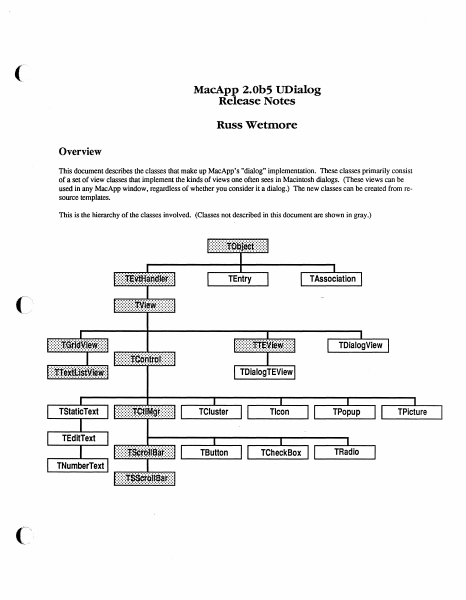
( MacApp 2.0b5 UDialog Release Notes Russ Wetmore Overview This document describes the classes that make up MacApp's "dialog" implementation. These classes primarily consist of a set of view classes that implement the kinds of views one often sees in Macintosh dialogs. (These views can be used in any MacApp window, regardless of whether you consider it a dialog.) The new classes can be created from resource templates. This is the hierarchy of the classes involved. (Classes not described in this document are shown in gray.) .·:·.·~;-;f:ci······;;.~~-:· TEntry .;::::::r.~lf·ITTan1;1,.~:::: ..................... TAssociation . ,.. ·.·.··:·:·:· :-:·:·:·;;...r.~1·.:iv.· : TDialogView :::::::::~:~:-~: .. ~~:::::: TDialogTEView TStaticText TCluster Tlcon TPopup TButton TCheckBox TRadio TEditText TNumberText :::::::r:ssc:r-Oitsar:::: .·.·.·.·.·.·.·.·.·.·.·.·.·.·.·.·.·.·.·.· TPicture Global Constants Choices mOKHit mCancelHit mButtonHit mCheckBoxHit mClusterHit mEdi t.TextHi t miconHit mListitemHit mListScrollBarHit mPictureHit mPopupHit mRadioHit mStaticTextHit mHScrollBarHit mVScrollBarHit mEditTabKey mEditReturnKey mEditEnterKey m.PatternHit mControlHit 1; 2; 3; 4; 5; 6; 7; 8; 9; 10; 11; 12; 13; 14; 15; 16; 17; 18; 19; 20; View Template Identifiers kNoidentifier kNoTemplate kNoResource '., -1; -1; Miscellaneous kYesButton kNoButton kPreferColor kControlOn kRedraw kDontRedraw kFrame ChrOO ChrlF kMaxTEWidth Wed, Aug 3, 1988 1; 3; TRUE; TRUE; TRUE; FALSE; [adnLineTop, adnLineLeft, adnLineBottom, adnLineRight]; CHR (0); CHR($1F); $2BO; ©1988 ti Apple Computer 2 Global Types ID Type = ResType; adornPieces adnLineTop, adnLineLeft, adnLineBottom, adnLineRight, adnDummy, adnOval, adnRRect, adnShadow ) ; Draw a line at the top of the extent. Draw a line on the left side of the extent. Draw a line at the bottom of the extent. Draw a line on the right side of the extent. Placeholder (replaces adnPatFill). Do a FrameOval using the extent Do a FrameRound.Rect using the extent. Draw drop-shadows against framed selections. CntlAdornment SET OF adornPieces; ControlCharSet SET OF ChrOO .. ChrlF; Used by TEdi t Text for allowable control chars. Global Routines PROCEDURE InitUDialog; This routine initializes the UDialog unit. It must be called before any of the view classes in this unit can be created from 'view' resources. FUNCTION NewTemplateWindow (viewRsrcID: INTEGER; itsDocument: TDocument): TWindow; This routine creates a new TWindow (or descendant) from the 'view' template with the given resource ID. PROCEDURE RegisterType (typeName: Str255; protoObj: TObject); This routine registers the given object (which can be an instance of any descendant of TObject) for use by TEvtHandler and its descendants when creating views from a template. The TEntry Class This class is used by TAssociation to form a very basic and cheap text item dictionary mechanism whose main use will be substitution of text in dialog-type window items. T…

Showing first 3,000 characters of 51,345 total. Open the full document →

Subscribe to developer
mp.ls