Home Documents Macintosh Introduction To Macintosh Programming Environments Draft
Introduction To Macintosh Programming Environments Draft

Introduction To Macintosh Programming Environments Draft
Macintosh · 1989 · PDF
FilenameIntroduction_to_Macintosh_Programming_Environments_draft_19890320.pdf
Size3.32 MB
Year1989
Subsection developer
Downloads4
Enjoying MacTrove? Anonymous downloads are free and unlimited. Create a free account to track favorites, contribute metadata corrections, and join the community chat.
Reader
Introduction To Macintosh Programming Environments Draft
/
Loading…
OCR / Text contents
I J t ( tl Macintosh~ Introduction to Macintosh Programming Environments Beta Draft Mitchell Developer Gass Technical March 20, 1989 Apple Confidential C Apple Computer, Inc., 1989 Publications Beta Draft S APPLE COMPUI'ER, INC. Apple, the Apple logo, AppleTalk, This manual is copyrighted, with all rights reserved. Under the copyright A/UX, HyperCard, MacApp, Macintosh, and SANE are registered laws, this manual may not be copied, in whole or in pa.rt, without written consent of Apple. © Apple Computer, Inc., 1989 20525 Mariani Avenue Cupertino, CA 95014 (408) 996-1010 trademarks of Apple Computer, Inc. APDA, Hypetralk, MacWorlcStation, MPW, MultiFinder, and ResEdit are trademarks of Apple Computer, Inc. Adobe Illustrator is a trademark of Adobe Systems Incorporated. ITC Garamond and ITC Zapf Dingbats are registered trademarks of International Typeface Corporation. Language Systems FORTRAN is a trademark of Language Systems Corp. Llghtspeed is a registered trademark of Llghtspeed, Inc. MacFortan/MPW is a trademark of Absoft. Microsoft is a registered trademark of Microsoft Corporation. POSTSCRIPT is a registered trademark of Adobe Systems Incorporated. SNA is a registered trademark of International Business Machines Corporation. Symantec is a registered trademark of Symantec Corporation. THINK's LlghtspeedC and THINK's Llghtspeed Pascal are trademarks of Symantec Corporation. TML Pascal is a trademark of TML Systems, Inc. UNIX is a registered trademark of AT&T Information Systems. Simultaneously published in the United States and Canada. n Beta Draft • Contents Preface Jx Chapter 1 Programming for the Macintosh Family A standardized user interface 2 Event-driven prograrm 2 The User Interface Toolbox 5 Resources 6 1 Chapter 2 A Quick Look at Available Development Environments Choosing a development environment 10 HyperCard 10 MacWorkStation 10 MacApp 10 Other development environments 11 MPW 11 Chapter 3 HyperCard 13 About HyperCard 14 Advantages of HyperCard 14 Easy to learn 14 Speeds development 14 Provides a rich environment 15 Universal availability 15 Extensibility 15 Disadvantages of HyperCard 15 Can only be used to develop stacks 15 Fewer features than other programming languages No direct access to the Toolbox 16 Using HyperCard 16 Creating objects 16 Writing scripts 19 9 16 lii Beta Draft Chapter 4 MacWorkStation 21 About MacWorkStation 22 Advantages of MacWorkStation 22 Provides the full power of the Macintosh Eliminates Macintosh programming Doesn't require host processing time Speeds application development 23 Is extensible 23 Disadvantages of MacWorkStation 23 Using MacWorkStation 24 Writing the client application 24 Selecting a communication method Writing additional code 24 Writing the log-on and log-off scripts Creating the MacWorkStation document Chapter 5 MacApp 22 23 23 24 25 25 27 About MacApp . 28 Advantages of MacApp 28 Reduces coding required for applications 28 Speeds application developme…

Showing first 3,000 characters of 78,162 total. Open the full document →
Home Documents Macintosh Native Driver White Paper
Native Driver White Paper

Native Driver White Paper

Macintosh · 1994 · PDF
FilenameNative_Driver_White_Paper_199405.pdf
Size0.17 MB
Year1994
Subsection developer / Copland / project_history
Downloads2
Enjoying MacTrove? Anonymous downloads are free and unlimited. Create a free account to track favorites, contribute metadata corrections, and join the community chat.
Reader
Native Driver White Paper
/
Loading…
OCR / Text contents
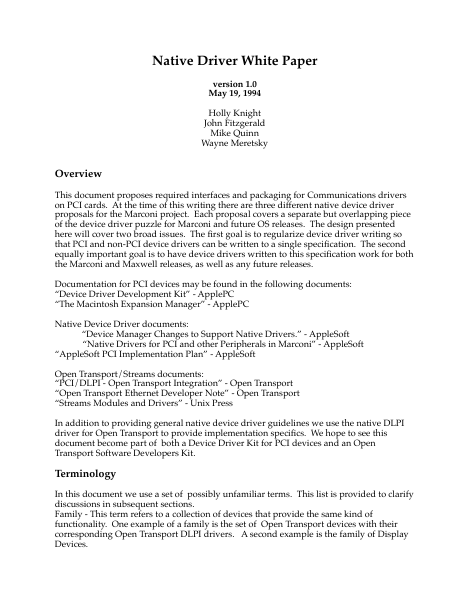
Native Driver White Paper version 1.0 May 19, 1994 Holly Knight John Fitzgerald Mike Quinn Wayne Meretsky Overview This document proposes required interfaces and packaging for Communications drivers on PCI cards. At the time of this writing there are three different native device driver proposals for the Marconi project. Each proposal covers a separate but overlapping piece of the device driver puzzle for Marconi and future OS releases. The design presented here will cover two broad issues. The first goal is to regularize device driver writing so that PCI and non-PCI device drivers can be written to a single specification. The second equally important goal is to have device drivers written to this specification work for both the Marconi and Maxwell releases, as well as any future releases. Documentation for PCI devices may be found in the following documents: “Device Driver Development Kit” - ApplePC “The Macintosh Expansion Manager” - ApplePC Native Device Driver documents: “Device Manager Changes to Support Native Drivers.” - AppleSoft “Native Drivers for PCI and other Peripherals in Marconi” - AppleSoft “AppleSoft PCI Implementation Plan” - AppleSoft Open Transport/Streams documents: “PCI/DLPI - Open Transport Integration” - Open Transport “Open Transport Ethernet Developer Note” - Open Transport “Streams Modules and Drivers” - Unix Press In addition to providing general native device driver guidelines we use the native DLPI driver for Open Transport to provide implementation specifics. We hope to see this document become part of both a Device Driver Kit for PCI devices and an Open Transport Software Developers Kit. Terminology In this document we use a set of possibly unfamiliar terms. This list is provided to clarify discussions in subsequent sections. Family - This term refers to a collection of devices that provide the same kind of functionality. One example of a family is the set of Open Transport devices with their corresponding Open Transport DLPI drivers. A second example is the family of Display Devices. Scanning - I use the word scanning or scanner to describe code that matches a device with its corresponding driver. The scanning portion of device location is one of the problem areas discussed in this paper. Scanning is probably a sub-function of the family Expert. Expert - Expert is a term coined by Brenden Creane to describe family code that extracts appropriate information from the system (ROM, Slot Manager, Expansion Manager, etc.) and presents the device specific information to each family device in a format agreed upon (documented). A family Expert is the administration function for a family. Experts are important when devices are brought into the system (classically at boot time) but are not part of the primary data paths to a device. Driver Components All native device drivers are CFM-loadable modules that export their API by using CFM’s export-by-name feature. Native drivers are located in either System-ROM, PCI-card RO…

Showing first 3,000 characters of 46,940 total. Open the full document →
Home Documents Macintosh Native Driver Implementation
Native Driver Implementation

Native Driver Implementation

Macintosh · 1994 · PDF
FilenameNative_Driver_Implementation_199404.pdf
Size0.08 MB
Year1994
Subsection developer / Copland / project_history
Downloads2
Enjoying MacTrove? Anonymous downloads are free and unlimited. Create a free account to track favorites, contribute metadata corrections, and join the community chat.
Reader
Native Driver Implementation
/
Loading…
OCR / Text contents
Apple Confidential Information 1 Native Drivers for PCI and other Peripherals in Marconi April 13, 1994 Please direct all comments to: Wayne Meretsky AppleLink: WNM Extension: 4-2955 Apple Confidential Information 2 Scope This document includes the design and implementation plan for allowing entirely native device drivers to be used with Marconi. Summary It is difficult to explain to third party developers of peripheral equipment exactly why the only implementation option available for writing a device driver precludes native code. Combined with the move away from NuBus and towards PCI, the developer story is poor. To entice card developers to create Macintosh devices and to simplify the transition to a Modern Operating System, a native driver model has been designed that will allow native drivers to seamlessly integrate with System Software. Finally, Apple must guarantee that these native drivers will continue to function well with future releases of system software including Maxwell. Approach Marconi will include a new Device Manager that supports a new format for device drivers. Attempts to open a device driver will cause the Device Manager to look for this new driver format in addition to the presently defined 'DRVR' described by Inside Macintosh Volume II, Chapter 6. Device Manager Support The process of locating device drivers during startup does not presently utilize the Device Manager's OPEN service because that service does not provide sufficient control over the exact loading and initialization process that is required by system startup. In fact, it is widely held that the Device Manager's OPEN service is never called to open any driver because the behavior defined by OPEN is always inappropriate. Due to the added complexity of opening native drivers, the entire process of locating a driver, loading it into memory, and initializing the driver's related data structures will be packaged into a new externally defined and supported API extension to the Device Manager. All system software that presently loads and installs drivers into the system must be changed to utilize this new service if they are to be capable of supporting native device drivers. In addition to changes to support native drivers, the Device Manager will provide a new flavor of IODone to greatly simplify the life of many driver writers. This spin of request completion, IORequestDone, allows the driver to specify which request has completed. The parameter block is presumed to be located Apple Confidential Information 3 somewhere on the device control block's list of outstanding requests rooted by the dCtlQHdr but, unlike IODone, it need not be the first request on that queue. The new API is as follows: void IORequestDone (DCtlPtr theDce, ParmBlkPtr thePb, OSErr theResult); Native Device Driver Description Device drivers are best characterized by three general properties: • Container format • API exported from driver to system • API imported by driver from sys…

Showing first 3,000 characters of 12,234 total. Open the full document →
Home Documents Macintosh Running Emulated Drivers
Running Emulated Drivers

Running Emulated Drivers

Macintosh · 1993 · PDF
FilenameRunning_Emulated_Drivers_199303.pdf
Size0.07 MB
Year1993
Subsection developer / Copland / project_history
Downloads3
Enjoying MacTrove? Anonymous downloads are free and unlimited. Create a free account to track favorites, contribute metadata corrections, and join the community chat.
Reader
Running Emulated Drivers
/
Loading…
OCR / Text contents
Running Emulated Drivers Wayne Meretsky March 9, 1993 Summary This document describes the problems of running emulated device drivers in the V1 software system. Also discussed are proposed solutions to some of those problems and the costs associated with those solutions. Included is a brief description of hardware support that must be included in any native expansion slot card (PSI, PCI, etc). whose purpose is to allow NuBus cards to be plugged into the system. With this provision, a NuKernel based system should be able to remain compatible with all but the most bizzare device drivers and applications. What software cannot be emulated? In a NuKernel based system, software that is invoked as a result of a hardware interrupt, synchronously to the interruption, and at interrupt level, cannot be emulated. For the purpose of this discussion this classification of software is termed interruptlevel software. Note that in System 7, there is a tremendous amount of interrupt-level software. Applications , for example, that make asynchronous I/O requests have their completion routines run synchronously to the hardware interrupt that signifies the completion of the I/O request. These applications, therefore, contain interrupt level software. In the V1 system, however, NuKernel Software Interrupts are used to get the execution of completion routines out of interrupt level. In a V1 system, interrupt-level software includes the following: • ADB device drivers may be interrupt-level software. This depends upon the amount re-work done to the ADB manager. Techniques for removing ADB device drivers from interrupt level have been demonstrated by the NuKernel team. • Certain system software managers such as the VBL Manager, Time Manager, SCSI Manager, etc. These managers all interact with some hardware at interrupt level. However, in a V1 system, these are all ported by the NuKernel team and execute only native instructions. Therefore, unless there is a need to support third party patches to these managers, they represent no problem. Because of changes to the hardware it is doubtful that these patches would work properly even if they were emulated. • Some DRVRs (Serial, Sound, etc.) have hardware interrupt handlers. The TNT team in MSD will be providing native versions of these drivers for V1. Therefore, unless there is a need to support third party M68000 drivers for these devices, they represent no problem. Because of changes to the hardware in TNT it is doubtful that these third-party drivers will work even if they are emulated. • Most NuBus cards have hardware interrupt handlers. These are the most troublesome because the drivers are contained in ROM on the NuBus cards and cannot be easily replaced. This document outlines a strategy that will be capable of supporting most, but not all, NuBus cards. • Applications that have interrupt handlers. This includes certain strange applications that chose to avoid the Device Manager model for dealing with devices. The…

Showing first 3,000 characters of 16,606 total. Open the full document →

Home Documents Macintosh OS Releases Org Roadmap
OS Releases Org Roadmap

OS Releases Org Roadmap

Macintosh · 1994 · PDF
FilenameOS_Releases_org_roadmap_199401.pdf
Size0.07 MB
Year1994
Subsection developer / Copland / project_history
Downloads2
Enjoying MacTrove? Anonymous downloads are free and unlimited. Create a free account to track favorites, contribute metadata corrections, and join the community chat.
Reader
OS Releases Org Roadmap
/
Loading…
OCR / Text contents
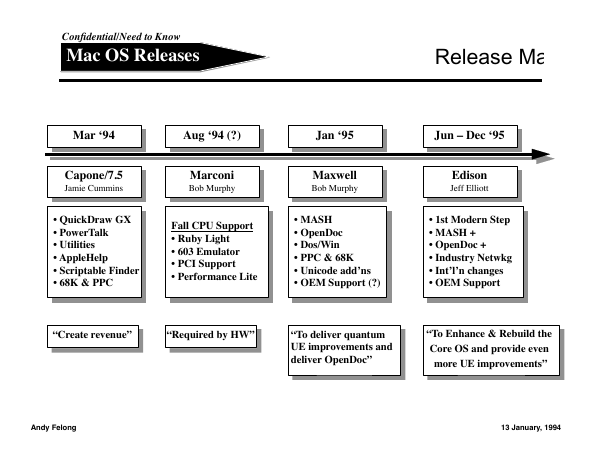
Confidential/Need to Know Release Map Mac OS Releases Mar ‘94 Aug ‘94 (?) Jan ‘95 Jun – Dec ‘95 Capone/7.5 Marconi Maxwell Edison Jamie Cummins Bob Murphy Bob Murphy Jeff Elliott • QuickDraw GX • PowerTalk • Utilities • AppleHelp • Scriptable Finder • 68K & PPC Fall CPU Support • Ruby Light • 603 Emulator • PCI Support • Performance Lite • MASH • OpenDoc • Dos/Win • PPC & 68K • Unicode add’ns • OEM Support (?) • 1st Modern Step • MASH + • OpenDoc + • Industry Netwkg • Int’l’n changes • OEM Support “Create revenue” “Required by HW” “To deliver quantum UE improvements and deliver OpenDoc” “To Enhance & Rebuild the Core OS and provide even more UE improvements” Andy Felong 13 January, 1994
Home Documents Macintosh Software Extensibility And The System Object Model
Software Extensibility And The System Object Model

Software Extensibility And The System Object Model

Macintosh · 1992 · PDF
FilenameSoftware_Extensibility_and_the_System_Object_Model_19960501.pdf
Size0.15 MB
Year1992
Subsection developer / Copland / D11E4_19960613
Downloads5
Enjoying MacTrove? Anonymous downloads are free and unlimited. Create a free account to track favorites, contribute metadata corrections, and join the community chat.
Reader
Software Extensibility And The System Object Model
/
Loading…
OCR / Text contents
ð Software Extensibility and the System Object Model (SOM) ð WWDC Release May 1996 © Apple Computer, Inc. 1992–1996 ð Apple Computer, Inc. © 1992–1996 Apple Computer, Inc. All rights reserved. No part of this publication may be reproduced, stored in a retrieval system, or transmitted, in any form or by any means, mechanical, electronic, photocopying, recording, or otherwise, without prior written permission of Apple Computer, Inc., except to make a backup copy of any documentation provided on CD-ROM. The Apple logo is a trademark of Apple Computer, Inc. Use of the “keyboard” Apple logo (Option-Shift-K) for commercial purposes without the prior written consent of Apple may constitute trademark infringement and unfair competition in violation of federal and state laws. No licenses, express or implied, are granted with respect to any of the technology described in this book. Apple retains all intellectual property rights associated with the technology described in this book. This book is intended to assist application developers to develop applications only for Apple-labeled or Apple-licensed computers. Every effort has been made to ensure that the information in this manual is accurate. Apple is not responsible for typographical errors. Apple Computer, Inc. 1 Infinite Loop Cupertino, CA 95014 408-996-1010 Apple, the Apple logo, AppleLink, AppleScript, AppleShare, AppleTalk, GeoPort, HyperCard, ImageWriter, LocalTalk, Macintosh, MacTCP, OpenDoc, PowerBook, Power Macintosh, PowerTalk, QuickTime, TrueType, and WorldScript are trademarks of Apple Computer, Inc., registered in the United States and other countries. Balloon Help, Chicago, Finder, Geneva, Mac, and QuickDraw are trademarks of Apple Computer, Inc. IBM is a registered trademark of International Business Machines Corporation. MacPaint and MacWrite are registered trademarks, and Clarisworks is a trademark, of Claris Corporation. NuBus is a trademark of Texas Instruments. PowerPC is a trademark of International Business Machines Corporation, used under license therefrom. UNIX is a registered trademark of Novell, Inc. in the United States and other countries, licensed exclusively through X/Open Company, Ltd. Simultaneously published in the United States and Canada. Even though Apple has reviewed this manual, APPLE MAKES NO WARRANTY OR REPRESENTATION, EITHER EXPRESS OR IMPLIED, WITH RESPECT TO THIS MANUAL, ITS QUALITY, ACCURACY, MERCHANTABILITY, OR FITNESS FOR A PARTICULAR PURPOSE. AS A RESULT, THIS MANUAL IS SOLD “AS IS,” AND YOU, THE PURCHASER, ARE ASSUMING THE ENTIRE RISK AS TO ITS QUALITY AND ACCURACY. IN NO EVENT WILL APPLE BE LIABLE FOR DIRECT, INDIRECT, SPECIAL, INCIDENTAL, OR CONSEQUENTIAL DAMAGES RESULTING FROM ANY DEFECT OR INACCURACY IN THIS MANUAL, even if advised of the possibility of such damages. THE WARRANTY AND REMEDIES SET FORTH ABOVE ARE EXCLUSIVE AND IN LIEU OF ALL OTHERS, ORAL OR WRITTEN, EXPRESS OR IMPLIED. No Apple dealer, agent, or employee is authorized to make any …

Showing first 3,000 characters of 27,723 total. Open the full document →

Home Documents Macintosh Text Handling And Internationalization
Text Handling And Internationalization

Text Handling And Internationalization

Macintosh · 1996 · PDF
FilenameText_Handling_and_Internationalization_19960429.pdf
Size0.83 MB
Year1996
Subsection developer / Copland / D11E4_19960613
Downloads5
Enjoying MacTrove? Anonymous downloads are free and unlimited. Create a free account to track favorites, contribute metadata corrections, and join the community chat.
Reader
Text Handling And Internationalization
/
Loading…
OCR / Text contents
ð INSIDE MACINTOSH Text Handling and Internationalization ð WWDC Release May 1996 © Apple Computer, Inc. 1994 - 1996 ð Apple Computer, Inc. © 1996 Apple Computer, Inc. All rights reserved. No part of this publication may be reproduced, stored in a retrieval system, or transmitted, in any form or by any means, mechanical, electronic, photocopying, recording, or otherwise, without prior written permission of Apple Computer, Inc., except to make a backup copy of any documentation provided on CD-ROM. The Apple logo is a trademark of Apple Computer, Inc. Use of the “keyboard” Apple logo (Option-Shift-K) for commercial purposes without the prior written consent of Apple may constitute trademark infringement and unfair competition in violation of federal and state laws. No licenses, express or implied, are granted with respect to any of the technology described in this book. Apple retains all intellectual property rights associated with the technology described in this book. This book is intended to assist application developers to develop applications only for Apple-labeled or Apple-licensed computers. Every effort has been made to ensure that the information in this manual is accurate. Apple is not responsible for typographical errors. Apple Computer, Inc. 1 Infinite Loop Cupertino, CA 95014 408-996-1010 Apple, the Apple logo, Macintosh, and WorldScript are trademarks of Apple Computer, Inc., registered in the United States and other countries. Mac and QuickDraw are trademarks of Apple Computer, Inc. Adobe, Acrobat, and PostScript are trademarks of Adobe Systems Incorporated or its subsidiaries and may be registered in certain jurisdictions. Helvetica and Palatino are registered trademarks of Linotype-Hell AG and/or its subsidiaries. ITC Zapf Dingbats is a registered trademark of International Typeface Corporation. QuickView™ is licensed from Altura Software, Inc. Simultaneously published in the United States and Canada. Even though Apple has reviewed this manual, APPLE MAKES NO WARRANTY OR REPRESENTATION, EITHER EXPRESS OR IMPLIED, WITH RESPECT TO THIS MANUAL, ITS QUALITY, ACCURACY, MERCHANTABILITY, OR FITNESS FOR A PARTICULAR PURPOSE. AS A RESULT, THIS MANUAL IS SOLD “AS IS,” AND YOU, THE PURCHASER, ARE ASSUMING THE ENTIRE RISK AS TO ITS QUALITY AND ACCURACY. IN NO EVENT WILL APPLE BE LIABLE FOR DIRECT, INDIRECT, SPECIAL, INCIDENTAL, OR CONSEQUENTIAL DAMAGES RESULTING FROM ANY DEFECT OR INACCURACY IN THIS MANUAL, even if advised of the possibility of such damages. THE WARRANTY AND REMEDIES SET FORTH ABOVE ARE EXCLUSIVE AND IN LIEU OF ALL OTHERS, ORAL OR WRITTEN, EXPRESS OR IMPLIED. No Apple dealer, agent, or employee is authorized to make any modification, extension, or addition to this warranty. Some states do not allow the exclusion or limitation of implied warranties or liability for incidental or consequential damages, so the above limitation or exclusion may not apply to you. This warranty gives you specific legal rights, and you may als…

Showing first 3,000 characters of 324,094 total. Open the full document →

Home Documents Macintosh Human Interface Toolbox
Human Interface Toolbox

Human Interface Toolbox

Macintosh · 1994 · PDF
FilenameHuman_Interface_Toolbox_19960430.pdf
Size1.52 MB
Year1994
Subsection developer / Copland / D11E4_19960613
Downloads5
Enjoying MacTrove? Anonymous downloads are free and unlimited. Create a free account to track favorites, contribute metadata corrections, and join the community chat.
Reader
Human Interface Toolbox
/
Loading…
OCR / Text contents
INSIDE MACINTOSH Human Interface Toolbox WWDC Release May 1996 © Apple Computer, Inc. 1994 - 1996 Apple Computer, Inc. © 1994–1996 Apple Computer, Inc. All rights reserved. No part of this publication may be reproduced, stored in a retrieval system, or transmitted, in any form or by any means, mechanical, electronic, photocopying, recording, or otherwise, without prior written permission of Apple Computer, Inc., except to make a backup copy of any documentation provided on CD-ROM. The Apple logo is a trademark of Apple Computer, Inc. Use of the “keyboard” Apple logo (Option-Shift-K) for commercial purposes without the prior written consent of Apple may constitute trademark infringement and unfair competition in violation of federal and state laws. No licenses, express or implied, are granted with respect to any of the technology described in this book. Apple retains all intellectual property rights associated with the technology described in this book. This book is intended to assist application developers to develop applications only for Apple-labeled or Apple-licensed computers. Every effort has been made to ensure that the information in this manual is accurate. Apple is not responsible for typographical errors. Apple Computer, Inc. 1 Infinite Loop Cupertino, CA 95014 408-996-1010 Even though Apple has reviewed this manual, APPLE MAKES NO WARRANTY OR REPRESENTATION, EITHER EXPRESS OR IMPLIED, WITH RESPECT TO THIS MANUAL, ITS QUALITY, ACCURACY, MERCHANTABILITY, OR FITNESS FOR A PARTICULAR PURPOSE. AS A RESULT, THIS MANUAL IS SOLD “AS IS,” AND YOU, THE PURCHASER, ARE ASSUMING THE ENTIRE RISK AS TO ITS QUALITY AND ACCURACY. IN NO EVENT WILL APPLE BE LIABLE FOR DIRECT, INDIRECT, SPECIAL, INCIDENTAL, OR CONSEQUENTIAL DAMAGES RESULTING FROM ANY DEFECT OR INACCURACY IN THIS MANUAL, even if advised of the possibility of such damages. THE WARRANTY AND REMEDIES SET FORTH ABOVE ARE EXCLUSIVE AND IN LIEU OF ALL OTHERS, ORAL OR WRITTEN, EXPRESS OR IMPLIED. No Apple dealer, agent, or employee is authorized to make any modification, extension, or addition to this warranty. Some states do not allow the exclusion or limitation of implied warranties or liability for incidental or consequential damages, so the above limitation or exclusion may not apply to you. This warranty gives you specific legal rights, and you may also have other rights which vary from state to state. Apple, the Apple logo, Macintosh, and MPW are trademarks of Apple Computer, Inc., registered in the United States and other countries. Finder, Mac, and QuickDraw are trademarks of Apple Computer, Inc. SOM is a licensed trademark of IBM Corporation. Simultaneously published in the United States and Canada. Draft. „ Apple Computer, Inc. 4/30/96 Contents Chapter 1 Introduction to the Mac OS 8 Toolbox 1-1 Overview of the Mac OS 8 Toolbox 1-6 Apple Events and the Toolbox 1-8 Toolbox Event Routing 1-9 Periodic and Background Processing 1-10 Supporting the Mac OS 8 Event Model 1-10 Human…

Showing first 3,000 characters of 386,966 total. Open the full document →

Home Documents Macintosh Open Transport
Open Transport

Open Transport

Macintosh · 1994 · PDF
FilenameOpen_Transport_19960425.pdf
Size2.74 MB
Year1994
Subsection developer / Copland / D11E4_19960613
Downloads2
Enjoying MacTrove? Anonymous downloads are free and unlimited. Create a free account to track favorites, contribute metadata corrections, and join the community chat.
Reader
Open Transport
/
Loading…
OCR / Text contents
K INSIDE MACINTOSH Open Transport K WWDC Release May 1996 © Apple Computer, Inc. 1994 - 1996 K Apple Computer, Inc. © 1994-1996 Apple Computer, Inc. All rights reserved. No part of this publication may be reproduced, stored in a retrieval system, or transmitted, in any form or by any means, mechanical, electronic, photocopying, recording, or otherwise, without prior written permission of Apple Computer, Inc., except to make a backup copy of any documentation provided on CD-ROM. The Apple logo is a trademark of Apple Computer, Inc. Use of the “keyboard” Apple logo (Option-Shift-K) for commercial purposes without the prior written consent of Apple may constitute trademark infringement and unfair competition in violation of federal and state laws. No licenses, express or implied, are granted with respect to any of the technology described in this book. Apple retains all intellectual property rights associated with the technology described in this book. This book is intended to assist application developers to develop applications only for Apple-labeled or Apple-licensed computers. Every effort has been made to ensure that the information in this manual is accurate. Apple is not responsible for typographical errors. Apple Computer, Inc. 1 Infinite Loop Cupertino, CA 95014 408-996-1010 Apple, the Apple logo, and Macintosh are trademarks of Apple Computer, Inc., registered in the United States and other countries. Adobe, Acrobat, Adobe Illustrator, Adobe Photoshop, and PostScript are trademarks of Adobe Systems Incorporated or its subsidiaries and may be registered in certain jurisdictions. Helvetica and Palatino are registered trademarks of Linotype-Hell AG and/or its subsidiaries. ITC Zapf Dingbats is a registered trademark of International Typeface Corporation. QuickView™ is licensed from Altura Software, Inc. CompuServe is a registered service mark of CompuServe, Inc. Docutek is a trademark of Xerox Corporation. FrameMaker is a registered trademark of Frame Technology Corporation. NuBus is a trademark of Texas Instruments. UNIX is a trademark of UNIX System Laboratories, Inc. Simultaneously published in the United States and Canada. Even though Apple has reviewed this manual, APPLE MAKES NO WARRANTY OR REPRESENTATION, EITHER EXPRESS OR IMPLIED, WITH RESPECT TO THIS MANUAL, ITS QUALITY, ACCURACY, MERCHANTABILITY, OR FITNESS FOR A PARTICULAR PURPOSE. AS A RESULT, THIS MANUAL IS SOLD “AS IS,” AND YOU, THE PURCHASER, ARE ASSUMING THE ENTIRE RISK AS TO ITS QUALITY AND ACCURACY. IN NO EVENT WILL APPLE BE LIABLE FOR DIRECT, INDIRECT, SPECIAL, INCIDENTAL, OR CONSEQUENTIAL DAMAGES RESULTING FROM ANY DEFECT OR INACCURACY IN THIS MANUAL, even if advised of the possibility of such damages. THE WARRANTY AND REMEDIES SET FORTH ABOVE ARE EXCLUSIVE AND IN LIEU OF ALL OTHERS, ORAL OR WRITTEN, EXPRESS OR IMPLIED. No Apple dealer, agent, or employee is Draft. Confidential.  Apple Computer, Inc. 4/25/96 authorized to make any modification, extension, or addit…

Showing first 3,000 characters of 500,000 total. Open the full document →

Home Documents Macintosh File Navigation And Access
File Navigation And Access

File Navigation And Access

Macintosh · 1992 · PDF
FilenameFile_Navigation_and_Access_19960430.pdf
Size0.66 MB
Year1992
Subsection developer / Copland / D11E4_19960613
Downloads4
Enjoying MacTrove? Anonymous downloads are free and unlimited. Create a free account to track favorites, contribute metadata corrections, and join the community chat.
Reader
File Navigation And Access
/
Loading…
OCR / Text contents
ð INSIDE MACINTOSH File Navigation and Access ð WWDC Release May 1996 © Apple Computer, Inc. 1992 - 1996 ð Apple Computer, Inc. © 1992–1996 Apple Computer, Inc. All rights reserved. No part of this publication may be reproduced, stored in a retrieval system, or transmitted, in any form or by any means, mechanical, electronic, photocopying, recording, or otherwise, without prior written permission of Apple Computer, Inc., except to make a backup copy of any documentation provided on CD-ROM. The Apple logo is a trademark of Apple Computer, Inc. Use of the “keyboard” Apple logo (Option-Shift-K) for commercial purposes without the prior written consent of Apple may constitute trademark infringement and unfair competition in violation of federal and state laws. No licenses, express or implied, are granted with respect to any of the technology described in this book. Apple retains all intellectual property rights associated with the technology described in this book. This book is intended to assist application developers to develop applications only for Apple-labeled or Apple-licensed computers. Every effort has been made to ensure that the information in this manual is accurate. Apple is not responsible for typographical errors. Apple Computer, Inc. 1 Infinite Loop Cupertino, CA 95014 408-996-1010 WARRANTY OR REPRESENTATION, EITHER EXPRESS OR IMPLIED, WITH RESPECT TO THIS MANUAL, ITS QUALITY, ACCURACY, MERCHANTABILITY, OR FITNESS FOR A PARTICULAR PURPOSE. AS A RESULT, THIS MANUAL IS SOLD “AS IS,” AND YOU, THE PURCHASER, ARE ASSUMING THE ENTIRE RISK AS TO ITS QUALITY AND ACCURACY. IN NO EVENT WILL APPLE BE LIABLE FOR DIRECT, INDIRECT, SPECIAL, INCIDENTAL, OR CONSEQUENTIAL DAMAGES RESULTING FROM ANY DEFECT OR INACCURACY IN THIS MANUAL, even if advised of the possibility of such damages. THE WARRANTY AND REMEDIES SET FORTH ABOVE ARE EXCLUSIVE AND IN LIEU OF ALL OTHERS, ORAL OR WRITTEN, EXPRESS OR IMPLIED. No Apple dealer, agent, or employee is authorized to make any modification, extension, or addition to this warranty. Some states do not allow the exclusion or limitation of implied warranties or liability for incidental or consequential damages, so the above limitation or exclusion may not apply to you. This warranty gives you specific legal rights, and you may also have other rights which vary from state to state. Apple, the Apple logo, and Macintosh are trademarks of Apple Computer, Inc., registered in the United States and other countries. UNIX is a trademark of UNIX System Laboratories, Inc. Simultaneously published in the United States and Canada. Even though Apple has reviewed this manual, APPLE MAKES NO Draft.  Apple Computer, Inc. 4/30/96 Contents Figures Chapter 1 vii File Navigation and Access Overview 1-1 The Mac OS 8 Files Environment 1-3 The Mac OS 8 File Manager 1-3 Speed 1-4 Reentrancy 1-4 Support for Volume-Format Plug-ins 1-4 Use of Notification Services 1-5 International String Support 1-5 Virtual Memory and Microkerne…

Showing first 3,000 characters of 220,613 total. Open the full document →

Subscribe to developer
mp.ls