

Thread
Backlit Portable with broken display cable
UPDATE 28-11-17UPDATE 28-11-17UPDATE 28-11-17UPDATE 28-11-17UPDATE 28-11-17
THIS IS THE OLDEST POST HERE ASKING FOR DEVELOPING TOOLS FOR APPS AND PLUGINS.
It started been focusing on Audio but later evolved to a General State.
ORIGINAL POST
Do we have here the tools to DEVELOP plug-ins?
To program in MAX there should be some packages...Documentation, etc
To program vst plug there should be some steinberg SDK
I have no clue about Protools RTAS or TDM plugs SDK, probably they sold the SDK in a secrecy contract (?)
It may involved programming in C+, Java or XCode or anything.
In the OS9/X transition lots of apps said that were carbonized. I think it meaned that it could work in OS9 and X, or maybe it meaned that it could work with OS X...I am not sure what that means.
I know Classilla http://www.floodgap.com/software/classilla/ is developed using Codewarrior http://macintoshgarden.org/search/node/codewarrior
http://macintoshgarden.org/author/metrowerks==> This could be backup on our servers, at least the importants ones
This thing seem interesting to take windows program to OS9 http://macintoshgarden.org/apps/microsoft-visual-c-40-cross-development-edition-macintosh
Interesting...http://macintoshgarden.org/apps/apple-developer-cd-collection
Let's post here tools needed to make any kind of AUDIO software in OS9. I readed here somewhere that the only commom way to program things was with MAX MSP.
MAX http://en.wikipedia.org/wiki/Max_%28software%29
The goal is to have the documentation and tools to develop our owns plug-ins/host/guess. RTAS, VST, MAS, etc.
At least Steinberg OS9 sdk should be easy...
http://www.steinberg.net/en/company/developers.html
THIS IS THE OLDEST POST HERE ASKING FOR DEVELOPING TOOLS FOR APPS AND PLUGINS.
It started been focusing on Audio but later evolved to a General State.
ORIGINAL POST
Do we have here the tools to DEVELOP plug-ins?
To program in MAX there should be some packages...Documentation, etc
To program vst plug there should be some steinberg SDK
I have no clue about Protools RTAS or TDM plugs SDK, probably they sold the SDK in a secrecy contract (?)
It may involved programming in C+, Java or XCode or anything.
In the OS9/X transition lots of apps said that were carbonized. I think it meaned that it could work in OS9 and X, or maybe it meaned that it could work with OS X...I am not sure what that means.
I know Classilla http://www.floodgap.com/software/classilla/ is developed using Codewarrior http://macintoshgarden.org/search/node/codewarrior
http://macintoshgarden.org/author/metrowerks==> This could be backup on our servers, at least the importants ones
This thing seem interesting to take windows program to OS9 http://macintoshgarden.org/apps/microsoft-visual-c-40-cross-development-edition-macintosh
Interesting...http://macintoshgarden.org/apps/apple-developer-cd-collection
Let's post here tools needed to make any kind of AUDIO software in OS9. I readed here somewhere that the only commom way to program things was with MAX MSP.
MAX http://en.wikipedia.org/wiki/Max_%28software%29
The goal is to have the documentation and tools to develop our owns plug-ins/host/guess. RTAS, VST, MAS, etc.
At least Steinberg OS9 sdk should be easy...
http://www.steinberg.net/en/company/developers.html
Hi there!
The title says it all - I've recently acquired a Macintosh Portable "demo unit" (much alike the one who was being sold on ebay a couple of weeks ago) that was selling for a pretty low price and I'd be interested in getting it back to work.
The unit has multiple problems, including a dead hard drive, but probably the biggest one is that the video cable is broken - totally cut in two pieces.
I know that earlier, M5120 portables had a ribbon cable that was easier to repair, but the backlit model unfortunately has a flex cable, so I guess I should pretty much rebuild the whole thing from scratch.
I looked around for information about how to do it without any luck - the only reference I've found is this old post from Uniserver, but the pictures are long gone.
I know it's going to be painful and take a lot of time, but I'd really really like to have it alive
The title says it all - I've recently acquired a Macintosh Portable "demo unit" (much alike the one who was being sold on ebay a couple of weeks ago) that was selling for a pretty low price and I'd be interested in getting it back to work.
The unit has multiple problems, including a dead hard drive, but probably the biggest one is that the video cable is broken - totally cut in two pieces.
I know that earlier, M5120 portables had a ribbon cable that was easier to repair, but the backlit model unfortunately has a flex cable, so I guess I should pretty much rebuild the whole thing from scratch.
I looked around for information about how to do it without any luck - the only reference I've found is this old post from Uniserver, but the pictures are long gone.
I know it's going to be painful and take a lot of time, but I'd really really like to have it alive
if you know your max/msp, making a vst/rtas-plug is pretty simple. the pluggo package comes with this tutorial. as with the original pluggo-plugins the very same object is valid both in protools and cubase etc... 
Just for reference, this is the cable I'm talking of.
I've thought about finding another flex cable with the same number of connections, but this cable here splits in two parts...
Ideally, if someone had a spare, that'd be awesome; but I have a feeling finding a compatible part is going to be tough.
Does anybody know if the CN1 header is connected to the video cable somehow?
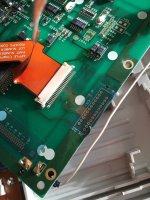
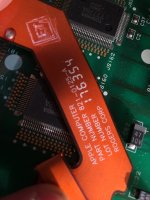
I've thought about finding another flex cable with the same number of connections, but this cable here splits in two parts...
Ideally, if someone had a spare, that'd be awesome; but I have a feeling finding a compatible part is going to be tough.
Does anybody know if the CN1 header is connected to the video cable somehow?
i am working on a new host as you can see in the respective forum thread
give me a few days with the thing i promised mactron (i have some other hobbies, too) then we will see what we need next.
-110

@110 Can you tell us the process you made to achieve that?
If you have ah ohmmeter (one function of a multimeter) test continuity between the pins on CN1 and the video cable header. If they're common, then it might be easier to adapt something.
Digi-Key sells a wide variety of flat flex cables. As you wrote, the difficulty is that this cable splits into two cables. Also the turns in the cable are a small problem, although I think you can deal with those by creative folding -- but not too much folding. Folding can easily break the conductors in the cable.
If CN1 connects, then it might be possible to get two flat flex cables from Digi-Key (or similar) which match the two smaller cables after the split. They can be bought with flat ends suitable for connectors as shown in your picture, or with tinned pinned ends that might be matable with CN1 and cables with one end flat and the other end pinned are also available.
Most PCB fab places are starting to offer FFC services, so if someone could take the time to map it out into a new Gerber file it could be reproduced again.
But I dunno how viable of an option that is. Worse comes to worse, figure out which connections are broken and then run wires.
But I dunno how viable of an option that is. Worse comes to worse, figure out which connections are broken and then run wires.
http://macos9lives.com/smforum/index.php?topic=1191.0
110 making a Custom VST host app at the Mactron request called hozzt03 in MAX.
@ 110 or Dr Bu. Has a OS9 MAX programming environment strong enought to move hardware modeled emulations?
Is there out info about modeling hardware based on electronics schematics? Or the math models used to emulate things?
For example. I would like to have an app like the piano keyboard you get from logic to use the Apple keyboard sending midi. Is this reachable within MAX? Or that should be a Codewarrior project involving OMS?
110 making a Custom VST host app at the Mactron request called hozzt03 in MAX.
@ 110 or Dr Bu. Has a OS9 MAX programming environment strong enought to move hardware modeled emulations?
Is there out info about modeling hardware based on electronics schematics? Or the math models used to emulate things?
For example. I would like to have an app like the piano keyboard you get from logic to use the Apple keyboard sending midi. Is this reachable within MAX? Or that should be a Codewarrior project involving OMS?
Good news! CN1 is connected to the flat flex connector!, maybe it was the connector for the non-backlit model.
At this point, I think I will make a new cable using very thin wire, the same I use to repair traces on logic boards.
then put all of the wires in a loom and route it to the display.
Soon I will start making the pin-mapping for both ends, I'll let you know!
At this point, I think I will make a new cable using very thin wire, the same I use to repair traces on logic boards.
then put all of the wires in a loom and route it to the display.
Soon I will start making the pin-mapping for both ends, I'll let you know!
http://web.archive.org/web/20000816175421/http://www.opcode.com/products/max/
looks like opcode was distributing max aswell
looks like opcode was distributing max aswell
Quote
For example. I would like to have an app like the piano keyboard you get from logic to use the Apple keyboard sending midi. Is this reachable within MAX?
im not familiar with Logic...do you mean something like this?
...ok i see. well tell me how it works. configuring keys for dynamics/velocity and octaves is easy.
If you want the connector from a display with the cable I have a set. It would give you a head start. I even have spare mobos, I can probably pull the connector from a mobo. I dont think shipping will be all that much since it will be a pretty small package. It just make take a long time! Not sure how much of a rush you are in to complete it.
Also I am not familiar with the backlit models. Im not sure if there is a spot on the mainboard for a connector for this cable.
Also I am not familiar with the backlit models. Im not sure if there is a spot on the mainboard for a connector for this cable.
i have 2 smaller midi keyboards that fit nicely next to a real keyboard
the pcr-30 by edirol
and the mk-225c by evolution (similar to mk-425c)
highly reccommended!
the pcr-30 by edirol
and the mk-225c by evolution (similar to mk-425c)
highly reccommended!
I just looked at some pics. What does the other end of this cable look like?
Quote
Can you tell us the process you made to achieve that?
Is that born in MAX with pluggo's Plugmaker or a CodeWarrior app? I can't test nor open sit files at this time...
Please, don't answer only here. I made a separate post for your StandalonePiano
any maxpatch can be turned into an app first saving it as a "collective", then using "applicationinstaller" that lives in the max/msp folder - which i am sure you have installed by now
see the attached pdf tuturial chapter "collectives"
oops...now i dont know how to move this post to your new thread
Thanks for your help!
This is the other end, the plug is the same for both backlit and non-backlit, the backlit then goes to a flat flex. that joins the data and the backlight.
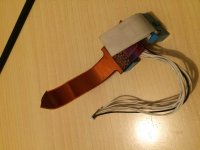
This is the other end, the plug is the same for both backlit and non-backlit, the backlit then goes to a flat flex. that joins the data and the backlight.
http://www.soundonsound.com/sos/aug08/articles/max5.htm
heres a more recent article on max
i think max is now (shortly after this article been)
100% aimed at ableton live!
having been renamed max for live
yes i was right, heres a link:
http://www.soundonsound.com/sos/feb10/articles/maxforlive.htm
http://www.soundonsound.com/sos/may10/articles/livetech_0510.htm
its funny
http://www.soundonsound.com/sos/sep08/articles/monome.htm (controller similar to tenori-on)
looking at this article u can tell they still retain their taste for MAC OS 9 Fonts !!!!!
when they programmed this monome controller, i saw this screen and i was like.. mac os 9???

in fact the whole world wide web had this look in 2001-2002-2003
i miss this:)
heres a more recent article on max
i think max is now (shortly after this article been)
100% aimed at ableton live!
having been renamed max for live
yes i was right, heres a link:
http://www.soundonsound.com/sos/feb10/articles/maxforlive.htm
http://www.soundonsound.com/sos/may10/articles/livetech_0510.htm
its funny
http://www.soundonsound.com/sos/sep08/articles/monome.htm (controller similar to tenori-on)
looking at this article u can tell they still retain their taste for MAC OS 9 Fonts !!!!!
when they programmed this monome controller, i saw this screen and i was like.. mac os 9???
in fact the whole world wide web had this look in 2001-2002-2003
i miss this:)
Hmmmm....
So the backlight cables route into the flex ribbon also? Well if you think the non-backlit cable will at least get you most of the way there let me know if you want it. Looks like you would still have to run some wires anyway for the power parts of the backlighting.
So the backlight cables route into the flex ribbon also? Well if you think the non-backlit cable will at least get you most of the way there let me know if you want it. Looks like you would still have to run some wires anyway for the power parts of the backlighting.
pluggo has 2 dedicated hosts simply called "Pluggo" (for effects) and "Pluggo synth" (for vsti) made for loading vst-objects into the pluggo-environment. in PT these two dont work, because (as i picked up somewhere) PT dont allow plugins to open popup windows.

VST hosts also do not allow to open subwindows. for northpole or mda delay this is no problem, because oyu can learn their 7 parameters by heart, but i dont want to create imposcar patches blindly.
Quote
so, my personal way of dealing with this is to create a different pluggo-object for every vst-object. this is kind of boring work and should be done with scripts but ive been too lazy to learn that. (maybe 110 knows how)
for how many different plug-ins do you do that? and do you need control over the parameters of the hosted VST?
Quote
anyway, attached is an example: the "spectral_monkeyage_pi".
funny that you mention it. monkeyage and northpole were the two VSTs whhere i´ve built a VST to VST bridge for ... in order to make them stereo. lol.
Quote
because the _pi-object looks up the spectral_monkeyage-vst everytime it opens. i use the vstplugins-folder in the max/msp folder itself.
i have never tried it but it should work to put those VST in the pluggo runtime folder, which is an unlimited, default runtime search path.
we will come back to this at a later point.
Yep, the flex cable carries both the backlight power and the video data: the two different types of signals are then split in two different cables, the one coming out of the blue plug goes to the motherboard and it's the same cable non-backlit portables use (with the difference, if I've understood the diagram correctly, that in the non-backlit the other side of the cable goes directly to the LCD assembly, with nothing in between), while the other goes to the inverter.
I'm not sure if we have the "motherboard-end" video cable, but I think we have!
The trouble here is that the two of them join in the same flex cable, so from what I've understood we should have two possibilities:
1) Reuse the flex connector on both sides (LCD and middle board) and connect a new flex cable. Since the cable actually splits in two, trag's idea to use two flex cables one next to the other sounds good and feasible, and it would have the benefit to avoid desoldering as much as possible. However, judging by the pic I'm not sure whether the flex cable goes into a plug in the middle-board, or is just part of the middle-board itself: in the first case a replacement would be easy, but in the second it'd become non-trivial.
2) Make use of CN1 header to solder a normal socket for a ribbon cable that carries both signals and then connect the cable to the middle-board by soldering each wire to its corresponding pin. This sounds like a lot of work, especially because we'd have to determine in some way which wire goes to which pin to avoid making the wrong connections; however, depending on how the middle-board is actually made (I haven't had a chance to see it in person, since I've directly delivered the portable to ferrix's place), it might be easier than adapting a flex cable on that end.
A third way that could be possible would be to reuse the two-flex idea of the first possibility, and then get a plug for each cable and solder that plug, running some wires, to the middle-board (that is in the case the flex cable is actually part of the middle-board, and not just inserted with a socket).
I'm not sure if we have the "motherboard-end" video cable, but I think we have!
The trouble here is that the two of them join in the same flex cable, so from what I've understood we should have two possibilities:
1) Reuse the flex connector on both sides (LCD and middle board) and connect a new flex cable. Since the cable actually splits in two, trag's idea to use two flex cables one next to the other sounds good and feasible, and it would have the benefit to avoid desoldering as much as possible. However, judging by the pic I'm not sure whether the flex cable goes into a plug in the middle-board, or is just part of the middle-board itself: in the first case a replacement would be easy, but in the second it'd become non-trivial.
2) Make use of CN1 header to solder a normal socket for a ribbon cable that carries both signals and then connect the cable to the middle-board by soldering each wire to its corresponding pin. This sounds like a lot of work, especially because we'd have to determine in some way which wire goes to which pin to avoid making the wrong connections; however, depending on how the middle-board is actually made (I haven't had a chance to see it in person, since I've directly delivered the portable to ferrix's place), it might be easier than adapting a flex cable on that end.
A third way that could be possible would be to reuse the two-flex idea of the first possibility, and then get a plug for each cable and solder that plug, running some wires, to the middle-board (that is in the case the flex cable is actually part of the middle-board, and not just inserted with a socket).
What the,,,,,, How did you rip that?
Backlit and non back lit have different cable and connector on mb. What you have there is even more Rare!!!! You have a non backlit to backlit upgrade cable, used in conjunction with a special backlight controller card.
He bought it with a broken cable, it is a not-for-resale unit.
at this point, I think the best way is to solder a new cable (like a floppy drive cable) to the transition between the gray ribbon cable and the orange flat-flex, then solder that cable to CN1 on the display and on the inverter
Also, how do I test the logic board?, tried hooking up my bench power supply to the main battery, together with a brand new 9v secondary battery, but it shows no life...
the hard drive's rubber gasket is melted, so I am also looking for a cable adapter (or a good diagram)
Is the logic Board a Backlit or a Non-backlit model?
at this point, I think the best way is to solder a new cable (like a floppy drive cable) to the transition between the gray ribbon cable and the orange flat-flex, then solder that cable to CN1 on the display and on the inverter
Also, how do I test the logic board?, tried hooking up my bench power supply to the main battery, together with a brand new 9v secondary battery, but it shows no life...
the hard drive's rubber gasket is melted, so I am also looking for a cable adapter (or a good diagram)
Is the logic Board a Backlit or a Non-backlit model?
Pic of mobo would help to determine which model. But if you google for images, you can see the difference also. If its a demo unit it should be a non-backlit. This is confirmed by having the upgrade kit cable.
That looks like a non-backlit, right?
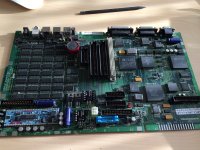
Ya, thats a non-backlit model. Regular production, just like in my demo unit.
Great!
How do I turn it on?
Tried hooking my benchtop supply to the main battery and a good 9V battery, but no signs of life
what does the switch on the side do?
How do I turn it on?
Tried hooking my benchtop supply to the main battery and a good 9V battery, but no signs of life
what does the switch on the side do?
Which switches? There are three!
You have the programmer/reset switches on the side. Then you have the battery swap switch sort buried in the back. When the battery cover is removed, it switches power to the 9v so you can swap the battery without losing settings.
The thing is, the Portable is sensitive to amperage and voltage. Even though it a 6 volt cell, you may want to bump it up to 6.5/7 volt. You do not need the 9v since it only works when the switch is up. So supply power at battery terminals (2 amp should work) and push that switch in.
Then try pressing ad holding both the programer/reset switches a few times. Then the space bar to boot. This works for me to get them going.
Odds are though, you need a re-cap of the mobo. I am sending mine out next week to Uniserver for that service since a clean working board is so rare.
You have the programmer/reset switches on the side. Then you have the battery swap switch sort buried in the back. When the battery cover is removed, it switches power to the 9v so you can swap the battery without losing settings.
The thing is, the Portable is sensitive to amperage and voltage. Even though it a 6 volt cell, you may want to bump it up to 6.5/7 volt. You do not need the 9v since it only works when the switch is up. So supply power at battery terminals (2 amp should work) and push that switch in.
Then try pressing ad holding both the programer/reset switches a few times. Then the space bar to boot. This works for me to get them going.
Odds are though, you need a re-cap of the mobo. I am sending mine out next week to Uniserver for that service since a clean working board is so rare.
Thanks!,
So is it just like a PB100?, but near the two interrupt/reset buttons, there is also a slide switch with an arrow and a circle, what does it do?
Yup, Ordering caps soon!
tonight I will try again and see what happens!
So is it just like a PB100?, but near the two interrupt/reset buttons, there is also a slide switch with an arrow and a circle, what does it do?
Yup, Ordering caps soon!
tonight I will try again and see what happens!
That just locks the switches to prevent accidental pressing.