Thread
Two Sick SE/30 Logic Boards
I'm working on Rev 2.0 of the capacitor diagram right now.
Note to the iBook: It's not a big deal if I spend 45 minutes trying to set up a nice drawing of a Sony Stereo Sound Chip and I go press Delete and you somehow confuse that with logging out. Of course there is a autosave function in AppleWorks but apparently that was on vacation. Bullocks -- this time we redraw the whole thing scaled up 3x (Yes I measured the sound chip and it's 6x19mm) and put nice "SONY 03E03G ..." on it.
It'll be better this time because apparently I forgot to include the half circle indentation on the last drawing, so the reference to Pin 1 was unobtainable because there was no reference mark. That's okay I look at it now and it looks all fugly anyways, polluting JDW's nice socketed motherboard image with terrible graphics. Steve Jobs would have told me off in front of a crowd for that. :disapprove:
Note to the iBook: It's not a big deal if I spend 45 minutes trying to set up a nice drawing of a Sony Stereo Sound Chip and I go press Delete and you somehow confuse that with logging out. Of course there is a autosave function in AppleWorks but apparently that was on vacation. Bullocks -- this time we redraw the whole thing scaled up 3x (Yes I measured the sound chip and it's 6x19mm) and put nice "SONY 03E03G ..." on it.
It'll be better this time because apparently I forgot to include the half circle indentation on the last drawing, so the reference to Pin 1 was unobtainable because there was no reference mark. That's okay I look at it now and it looks all fugly anyways, polluting JDW's nice socketed motherboard image with terrible graphics. Steve Jobs would have told me off in front of a crowd for that. :disapprove:
OK. I await your Rev. 2.0!
Meanwhile, I've given up on the one SE/30 board (the one I've been talking about) for now, and am instead concentrating my efforts on this apparently made in Ireland board that will only work if I bend it a certain way. I've concluded that it's either a bad trace somewhere or a bad solder joint somewhere (I noticed that it gets somewhat better when it's warm, so it could be heat/age related).
I would like to get these boards working, but I'm not sure if I'm competent enough at this point to do it myself (although I'm learning fast!)
Until next time...
c
Meanwhile, I've given up on the one SE/30 board (the one I've been talking about) for now, and am instead concentrating my efforts on this apparently made in Ireland board that will only work if I bend it a certain way. I've concluded that it's either a bad trace somewhere or a bad solder joint somewhere (I noticed that it gets somewhat better when it's warm, so it could be heat/age related).
I would like to get these boards working, but I'm not sure if I'm competent enough at this point to do it myself (although I'm learning fast!)
Until next time...
c
Does anybody want to tackle one of these boards themselves? Let me know and we can go from there.
Also, I appreciate all the wonderful help I've gotten here.
Thank you very much!
c
Also, I appreciate all the wonderful help I've gotten here.
Thank you very much!
c
I can take a look at them. I have an oscilloscope and working machine to make comparison charts with.
Great!
That would be nice. I have two (hence the topic name), but I will deal with the one which I tried to rework (and therefore should technically function properly, if not for this latent and as of yet unknown problem).
I guess I'll mail it??
It'll figure itself out, I suppose...
c
That would be nice. I have two (hence the topic name), but I will deal with the one which I tried to rework (and therefore should technically function properly, if not for this latent and as of yet unknown problem).
I guess I'll mail it??
It'll figure itself out, I suppose...
c
I would send them both. What you may think is one way, but could be different than the boards actual condition. I am in the states, and send me a PM.
Reason I say this, if it comes down to being a rare or impossible chip to replace thats actually bad, it may be a different chip on the opposite board, and i could make 1 board work from 2.
Then again, i could fix both of them. Never know.
Reason I say this, if it comes down to being a rare or impossible chip to replace thats actually bad, it may be a different chip on the opposite board, and i could make 1 board work from 2.
Then again, i could fix both of them. Never know.
OK. I will send both, then.
I'll also send you a PM (private message?) with more information.
c
I'll also send you a PM (private message?) with more information.
c
yup  , Plus I can swap out all the HAL/PAL/GAL ICs from your board, to my working one and rule those out.
, Plus I can swap out all the HAL/PAL/GAL ICs from your board, to my working one and rule those out.
OK. That sounds good!
c
c
Ta Da!

It's a US Legal size image (try a Super A4 ISO size at 22.7x35.6cm if you're outside the US) , so it should print out fine if you have that capability. It was designed originally to fit on 8.5x11 US Letter but there simply wasn't enough room (and that was before I added the Procedure part, and the Polarities section). Then I tried A4, and nope. The Legal size is just barely enough to contain practically everything you need. I did it all with AppleWorks 6.2.9...I really should move on and discover proper image and drawing applications :disapprove:
Notice: All functions of the capacitors are not set in stone. Still waiting on some expert advice based on detailed circuit analysis. I have a copy of the BOMARC and Apple diagrams if anybody wants to tackle that (shouldn't take long).
It's a US Legal size image (try a Super A4 ISO size at 22.7x35.6cm if you're outside the US) , so it should print out fine if you have that capability. It was designed originally to fit on 8.5x11 US Letter but there simply wasn't enough room (and that was before I added the Procedure part, and the Polarities section). Then I tried A4, and nope. The Legal size is just barely enough to contain practically everything you need. I did it all with AppleWorks 6.2.9...I really should move on and discover proper image and drawing applications :disapprove:
Notice: All functions of the capacitors are not set in stone. Still waiting on some expert advice based on detailed circuit analysis. I have a copy of the BOMARC and Apple diagrams if anybody wants to tackle that (shouldn't take long).
Thank you, Mk.558!
c
c
Yes, i would like to see those just to take a peek.
Mk,
In the words of Peter Griffin, "That's phreakin' sweet!" Brilliant!
73s de Phreakout. :rambo:
In the words of Peter Griffin, "That's phreakin' sweet!" Brilliant!
73s de Phreakout. :rambo:
I had received the boards today.
I realize you were trying to learn, and i cannot knock on anyone for trying and learning. However constructive criticism says this:
Need to be a lot less sloppy with the soldering iron. You have done some extreme damage to the boards. Im sure i can fix it, but the thing that bothers me are the vias. its like you drilled out the vias? you cannot do this. ever.... you will break connections between layers of the PCB. and possibly short layer-to-layer. Trust me, i know....
These are 4 layer boards, and traces run from layer to layer. Each traces is connected between layers if routed between layers, through a Via. If the via is broken/drilled/etc you can damage the the inter-layer connection. Anyway, I have schematics so its not difficult for me to fix. I just have to hope layers arnt shorted, or i will have to cut traces, and route around it to clear the shorts.
Also on one board, I noticed you have a bare copper wire run from C8 all the way around to the bottom of the board. I am not going to explain the reasons why this is a bad idea ;-)
On the flip side though, it seems besides the ones with broken pads, you got the capacitors soldered in place perfectly fine. No problems there, good job
So... What I am going to do, is fix these boards, I will document everything that I do, on my youtube channel, etc... Therefore, I recommend you and everyone who has a modern computer, watch youtube, and use this as a learning experience in case the same thing happens to anyone else.
Stuff happens, no one can predict it. All we can do as human beings is learn from it. So we shall
I am heading up to parts express tomorrow because I have to restock on my caps so I can do the other 2 boards. I use radials. I dont use tantalum because I dont like the spontaneous shorting that could happen when they age. When tantalum caps get old, they start to become noisy when DC leakage starts to creep in. Then sometimes they will just short. Which in high current circuits result in a BANG.
P.S. I am sorry, I am trying to not be offensive to anyone. I am simply stating my findings, and mention ways to work around it and learn from it, as we have to fix this before I can begin further troubleshooting of which IC could have taken a hit.
I realize you were trying to learn, and i cannot knock on anyone for trying and learning. However constructive criticism says this:
Need to be a lot less sloppy with the soldering iron. You have done some extreme damage to the boards. Im sure i can fix it, but the thing that bothers me are the vias. its like you drilled out the vias? you cannot do this. ever.... you will break connections between layers of the PCB. and possibly short layer-to-layer. Trust me, i know....
These are 4 layer boards, and traces run from layer to layer. Each traces is connected between layers if routed between layers, through a Via. If the via is broken/drilled/etc you can damage the the inter-layer connection. Anyway, I have schematics so its not difficult for me to fix. I just have to hope layers arnt shorted, or i will have to cut traces, and route around it to clear the shorts.
Also on one board, I noticed you have a bare copper wire run from C8 all the way around to the bottom of the board. I am not going to explain the reasons why this is a bad idea ;-)
On the flip side though, it seems besides the ones with broken pads, you got the capacitors soldered in place perfectly fine. No problems there, good job
So... What I am going to do, is fix these boards, I will document everything that I do, on my youtube channel, etc... Therefore, I recommend you and everyone who has a modern computer, watch youtube, and use this as a learning experience in case the same thing happens to anyone else.
Stuff happens, no one can predict it. All we can do as human beings is learn from it. So we shall
I am heading up to parts express tomorrow because I have to restock on my caps so I can do the other 2 boards. I use radials. I dont use tantalum because I dont like the spontaneous shorting that could happen when they age. When tantalum caps get old, they start to become noisy when DC leakage starts to creep in. Then sometimes they will just short. Which in high current circuits result in a BANG.
P.S. I am sorry, I am trying to not be offensive to anyone. I am simply stating my findings, and mention ways to work around it and learn from it, as we have to fix this before I can begin further troubleshooting of which IC could have taken a hit.
Wow. Techknight, that sounds so bad that I simply MUST see a photo! I think we can keep it anonymous so the original owner won't get embarrassed or offended. But if my board photos can serve as an example of what to do, it would also be good to have photos of "what NOT to do!"
Well like i said, I am trying not to offend the rightful owner. I am trying to be constructive about this and not hurt anyone's feelings. He tried, and he actually did pretty good on the install of the new caps. its just that some errors were made that shouldnt have been.
Well, then take a photo "with the owner's consent" of course. My think is that a photo showing "what not to do" might help others avoid the same mistakes in the future. It seems like such is needed in light of the fact many of these folks have seen my "BEFORE/AFTER photos" but still are making these kind of mistakes.
Ya, ill take photos. But it will be up to the owner whether he wants them shared in the public. BTW, check your PM.
Hi, all,
Well, all I can say is I'm learning.
This is a very important learning experience.
Hopefully, techknight can help me out of my hole, and I can then proceed to learn more so these mistakes don't happen again.
Thank you all for the invaluable information and wonderful help.
c
Well, all I can say is I'm learning.
This is a very important learning experience.
Hopefully, techknight can help me out of my hole, and I can then proceed to learn more so these mistakes don't happen again.
Thank you all for the invaluable information and wonderful help.
c
Thats why i will video/photo document my proceedures. this way, you and everyone can learn from it, and when the next capacitor replacement comes on a new conquest, You can perform it with confidence
Oh, also, I want to teach you all this tidbit:
Routing through a via is often easier than taking a route around the entire board. Ratshack sells 30 guage wire, which is fine wire. This wire is small enough when stripped, will fit through an existing via to reconnect a broken via trace segment.
Also flux and tin the via with fresh solder BEFORE soldering anything to it, in it, or on it.
Oh, also, I want to teach you all this tidbit:
Routing through a via is often easier than taking a route around the entire board. Ratshack sells 30 guage wire, which is fine wire. This wire is small enough when stripped, will fit through an existing via to reconnect a broken via trace segment.
Also flux and tin the via with fresh solder BEFORE soldering anything to it, in it, or on it.
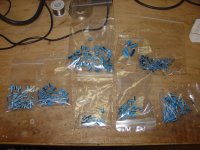
Got my big bag o caps today from parts express. Low-profile mini radials as well. So, low clearance.
Have photos? Or a link to a photo of those caps?
I can take some. i think they are Lelon brand, audio grade capacitors. I use them for everything and never have a problem. Its local, cant complain.
I'm eager for photos, too.
If I do this kind of restoration/repair again (and I probably will), I'd like to see the right way is versus the wrong way so I don't make the same mistake(s) unknowingly.
c
p.s. A question for techknight: Aren't tantalum-type capacitors supposed to last longer?
If I do this kind of restoration/repair again (and I probably will), I'd like to see the right way is versus the wrong way so I don't make the same mistake(s) unknowingly.
c
p.s. A question for techknight: Aren't tantalum-type capacitors supposed to last longer?
They do. Certainly. BUT I just dont like the fact when they DO decide to fail, they fail violently.
I would rather recap again in another 10 years versus a tantalum blow-out and have a bad board because of it. Its hard to find SE/30 parts now, What about 10 years from now?
I would rather recap again in another 10 years versus a tantalum blow-out and have a bad board because of it. Its hard to find SE/30 parts now, What about 10 years from now?
As you wish: Pics and what I found wrong.


I agree 100%. I use Panasonic FP SMD radial capacitors for recapping: these have low ESR values, almost as low as Tantalums.
I have seen many logic boards were Apple used a combination of Tantalum and radial SMD capacitors so there must be a reason for doing so.
Probably because with Tantalum capacitors their failure mode tends to be by short-circuit.
Anyway, I guess the Panasonic FP capacitors will good for about 15 years.
The fluid filled caps will indeed last a mere 15 to 20 years. And although it's true that shorts kill tantalums, shorts also kill fluid filled caps too! So when speaking of recapping an SE/30 motherboard, the merits are on the side of the tantalums because the tantalums have no 15-20 year life limit (they can't ever "leak"). The only 2 exceptions are C2 and C11, which are too big in terms of capacity (and voltage specification) to be replaced by tantalums -- you'll still have to replace those every 15 to 20 years.
Yea, Tantalum caps are fine usually but i just prefer not to use them based on my own judgement. Albeit I dont think i have seen very many shorted tantalums. Maybe 6 or so for the 15 or so years ive been repairing electronics. (been doing it since i was a low teen, 27 now). I have seen a crapload of leaky electrolytics both electrically and physically, but i have only seen ONE shorted lytic, and it just so happened to be in a vintage Harmon Kardon receiver of all things, part of the DC protect soft-start circuit.
For the record, I have seen leaky and shorted ceramic capacitors roughly about the same order of magnitude as any other capacitor. Its all a crapshoot. its guaranteed anything electronic will fail eventually. I remember working on the older Hitachi ultravision SD projection sets, and seeing that nicely exploded ceramic capacitor right off the horizontal output transistor in those sets. Always took out the B+ picofuse every time. I even remember seeing a similar issue on zenith sets as well.
Edit: P.S. actually come to think of it, I found another shorted electrolytic. I was working on an Apple multiscan 15" monitor way back in the day, that all it did was power up and shoot a bright squiggly line up the center of the screen and pulsate. Done this every 2 seconds. Turned out to be a shorted and physically leaking small electrolytic and a transistor right next to it in the same circuit. I vaguely remember it being near the flyback in the horizontal stage.
For the record, I have seen leaky and shorted ceramic capacitors roughly about the same order of magnitude as any other capacitor. Its all a crapshoot. its guaranteed anything electronic will fail eventually. I remember working on the older Hitachi ultravision SD projection sets, and seeing that nicely exploded ceramic capacitor right off the horizontal output transistor in those sets. Always took out the B+ picofuse every time. I even remember seeing a similar issue on zenith sets as well.
Edit: P.S. actually come to think of it, I found another shorted electrolytic. I was working on an Apple multiscan 15" monitor way back in the day, that all it did was power up and shoot a bright squiggly line up the center of the screen and pulsate. Done this every 2 seconds. Turned out to be a shorted and physically leaking small electrolytic and a transistor right next to it in the same circuit. I vaguely remember it being near the flyback in the horizontal stage.
Here is the picture of all the caps I bought locally at parts express. $24.40 total cost.