

Thread
BrickOven™ PizzaBox Hack revisited . . .
. . . but not in the same vein . . .
I've mentioned this Hack in passing recently, here's linkage to the genesis of the project . . .
BrickOvenCube/6/605/MicroQuadraCluster
. . . none of Bigsadhu's MicroQuadraFeetsMacs™ ever made it to from the Isle of Kiwi to the Isle of Big Apple, but I'm concurrently completing/consolidating my collection . . .
. . . a hopeless task and more than likely thankless when the grlf inspects the level of clutter reduction that I'll ever manage (or wish) to achieve. :
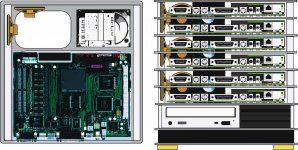
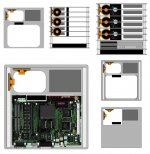
This unrealized Design Study will help somewhat and hopefully look really cool at the same time . . .
pic
pic
New Config:
Suggestions on what Cool Card might tempt me into adding another sub-Quadra level LC to the stack?
I've mentioned this Hack in passing recently, here's linkage to the genesis of the project . . .
BrickOvenCube/6/605/MicroQuadraCluster
. . . none of Bigsadhu's MicroQuadraFeetsMacs™ ever made it to from the Isle of Kiwi to the Isle of Big Apple, but I'm concurrently completing/consolidating my collection . . .
. . . a hopeless task and more than likely thankless when the grlf inspects the level of clutter reduction that I'll ever manage (or wish) to achieve. :
This unrealized Design Study will help somewhat and hopefully look really cool at the same time . . .
pic
pic
New Config:
Looks like I'll need to add a third MoBo to the mix to retain the symmetry of the OvenStack, maybe another MicroQuadraFeetsMac™ :?:
Suggestions on what Cool Card might tempt me into adding another sub-Quadra level LC to the stack?
What is the point of the orange loudspeakers?
BTW, i imagine this could be really an epic cluster for image rendering. Slap NetBSD on it (6.1 is nearly done and works smoothly on my Q650), add some Beowulf from PKGSRC as well as some kind of raytracer and you are done!
Or a distcc compile farm for 68k packages.
Not fast, but epic and awesome.
I say go for it. Do it. Do it now! I can't, i have only one LC475.
BTW, i imagine this could be really an epic cluster for image rendering. Slap NetBSD on it (6.1 is nearly done and works smoothly on my Q650), add some Beowulf from PKGSRC as well as some kind of raytracer and you are done!
Or a distcc compile farm for 68k packages.
Not fast, but epic and awesome.
I say go for it. Do it. Do it now! I can't, i have only one LC475.
Those are semi-scaled renditions of the brassy speakers in the bottom of each of the six 'zaBoxen, only three of the fans are utilized, the contrast is for differentiation. [ ] ]'>
] ]'>
I've always wanted to get under the hood of Linux, but decided against it, I enjoy playing with the toys in the physical realm, drivers and cards are where it's at for me.
] ]'>I've always wanted to get under the hood of Linux, but decided against it, I enjoy playing with the toys in the physical realm, drivers and cards are where it's at for me.
I see.
Your BrickOven could solve a NetBSD problem. NetBSD comes, in contrast to Linux, out of one hand, one source code repository. This has NetBSD enabled to use crosscompiling (compiling is the task of generating machine code or binaries from human written code). That means, i can compile the Operating System (kernel, shell, libs, apps, install media, X11 GUI, everything) for a slow architecture such as mac68k on a fast architecture such as amd64 or i386.
NetBSD comes with all the tools one needs to start being productive. For example, a compiler, and GUI editor, a GUI mailer. But not everything is there. For example, there is no browser. You can add a package. But those packages have to be compiled at some time. For this, NetBSD has a system called PKGSRC, basically a directory tree that contains scripted instructions on where to download sourcecode and how to compile it. There are over 12000 packages to be built with each release, for each architecture.
Since the sourcecode in those thousands of packes comes from different sources, it can't be crosscompiled. Which is why you need to compile it on the target architecture. And there you have the problem. Mac68k is incredibly slow. Compiling a few packages needs days. The BrickOven could shorten the time to compile packages significantly. Indeed, one or two BrickOven and a fast networked fileserver could reduce the compiletime of all packages from several month to mere weeks. 8-o
So, where can i order a 8 Node BrickOven with LC475 boards clocked to 40MHz, NIC, 256MB Ram each and a basic NetBSD with distcc and ccache preinstalled? ;D
Your BrickOven could solve a NetBSD problem. NetBSD comes, in contrast to Linux, out of one hand, one source code repository. This has NetBSD enabled to use crosscompiling (compiling is the task of generating machine code or binaries from human written code). That means, i can compile the Operating System (kernel, shell, libs, apps, install media, X11 GUI, everything) for a slow architecture such as mac68k on a fast architecture such as amd64 or i386.
NetBSD comes with all the tools one needs to start being productive. For example, a compiler, and GUI editor, a GUI mailer. But not everything is there. For example, there is no browser. You can add a package. But those packages have to be compiled at some time. For this, NetBSD has a system called PKGSRC, basically a directory tree that contains scripted instructions on where to download sourcecode and how to compile it. There are over 12000 packages to be built with each release, for each architecture.
Since the sourcecode in those thousands of packes comes from different sources, it can't be crosscompiled. Which is why you need to compile it on the target architecture. And there you have the problem. Mac68k is incredibly slow. Compiling a few packages needs days. The BrickOven could shorten the time to compile packages significantly. Indeed, one or two BrickOven and a fast networked fileserver could reduce the compiletime of all packages from several month to mere weeks. 8-o
So, where can i order a 8 Node BrickOven with LC475 boards clocked to 40MHz, NIC, 256MB Ram each and a basic NetBSD with distcc and ccache preinstalled? ;D
Interesting application you've got there. It's all too Greek a GeekSpeak for me to do much more than grok the surface, but it sounds cool.
When all those MicroQuadras were headed to the recycler/dump down under, this was the only reasonably efficient way I could come up with to get some of the goodies off the streets of Oz and into a small package for repackaging here in the States. Doing a SETI work unit (delivered too slowly to be practical) was the only application I had in mind for it at the time.
It was a pipe dream kinda thing, but I'm looking into doing the Rev II version for real this time. I'll make up the plans as I go, I'm thinking a cold-plug drawer/carrier will be in order for expansion card playtime, but unnecessary for your application.
The dearth of individual 2.5" SCSI boot drives almost 11 years later is a major concern. :-/
When all those MicroQuadras were headed to the recycler/dump down under, this was the only reasonably efficient way I could come up with to get some of the goodies off the streets of Oz and into a small package for repackaging here in the States. Doing a SETI work unit (delivered too slowly to be practical) was the only application I had in mind for it at the time.
It was a pipe dream kinda thing, but I'm looking into doing the Rev II version for real this time. I'll make up the plans as I go, I'm thinking a cold-plug drawer/carrier will be in order for expansion card playtime, but unnecessary for your application.
The dearth of individual 2.5" SCSI boot drives almost 11 years later is a major concern. :-/
If you made them out of the IDE-equipped performas you could load up on CF adapters and solve that problem. You could also then make a backplane because all the boards would have their connections in one spot.
Could also then use something like an ATX power supply to drive it all with a single keyswitch that shorts PWR_OK to GND to turn the whole thing on.
Could also then use something like an ATX power supply to drive it all with a single keyswitch that shorts PWR_OK to GND to turn the whole thing on.
Gaaahh!!!!!! 8-o Ribbon cable inferno!
No need for disks, netboot. Use a simple loader on a floppy.
As for my previous text, i guess one could compress it like that: NetBSD itself can be made on fast machines for slow targets. But the packages must be made on that slow target which takes month. A bunch of BrickOven would reduce the time to weeks, maybe even days, thus improving release cycles.
I'm just wondering, what would be your usage for a BrickOven? It's nice to build a cluster and all, but it should have something to do, right? :approve:
As for my previous text, i guess one could compress it like that: NetBSD itself can be made on fast machines for slow targets. But the packages must be made on that slow target which takes month. A bunch of BrickOven would reduce the time to weeks, maybe even days, thus improving release cycles.
I'm just wondering, what would be your usage for a BrickOven? It's nice to build a cluster and all, but it should have something to do, right? :approve:
You could put your loader and maybe evev the OS on dougg3's ROM SIMM if you populate the empty SIMM Slot pads on all the MicroQuadra boards.
Stacking a rack of Quadra 650 boards for your NetBSDbox would be even better, full .040s and AAUI all around with oodles of lovely 72pin SIMM Slots for trag's 32MB sticks! }
Stacking a rack of Quadra 650 boards for your NetBSDbox would be even better, full .040s and AAUI all around with oodles of lovely 72pin SIMM Slots for trag's 32MB sticks! }
techneeq: you mentioned you have a 650. Do you have one of dougg3's ROM SIMMs? Can you put a SIMM socket into it? It might be interesting to see how well netbsd does with the modified ROM to allow 520MB RAM in those machines.
@bbraun: I don't have one of dougg3s SIMMs and i don't have the skill to add any sockets either, i'm afraid. I just recently started soldering crystals and caps.
NetBSD would benefit if the used virtual memory would otherwise approach the amount of physical memory. With more ram there would be still room for file caches and no need to swap out memory.
But there are other positive effects of more ram. You could use --pipe while compiling code. That way the compiler wouldn't have to use as much temporary files on disk, which is a very costly operation in terms of time. So, more physical memory could speed up compilation quite a bit if the right compiler flags are set.
One could even dare to try using make -j2 AND --pipe together, with that much ram. That should keep the CPU constantly under load, not wasting any time while accessing the net or disk.
@Trash80toHP_Mini: Yes, one could do a BrickOvenPro with Q650 boards, but where does one get the boards? Also the boards are larger and probably use up more energy compared to a Q605 and a NIC (same CPU, same clockspeed).
Don't forget, most people here didn't have macs back then, they had mostly C64/Amiga and then PCs. That's why almost all early macs are more rare here. Also a bit more pricey. Some things you can't find at all. For example, there are no NUBUS or PDS cards listed at ebay. Not one! Accelerator cards? I haven't seen any at Ebay germany. Ever.
NetBSD would benefit if the used virtual memory would otherwise approach the amount of physical memory. With more ram there would be still room for file caches and no need to swap out memory.
But there are other positive effects of more ram. You could use --pipe while compiling code. That way the compiler wouldn't have to use as much temporary files on disk, which is a very costly operation in terms of time. So, more physical memory could speed up compilation quite a bit if the right compiler flags are set.
One could even dare to try using make -j2 AND --pipe together, with that much ram. That should keep the CPU constantly under load, not wasting any time while accessing the net or disk.
@Trash80toHP_Mini: Yes, one could do a BrickOvenPro with Q650 boards, but where does one get the boards? Also the boards are larger and probably use up more energy compared to a Q605 and a NIC (same CPU, same clockspeed).
Don't forget, most people here didn't have macs back then, they had mostly C64/Amiga and then PCs. That's why almost all early macs are more rare here. Also a bit more pricey. Some things you can't find at all. For example, there are no NUBUS or PDS cards listed at ebay. Not one! Accelerator cards? I haven't seen any at Ebay germany. Ever.
If you've done crystals, a socket should be relatively just as easy. It's all through-hole. Just think of it as a crystal with 64 pins instead of 2.
I love this idea, I've got four 475/605 Mobos to recap and a couple of NICs already. One of the MoBos has a factory installed SIMM slot to test the ROMboot/bootstrapping netboot options.
If nyone interested in this test, keep an eye out on eBay.US for fugly 475/605s I can bottom fish and for good deals on those and the 128 MB SIMMs-n-NICs and full '040s/donors. I can build one (or both) versions while I'm at it. It'll be fun to test this application. I've probably got six full '040s for the testing phase
Can you run it remotely from Germany to do your compiling? }
If nyone interested in this test, keep an eye out on eBay.US for fugly 475/605s I can bottom fish and for good deals on those and the 128 MB SIMMs-n-NICs and full '040s/donors. I can build one (or both) versions while I'm at it. It'll be fun to test this application. I've probably got six full '040s for the testing phase
Can you run it remotely from Germany to do your compiling? }
I kind of have a similar concept in mind, but for space reasons. To have a single tower with logic boards containing each 68k architecture, from 68000 up to '040, with a KVM, so one box can run any existing 68k Mac application without taking up half a room.
Not at all. A properly designed backplane would replace all the ribbon cables with PCB traces.
Hackwhine! Hackwhine!
You're not destroying multiple Macs in one there are you???!!! 8-o
(Remember I'm allowed to Hackwhine in your threads.)
You're not destroying multiple Macs in one there are you???!!! 8-o
(Remember I'm allowed to Hackwhine in your threads.)
I don't see any destruction with this mod, He is just stacking logic boards.
Only one problem, the other mods have decided you really need to cut it out altogether, it looks like one of them removed a legion of emoticons from your post.
Cease and desist order is hereby in place, no warning issued . . . yet.
The Crate II is is a beautiful example of this.

The Performa boards are even better for this as you can remove the interconnect in the mac, addach them to a PCB and for the most part all the traces run parallel right up the height of the unit.
Maybe you could buy this and make a 72 Ghz Intel Atom Cluster
http://www.ebay.com/itm/Bulk-Lot-of-45-HP-t5740-Thin-Client-Computer-Intel-Atom-1-6GHz-4GB-Ram-4GB-Flash-/310639718370?pt=US_Thin_Clients&hash=item485391efe2
http://www.ebay.com/itm/Bulk-Lot-of-45-HP-t5740-Thin-Client-Computer-Intel-Atom-1-6GHz-4GB-Ram-4GB-Flash-/310639718370?pt=US_Thin_Clients&hash=item485391efe2
On monitor mounts, no less.
As JT mentioned, please don't do this. It literally adds nothing to the thread. Like, it contributes even less than "me too" and in general, it's not a very good schtick.
Also, as a general rule, I approve significantly of what's going to end up being 68k Mac blades.
I would approve significantly of a version of this based on Performa 630/6200/6400 boards, especially if you can figure out how to make the units share an optical drive without restarting or shutting down every system in the enclosure, and of course KVM into a well-integrated enclosure is always a plus.
Something like the tower version of this: http://www.fujitsu.com/fts/products/computing/servers/primergy/blades/bx400/ -- In fact, if you put it on castors, the whole thing becomes even better.
Yes, sir, i believe i can :approve: . I'll look into netbooting NetBSD on a LC475 from a floppy this weekend. Custom ROMs are fine, but maybe not really needed just yet.
It probably would be best and least intrusive to use a virtual machine to run the needed network services. What kind of VM can you run? Can you run VMWare virtual machines?
Getting the BrickOven to run stable under load (that means, providing proper networking connections, proper power supply, electromagnetic shielding, stable and plenty ram), that is the real problem. The software side could be done by every two-bit Unix admin.
Therein lies the rub. I'm not an admin of any type, by any stretch of the imagination . . .
. . . unless SneakerNet counts? :lol:
Would giving each MicroQuadra its own dedicated SCA drive help at all?
I'll look into the Quadra 630/Performa 6xx angle, that'd be really easy. I wouldn't even bother trying to make a backplane, just remove all the plastics and bolt 'em up with standoffs . . .
. . . ooooh!!!!! :O
< scampers off to play with hardware >
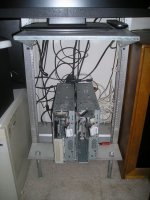
I can mount 'em vertically in bricks of four on the TelCo rack. Two bricks will fit under the 32" HDTV with room left over for a KM drawer.
Unfortunately the Two SIMM Slotted 640 DOS variant is in demand, those would rock, but I only have the one Q630 MoBo ATM. :-/
CS1 NICs will be difficult to source as well I think.
I've already got The OmniView Mac converter and MiniView four port PS/2 KVM, the cables for which can easily be converted to ADB. Would a "KVM'd" serial port connection be of any use?
-- Chassis would be a galvanized sheet metal enclosure behind the uprights for added cubic
-- largest cooling fan available to boost airflow on back of chassis
-- weatherstrip guide the exhaust fans, directing airflow toward auxiliary fan on backplane
-- MiniView four port PS/2 KVM with converted input connectors
-- Power Strip
Advantages:
-- retains Class A RFI shielding
-- retains UL approved packaging
-- available FDDs for boot
-- IDE a/o CD bay SCA converter options
I've got the MiniView A/B switch to gang two bricks of four Nodes each already hooked up to the Mac Converter . . .

. . . with four more 4 Port Miniview KVMs I can handle 4 Bricks/Sixteen nodes . . .
. . . and a Foundry Networks 24 port thingamajig If I decide to fill the Rack . . .
. . . to run it as a space heater for the winter months. :lol:
. . . unless SneakerNet counts? :lol:
Would giving each MicroQuadra its own dedicated SCA drive help at all?
I'll look into the Quadra 630/Performa 6xx angle, that'd be really easy. I wouldn't even bother trying to make a backplane, just remove all the plastics and bolt 'em up with standoffs . . .
. . . ooooh!!!!! :O
< scampers off to play with hardware >
I can mount 'em vertically in bricks of four on the TelCo rack. Two bricks will fit under the 32" HDTV with room left over for a KM drawer.
Unfortunately the Two SIMM Slotted 640 DOS variant is in demand, those would rock, but I only have the one Q630 MoBo ATM. :-/
CS1 NICs will be difficult to source as well I think.
I've already got The OmniView Mac converter and MiniView four port PS/2 KVM, the cables for which can easily be converted to ADB. Would a "KVM'd" serial port connection be of any use?
-- Chassis would be a galvanized sheet metal enclosure behind the uprights for added cubic
-- largest cooling fan available to boost airflow on back of chassis
-- weatherstrip guide the exhaust fans, directing airflow toward auxiliary fan on backplane
-- MiniView four port PS/2 KVM with converted input connectors
-- Power Strip
Advantages:
-- retains Class A RFI shielding
-- retains UL approved packaging
-- available FDDs for boot
-- IDE a/o CD bay SCA converter options
I've got the MiniView A/B switch to gang two bricks of four Nodes each already hooked up to the Mac Converter . . .
. . . with four more 4 Port Miniview KVMs I can handle 4 Bricks/Sixteen nodes . . .
. . . and a Foundry Networks 24 port thingamajig If I decide to fill the Rack . . .
. . . to run it as a space heater for the winter months. :lol:
I'm not sure, but i believe that 10 MBit ethernet to a fast fileserver with large buffers and maybe even a SSD is faster than any local disk. Mind you, sustained read or write isn't important, only random access times count.
At the weekend i'll play with the software side. :approve:
At the weekend i'll play with the software side. :approve:
Dunno about that 10bT vs. local disk angle, even at only 2-3MB/sec, direct connect local access almost has to be faster than a handshaken 10-Mb/sec. :?:
Local Disk for VM in a pinch?
Not to mention startup . . .
Local Disk for VM in a pinch?
Not to mention startup . . .
Just to let you know, you are not the first planning a 68k-mini-cluster. And i am not the first to connect the dots and think package-compile-cluster:
http://comments.gmane.org/gmane.os.netbsd.ports.mac68k/5448
Can't wait for the weekend to test some things. Haven't really played with the obscure stuff in NetBSD for years. I believe there is no easy netboot solution yet, i have to compile a special kernel. The generic kernel is 3.6 MB uncompressed, so i have to shrink it quite a bit, too. :approve:
As for disks, maybe they are a tad faster after all at random access, they are for sure at continuous transfers. This can be tested.
But the idea of not having them in the BrickOven is not without value. Imagine, no noise. If you assume a BrickOven with 7 nodes, you would have about 70 watts peak power you would have to provide on top. Not to speak of heat dissipation and maintenance.
http://comments.gmane.org/gmane.os.netbsd.ports.mac68k/5448
Can't wait for the weekend to test some things. Haven't really played with the obscure stuff in NetBSD for years. I believe there is no easy netboot solution yet, i have to compile a special kernel. The generic kernel is 3.6 MB uncompressed, so i have to shrink it quite a bit, too. :approve:
As for disks, maybe they are a tad faster after all at random access, they are for sure at continuous transfers. This can be tested.
But the idea of not having them in the BrickOven is not without value. Imagine, no noise. If you assume a BrickOven with 7 nodes, you would have about 70 watts peak power you would have to provide on top. Not to speak of heat dissipation and maintenance.
Why not just use remote desktop software to access each system? If you run MacOS you got Apple Remote Access and if you do run a BSD you got pretty much every other method to access the system. A KVM arrangement will give you a stupid large mess of cables. I still do not see why you need a CD drive for each. If you're networked you only need to mount a remote volume and pull data from there. Running SCA drives will also require another layer for each two slices you run. You build a disk image on one system and clone it to multiple CF cards.
I thought stupid large messes of cables were teh point of having a rack! :lol:
BrickOven2™ is meant for playing with each level independently over KVM. Having LC, LCII, LCIII, and three LC475/Q605 layers to make up the six CPU PDS Expansion Card PlayStation, so it needs KVM.
The original BrickOven™ was a six level 68040 hack looking for an application. It was a design exercise intended to hoover up some of the large excess of MicroQuadra™ boards in Aus.
The RackOven™ is just a day old design exercise. It's more feasible to run 1 to 6 bricks of four Q630 nodes each in a TelCo Rack than to build even one BrickOven™ if you really think about it. As far as CDs go, only one person mentioned using a single one for the array. I think using the CD Bay in each of the 6xx boxen for an adapted, fast access U160 or SCA Drive makes the most sense. No need for NetBooting or startup floppies and plenty of space for VM/scratch disk/whatever.
I'm not a UNIX geek or Network admin of any sort, I HATE networking, but KVMs and SneakerNet I've got down pat.
 )
)
Just as long as you don't destroy (modifiy) the case then I'm OK.
Your OKness is the least of concerns. :lol:
One nice thing about going with the 6xx version is that the case parts are pretty much flat slabs for storage, as opposed to the complex, voluminous forms of the 'zaBoxen.
I got a kick out of knocking the LisaP graphic out in AI this morning, I think I'll do a front view of what a six brick/24 node RackOven™ might look like in my TelCo Rack. [}] ]'>
One nice thing about going with the 6xx version is that the case parts are pretty much flat slabs for storage, as opposed to the complex, voluminous forms of the 'zaBoxen.
I got a kick out of knocking the LisaP graphic out in AI this morning, I think I'll do a front view of what a six brick/24 node RackOven™ might look like in my TelCo Rack. [}
] ]'>