

Thread
Socketed vs Soldered ... Fight!
Uniserver and I were tossing around a theoretical question ... Do you think that socketed or soldered 68030 processors would perform better, worse or the same in bechmarking when all other factors are the same? I'm tempted to test this simply to answer the question but curious to know what anyone else might expect.
My test case would be to use an SE/30 chassis with power supply and internal SCSI drive loaded with a clean System software and benchmarking suite loaded. I could then swap socketed and soldered logic boards between the two using the same RAM modules on both.
What's you guess?
My test case would be to use an SE/30 chassis with power supply and internal SCSI drive loaded with a clean System software and benchmarking suite loaded. I could then swap socketed and soldered logic boards between the two using the same RAM modules on both.
What's you guess?
if i had to guess... i would say the socketed cpu is going to preform 5 to 15% better in the Norton System info benchmarks.
video is going to preform 3 to 5% better... Ram and Hd will preform the same.
I sent Norton System Info to mcdermd, he will test and find out
video is going to preform 3 to 5% better... Ram and Hd will preform the same.
I sent Norton System Info to mcdermd, he will test and find out
Why would socketed work better? Wouldn't the possible smaller contact area create a better chance at signal not getting where it should be? I'm no electrician, but as a welder soldered Joints always acted more stable than twist connections.
As much as I'd prefer to have a socketed one, I'm putting my money on soldered.
Having a socket or not is NOT going to make a difference unless the contacts are really dirty(and then it probably does not even work). But of course you can still have cold solder joints on the soldered in CPU too. But still, if pins of your CPU are not making contact the board is likely not functioning or not functioning properly.
What may make a difference is if these boards have any other differences. You are not looking at the socket here, you are looking for different ROM or other firmware for other parts or other parts themselves being different between the two boards.
Make sure you use the same RAM when you switch boards. And no extra PDS cards!
What may make a difference is if these boards have any other differences. You are not looking at the socket here, you are looking for different ROM or other firmware for other parts or other parts themselves being different between the two boards.
Make sure you use the same RAM when you switch boards. And no extra PDS cards!
My theory is because the pins on the socketed one are gold plated...Should make a great electrical contact. And with the ceramic package, even the chip inside might be of better quality, Cost saving is always an after thought, Ok we did it! Now how do we make it cheaper 
I could be wrong but that is my guess.
My guess is the socketed one will perform higher..even if at a slight margin.
Edit: Ps:
kinda like what they did with the Classic II after the SE/30

I could be wrong but that is my guess.
My guess is the socketed one will perform higher..even if at a slight margin.
Edit: Ps:
kinda like what they did with the Classic II after the SE/30
I remember this discussion back in the '386 days. All tests run were almost identical as many other factors on the motherboard were involved. Also, no two motherboards of the same model tested identical.
I'd say no measurable difference, the contacts don't really enter into the equation, trace length might have a minimal impact.
If so, I'd put my money on the PGA having a bit more efficient pathway from MoBo to core.
It'd be difficult to come up with any difference, but having the system clock oscillator off within tolerances one way or the other would be of far greater impact. That alone would keep any two MoBos from performing identically. Test half a dozen crystals of the "same" frequency in one board and I'll bet you'll see measurable variances.
How many angels can dance on the top of a 68030? [ )] ]'>
If so, I'd put my money on the PGA having a bit more efficient pathway from MoBo to core.
It'd be difficult to come up with any difference, but having the system clock oscillator off within tolerances one way or the other would be of far greater impact. That alone would keep any two MoBos from performing identically. Test half a dozen crystals of the "same" frequency in one board and I'll bet you'll see measurable variances.
How many angels can dance on the top of a 68030? [
)] ]'>ok who is going to be the designated bookie?
I said "would be." The point it moot.
However the piccie gave me an idea where the form factors may make a quantifiable impact on performance.
Take one socketed MoBo with a single PowerCache Card and adapters for both the Proc Socket and the PDS. Test the two to see if there's a difference.
My money, all two bits of it, would be on the PGA Socket Adapter if it doesn't place the adapted proc even farther from system RAM & ROM that the PDS Adapter does.
However the piccie gave me an idea where the form factors may make a quantifiable impact on performance.
Take one socketed MoBo with a single PowerCache Card and adapters for both the Proc Socket and the PDS. Test the two to see if there's a difference.
My money, all two bits of it, would be on the PGA Socket Adapter if it doesn't place the adapted proc even farther from system RAM & ROM that the PDS Adapter does.
Interesting question, but I doubt the CPU packaging makes any difference. What could make a difference is the mask version of the CPU and other differences with supporting chips. I am guessing socketed boards are earlier versions of the CPU, so they might actually be not as good since chip production usually improves as the production matures. The board layout probably changed over time to reduce costs and improve reliability with minimal impact to performance.
While doing the test you might also want to swap the ROM to remove that variable. Trying a couple boards of each version would be more statistically significant, I say this since of anyone, mcdermd might have a few of each. I can try running benchmarks on my system with the same software. Which version are you running of Norton?
While doing the test you might also want to swap the ROM to remove that variable. Trying a couple boards of each version would be more statistically significant, I say this since of anyone, mcdermd might have a few of each. I can try running benchmarks on my system with the same software. Which version are you running of Norton?
I cant even believe this issue is even up for discussion. The speed of any electrical signal is only as fast as the capacitance of its substrate. And inductance too. NOT by sockets, etc...
I just went with soldered because I assumed the pins would be shorter and thus have a minutely less bit of latency.
place your bets, i nominate jt as the thread bookie,
This. I mean, really, come on people.
The relationship between the CPU and the rest of a computer isn't like, say, the relationship between an engine and the rest of the car. You're acting as if providing a "better" connection between the CPU pins and the motherboard will be akin to boring out the intake manifold or unkinking the exhaust to eek a few more horsepower out of a given engine block. (Or to use another analogy, like substituting a larger diameter hose between a faucet and a sprinkler to get it to throw a little further.) A 68030 is a state machine synchronized with an external clock input, and it *always* does the same amount of work in response to a single tick of the clock. *IT'S DIGITAL, FOR CRYING OUT LOUD*. If the connection to the motherboard/socket is good enough for the signal to get through (without excessive noise or interference) it's going to work exactly the same. If the connection were so bad that the CPU were missing clock beats then the computer's not going to work, because the CPU will fall out of sync with signals generated by other devices on the motherboard, like RAM, and CRASH. That's it, period. End of story.
If any measurable difference is observed between two SE/30 motherboards, one with a socketed CPU and the other soldered, it's because of some other difference, like slightly variant clock crystals. For people tossing out "trace length" as justification for thinking there's something to this:
A: At the speed electricity travels in a wire you need about a foot of distance to cause a one nanosecond delay. So the extra, what, two millimeters you get with a socket vs. soldered is *incredibly insignificant*.
B: Remember that "clock" thing? Imagine, if you will, a square dance being held in a gigantic hall. What the dancers do while dancing is dictated by what they hear from a caller standing on a stage at one end of the hall, who's shouting into a microphone connected to a single powerful PA speaker. (The hall doesn't have speakers anywhere else, all the sound is coming from the one spot.) In theory, if you were to view the dance from above (and again, assuming the hall is absolutely huge) you might be able to perceive that the dancers at the far end of the hall are dancing *very slightly* out of sync with the ones right in front of the stage. However, and this is the important thing: they're not dancing any slower. They respond when they hear the call exactly like the ones in the front and do so at the same speed. They just hear it a little later.
When translating this to a computer: Unless the distance from the CPU to the devices it's talking to on the motherboard is so far that the transit time of the signals consumes all the "margin of error" there is for the devices to respond to each other the computer will behave exactly the same. If the delay does exceed that boundary then the computer won't "run slower", it simply won't work. (Unless the clock speed were reduced to the point that the delay was once again acceptable.)
Thought processes like this are why outfits like Monster Cable succeed in milking idiots $50 a shot for "gold-plated gas-sealed made-by-dwarves-in-the-Black-Forest" RCA cables for digital audio. Our bits are cleaner so they sound better!
Yeah, it is a bit silly... But, I am wondering if the overall motherboard design, the sum of all the parts would perform any differently between versions. If so, any difference is probably in the noise. I have not heard of any major differences in '030 CPU masks other than a 1um to 0.8um die shrink for the 50MHz version, which would just improve thermal performance at lower speeds.
Gold plated monster cables are BOSS!
Didn't you know?
Hey there! yeah you, Mr. dino picture man, lol, Why are you taking what I am saying out of context? My point was there is going to be solid electrical connections wether
it's Socketed or Soldered.
I bet 5 bucks payable to Mcdermd, the socketed motherboard is going to be a margin faster in the video and cpu, in bench testing.
Didn't you know?
Hey there! yeah you, Mr. dino picture man, lol, Why are you taking what I am saying out of context? My point was there is going to be solid electrical connections wether
it's Socketed or Soldered.
I bet 5 bucks payable to Mcdermd, the socketed motherboard is going to be a margin faster in the video and cpu, in bench testing.
That's why I suggested that the two different adapter types be tested with the same PowerCache Card on the Same (socketed) SE/30 MoBo. That's the only instance I can come up with where trace length variables might possibly be measured. Not that they'd be in the least significant. [
)] ]'>That changes the test to which plumbing run is shorter and am I really better off with a socketed MoBo for other than the additional space freed up by leaving the PDS vacant.
Short answer: NO!!!!
You'll have to run the test for a VERY LOOOOONNNNG TIME in each config for any measurement to exceed margin of error. I find it intriguing to figure out how long it would take for a 1.25" longer electron pipe to show any significant differential . . . but I'm lazy . . . and sick again . . .
. . . fuggedaboudit!!!!!!!!!! :sadmac:
edit: the Toothy/Nasty/Dinocerous is spot on once again, BTW . . . just give it up already. :
Cut him some slack, he kinda grows on ya once you get past that snarling, nasty, scaly carnivorous outer shell. He's really just a big teddy bear that kicks the stuffing outta' nonsensical crap like this whenever it pops up.
We will have to wait for the benchmark results. Wont we?
Um . . . not really. :-/
Well hey, If there is no difference then my buddy mcdermd is 5 bucks richer, no harm done.
Yep, and that's about as cheap a credit hour as you're likely to buy. Now, for review, re-read all the opposing commentary, mull it over a bit and . . .
Na, I don't listen as trag said... Also as he said, carry on, And that i am pretty much wrong about everything.
When I am curious about stuff i find out! That means experiment, test, ask what might be considered by some of you as " stupid ass questions "...
However as even you said (jt) just now in the Cap thread, no question is a stupid question.
I am just a do'er, get er dun kinda guy.
The things that I know how to do, I do them well. The rest is google or questions 101.
Just don't get snippy with me. I'm just average joe plumbing store IT guy.
i like your credit hour ref, i paid nothing for my College, GM paid for it all...
When I am curious about stuff i find out! That means experiment, test, ask what might be considered by some of you as " stupid ass questions "...
However as even you said (jt) just now in the Cap thread, no question is a stupid question.
I am just a do'er, get er dun kinda guy.
The things that I know how to do, I do them well. The rest is google or questions 101.
Just don't get snippy with me. I'm just average joe plumbing store IT guy.
i like your credit hour ref, i paid nothing for my College, GM paid for it all...
I saw an earlier edit of this particular post, but not quickly enough. I'm really disappointed I missed whatever a certain someone said about me.edit: the Toothy/Nasty/Dinocerous is spot on once again, BTW . . . just give it up already. :
Cut him some slack, he kinda grows on ya once you get past that snarling, nasty, scaly carnivorous outer shell. He's really just a big teddy bear that kicks the stuffing outta' nonsensical crap like this whenever it pops up.
Off Topic:
Uniserver, dude, if it will help you keep your language/blood pressure under control rest assured at this point if I reply to one of your threads I'm not talking to you, nor do I have any "personal problem" with you. (I'm sure you have your good points despite clearly having some major gaps in your scientific education and an unfortunate tendency to fling infantile insults.) I'm well aware of exactly how useful it is to waste your breath arguing with crazy, I was just attempting to educate the innocent bystanders. And if you don't like the fact that I've put you into the "crazy" category just remember: it's you who painted the picture I'm judging you by and it's the same one that everyone else sees. If you choose to keep staking your credibility on gut feelings and "attractive notions" which have no basis in reality eventually everyone's going to drop you into that same bucket.
(Mods: If you feel this needs to be deleted, go for it. I apologize ahead of time.)
lol save it.
talk to some one who cares, it aint me or my less then 5 dollar a credit hour education
talk to some one who cares, it aint me or my less then 5 dollar a credit hour education
Thanks gorgonops, I appreciate your comments. BTW, I don't know about gorgonops, but I am not a huge fan of Three's Company (I caught the post before it was edited and you are not missing much).
it was good... I laughed so dam hard, it was good times.
love it.
love it.
Three's Company was pretty good TV, but I liked the blonde better back when she just kept her mouth shut and drove the T-Bird around with an air of mystery. [)] ]'>
As for all the gooshy stuff, mud fights, cat slinging and tomfoolery . . .
. . . toss uniserver into another class, my crazy bucket runneth over already around here!
)] ]'>As for all the gooshy stuff, mud fights, cat slinging and tomfoolery . . .
. . . toss uniserver into another class, my crazy bucket runneth over already around here!
lol more insults. thanks!
Yup, third class here I come.
Have a nice night)
Yup, third class here I come.
Have a nice night
) Nice Lucas ref, jt.
This is digital logic, ones and zeros, not some esoteric analog or RF circuit. Either it works or it doesn't, period. The CPU is driven by a clock oscillator and executes instructions and transfers data in lockstep with the oscillator. Apples to apples (excuse the pun) the *only* variable affecting the speed of the CPU is the clock speed. Bad connections may cause the system to be flaky and suffer random glitches and crashes, but if everything is in good enough shape to run reliably, it will run just as fast as if everything was made of fancy gold plated oxygen free copper and whatever other ridiculously expensive exotic materials you could find.
LOL... what a trainwreck. I LOVE IT.
But Even though this isnt analog or RF, and its digital, at breakneck speeds circuit lengths still become an issue. Even though its only 1s and 0s, The transition between 1 to 0, and 0 to 1 still fall into the "analog" domain. And CMOS/TTL have their own properties on which either state is recognized. So the less time the transition is spent in the undefined gray area, the better off you are. Therefore, if the rise-time or fall-time is grossly out the window, strange things happen. Now granted, the discussion about socketed/non-socketed CPUs at the SE/30 clock speeds, it doesnt matter... The clock is too slow even for the longest mess of a trainwreck wire to even matter. So my argument is moot.
But hypothetically when you start operating at clock speeds at the several hundred Mhz, those "wires" and their lengths and parasitic capacitive loading start coming into play, If the circuit trace or pin is too capacitive loaded it could cause race conditions in a parallel signal getting from A to B. And at even higher speeds, parasitic inductance start putting glitches on the line. Thats even worse....
Which is why if you look at modern motherboards, speed critical circuits are meandered to have equal lengths between A and B across all data lines.
For example if you purposely start introducing glitching in a microprocessor, your playing on these properties of electronics as i explained above. Allowing you to arbitrarily take control over an embedded/secured circuit. But when unexpected, it causes crashes as someone previously stated.
But Even though this isnt analog or RF, and its digital, at breakneck speeds circuit lengths still become an issue. Even though its only 1s and 0s, The transition between 1 to 0, and 0 to 1 still fall into the "analog" domain. And CMOS/TTL have their own properties on which either state is recognized. So the less time the transition is spent in the undefined gray area, the better off you are. Therefore, if the rise-time or fall-time is grossly out the window, strange things happen. Now granted, the discussion about socketed/non-socketed CPUs at the SE/30 clock speeds, it doesnt matter... The clock is too slow even for the longest mess of a trainwreck wire to even matter. So my argument is moot.
But hypothetically when you start operating at clock speeds at the several hundred Mhz, those "wires" and their lengths and parasitic capacitive loading start coming into play, If the circuit trace or pin is too capacitive loaded it could cause race conditions in a parallel signal getting from A to B. And at even higher speeds, parasitic inductance start putting glitches on the line. Thats even worse....
Which is why if you look at modern motherboards, speed critical circuits are meandered to have equal lengths between A and B across all data lines.
For example if you purposely start introducing glitching in a microprocessor, your playing on these properties of electronics as i explained above. Allowing you to arbitrarily take control over an embedded/secured circuit. But when unexpected, it causes crashes as someone previously stated.
I'm sticking to my original guess that the socketed se/30 is going to preform better even if by a small margin, in benchmarks.
Seriously though I'm really quite curious to see the benchmark results.
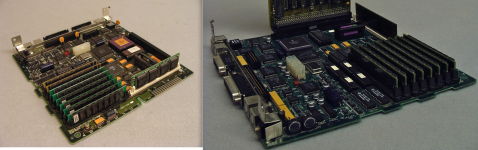
Looking more closely at the 2 different boards, I notice some differences. My hunch is, more changed then just the package,
Pretty sure the MMU on there too? It is an 030 after all. There is a alot going on in that little piece of silicon.
So place your bets!
Seriously though I'm really quite curious to see the benchmark results.
Looking more closely at the 2 different boards, I notice some differences. My hunch is, more changed then just the package,
Pretty sure the MMU on there too? It is an 030 after all. There is a alot going on in that little piece of silicon.
So place your bets!
While that's absolutely true, it's also a fact that a poorly laid out motherboard or one with bad connections will not run any slower. Either it is electrically "good enough" or it will be flaky and unreliable if it runs at all. It will *not* run more slowly unless you clock it at a lower speed, period. I see discussions like this crop up all the time in audiophool circles. You can instantly identify the engineers and the guys for whom the technical side is some sort of black magic.
As others have stated, there will likely be performance differences from one board to another, but they will be due to firmware and clock speed variation, nothing relating to whether the CPU is in a socket or not. Likewise the speed of the RAM has no impact whatsoever on performance. Either it's fast enough to perform reliably at the speed it's being clocked at, or it will cause the system to be flaky.
Consarnit, I sees you there talkin' yer high-falutin' book-learnin' but all I hear is "blaw blaw blaw words words libtarded words prepping free hydrogen those blast points TOO ACCURATE FOR SANDPEOPLE! blawblawblaw."
There is *one* thing I suppose you could toss out there, about the "if there is a variance..." hook: Ocassionally when bugs which affect the stability of a given model of computer are discovered which are due to sloppy or over-ambitious timing the quickest solution is usually to make changes which intentionally slow down the machine, such as inserting wait states or modifying a software driver. (The Commodore 64's serial port is the poster child for "fix it by making it slower" engineering.) So if this stupid argument is actually about whether an older SE/30 motherboard (and here I'm assuming that the older boards are the socketed ones) just might do something faster than a newer one then it's remotely possible... but as has been repeated many, many, MANY times the result will have absolutely nothing to do with the CPU being socketed. The obvious tradeoff for that tiny bit of extra speed is having a machine that's susceptable to whatever crash bug the engineering change was made to prevent.
Of course, a even later engineering change might fix the problem and improve the firmware so the newest machines perform even better than the original buggy versions...
*snicker* There's multiple kinds of crazy, Trash. Don't worry, you've got your own cool bucket. }. . . toss uniserver into another class, my crazy bucket runneth over already around here!
Aaaah, Three's Company. I can't think of a finer source of intellectual banter than that.

I have this long boring story about how watching "Three's Company" during my formative years prompted a revalation that basically cured me of the desire to watch sitcoms, but to keep it short... ever seen the South Park Episode where they regularly call out that the "Simpsons Did it!"? Three's Company did it *way* before the Simpsons did. (Granted, Lucy or the Honeymooners did a lot of it first, but Three's Company filled out the "Sexual Innuendo" plot category that was verboten before the 1970s.)
Thanks for the kind thoughts, G, but this five gallon dough pail is getting a bit constraining. Maybe you could drum up a 55 gallon container? That would give me an order of magnitude more elbow room and 5 gallons of volume left over for padding . . .
. . . If you reinstalled the lid without the plugs I could still breathe and less crazy would leak out the top!)
Dollars to doughnuts, if it's original to the Video Production Studio, Ernie Kovacs did it first!
. . . If you reinstalled the lid without the plugs I could still breathe and less crazy would leak out the top!
) Dollars to doughnuts, if it's original to the Video Production Studio, Ernie Kovacs did it first!
Good grief.
Run the bleeping test already. Just do it before someone has an electronic stroke (or maybe a real one for some of the more ... ah ... emotionally committed ... posters)
The quality of the thread has deteriorated as the "discussion" progressed. What comes next after cow patties?
Run the bleeping test already. Just do it before someone has an electronic stroke (or maybe a real one for some of the more ... ah ... emotionally committed ... posters)
The quality of the thread has deteriorated as the "discussion" progressed. What comes next after cow patties?
High school lunch "BBQ beef" sandwich.
Cow pies for dessert?
p.s. this thread can't possibly reach lows beneath the IP, so's we're doing out best to smoosh it around the plate without ingesting it seriously.
p.s. thread devolution has a long and colorful history here . . . at least in the forum archives anyway . . .
. . . lately this place has gotten a bit too stuffy by comparison . . . too much parade ground spit and polish . . .
. . . and not nearly enough playing out in the mud with the troops . . . IMO, of course. :rambo:
p.s. this thread can't possibly reach lows beneath the IP, so's we're doing out best to smoosh it around the plate without ingesting it seriously.
p.s. thread devolution has a long and colorful history here . . . at least in the forum archives anyway . . .
. . . lately this place has gotten a bit too stuffy by comparison . . . too much parade ground spit and polish . . .
. . . and not nearly enough playing out in the mud with the troops . . . IMO, of course. :rambo:
I thought an AC130H flew just a little bit above the mud most of the time.
Do you ever get back to the "Holy Land" aka LRAFB?
Do you ever get back to the "Holy Land" aka LRAFB?
Filtering out cow pies gets tiring after a while, especially when they constantly come from the same person. I found at least one solution we can individually control. The "manage foes" tab hides posts by users you specify in your user control panel:


Fine by me mr. ostrich, but that's a good way to get the mud in yer eyes. [] ]'>
@HS: the 68KMLAAF uses the AC130H to MAKE the mud the troopers play in, kinda like elephant wallows keep the savannah habitable.
Daisy Cutter floral arrangements are a sideline specialty of the support group's trash haulers. [}] ]'>
I'm thinking we might transition into the new jet, but the HerkyBird still ROCKS!!!!
Wright Pat's museum was my childhood mecca.
In my Big Apple lifetime, the growing Intrepid Collection served well in that role.
Udvar-Hazy Center would be the new mecca, I've driven right on past . . . too many times. :-/
] ]'>@HS: the 68KMLAAF uses the AC130H to MAKE the mud the troopers play in, kinda like elephant wallows keep the savannah habitable.
Daisy Cutter floral arrangements are a sideline specialty of the support group's trash haulers. [}
] ]'>I'm thinking we might transition into the new jet, but the HerkyBird still ROCKS!!!!
Wright Pat's museum was my childhood mecca.
In my Big Apple lifetime, the growing Intrepid Collection served well in that role.
Udvar-Hazy Center would be the new mecca, I've driven right on past . . . too many times. :-/
We're done here.