

Thread
Prototype Mac Case, that is the question . . .
. . . I just found the Apple logo stamped on the bottom of the 5.25" drive tray in the strangest, coolest sheet metal chassis for a wide, middling tal/mid level tower I've ever run across . . .
- It's without doubt an ATX case which is strange enough.
- Definitely not
- Swing out, removable MoBo/backplane tray, clips into the backplane w/plastic slide catch at the front
- clip-in three level 3.5" drive magazine
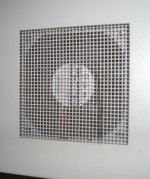
- odd fan mounted on left side, opposite the door
- odd missing corner on back of same
- various other earmarks of prortotypeness now that I think about it.
- 8 7/8" W x 14 1/2" H x 15 5/8" D
. . . pics late tonight, runnin' to work.
Sound like anything familiar? :?:
edit: Bermuda Triangle, NC was likely a hotbed for CHRP development. If not, a lot of Big Blue employees were relocated here just after that time-frame. Found it at a thrift in Raleigh with no front bezel or goodies inside, IIRC.
- It's without doubt an ATX case which is strange enough.
- Definitely not
- Swing out, removable MoBo/backplane tray, clips into the backplane w/plastic slide catch at the front
- clip-in three level 3.5" drive magazine
- odd fan mounted on left side, opposite the door
- odd missing corner on back of same
- various other earmarks of prortotypeness now that I think about it.
- 8 7/8" W x 14 1/2" H x 15 5/8" D
. . . pics late tonight, runnin' to work.
Sound like anything familiar? :?:
edit: Bermuda Triangle, NC was likely a hotbed for CHRP development. If not, a lot of Big Blue employees were relocated here just after that time-frame. Found it at a thrift in Raleigh with no front bezel or goodies inside, IIRC.
Could it be ...
Dunno, room for seven slots. IBM's PC division relocated here, I'll ask the grlf when that was, she was with that division and its later morph into Lenono.
late for wokr . . .toodles.
late for wokr . . .toodles.
I'd love to see pictures.
yeah pictures are nice! 
A friend of mine that worked on SQA for G4 Cube @ Apple indicated the protos were all cage in a tin box... with push button power switch.
Yeah, sounds right, I need to look closer, but this thing may never have had a front bezel in the first place. The removable door MoBo tray just screams "prototype enclosure." User friendly it ain't. There are a couple of numbers to check, but I came up with bopkes googling the part number though.
The only real verbiage on the case is Caution: Do Not Remove Tape in English & Ideograms . . . so this idiot tore the translucent yellow tape off the front to gain access to the power/reset buttons and LEDs.
This thing has spots to put speakers and fans all over the place!
Oopsie! :O
The only real verbiage on the case is Caution: Do Not Remove Tape in English & Ideograms . . . so this idiot tore the translucent yellow tape off the front to gain access to the power/reset buttons and LEDs.
This thing has spots to put speakers and fans all over the place!
Oopsie! :O
Quickie right off the camera at lunch specials. Sorry.
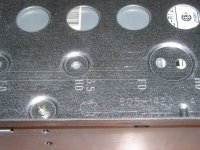
This is what got me looking . . .
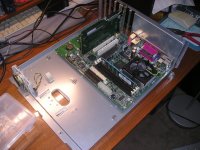
Notice the hook, whack on a board with a card on it, put in one screw to hold down the card and ain't nothin' movin' in there.
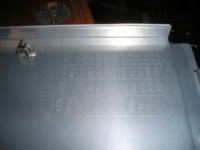
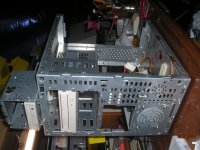
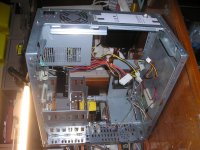
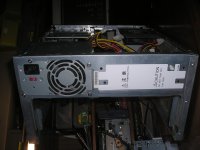
Found the mfr, but it feels like a prototyping case to me. Dunno.
Whatchathink? :?:
TTFN
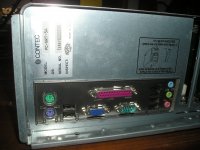
This is what got me looking . . .
Notice the hook, whack on a board with a card on it, put in one screw to hold down the card and ain't nothin' movin' in there.
Found the mfr, but it feels like a prototyping case to me. Dunno.
Whatchathink? :?:
TTFN
That to me looks like a prototype of the first INTEL Mac.
i think that whole unit slid into a modified G5 case.
i think that whole unit slid into a modified G5 case.
It does vaguely resemble the beige G3 in terms of overall shape and size, but many of the details seem to have more in common with a similar-era PC case I have (with the sideways-mounted PSU and shorter-wider shape). That stamped-in Apple logo does suggest that it's genuine, though. The motherboard tray does strike me as similar to the production G3 as well, if I remember correctly.
As for the extra slots, well, maybe this was an early prototype case originally intended to be more in line with the 9500/9600 (and perhaps it was developed into it at one point), and they simply cut it down to size at a later stage to get the G3 (which, aside from # of slots (and probably height; I've never seen a 9x00 in person closely enough to make detailed observations), is very similar to the 9x00, I think). It's purely speculation at this point, I think.
Who knows, you could have a veritable gold mine there!
I'm eager to hear (and see) more!
c
As for the extra slots, well, maybe this was an early prototype case originally intended to be more in line with the 9500/9600 (and perhaps it was developed into it at one point), and they simply cut it down to size at a later stage to get the G3 (which, aside from # of slots (and probably height; I've never seen a 9x00 in person closely enough to make detailed observations), is very similar to the 9x00, I think). It's purely speculation at this point, I think.
Who knows, you could have a veritable gold mine there!
I'm eager to hear (and see) more!
c
Hate to throw cold water on the fire, but my gut tells me that this is just a generic PC clone case missing the skins. The removable motherboard tray is a very common feature of "middling to good quality" PC cases, and the skins probably consisted of four parts: a snap-on plastic bezel, two "drop-down" or "tip-up" side panels, and a slides-on-from-the-back top that holds the side skins in place when it's secured. (Or, alternatively, it may just have consisted of the front bezel and a one-piece "U" shaped cover.) In fact, this case looks a *lot* like several cases I owned in the 1999-2004-ish time period. (Perhaps even a dead ringer for a particular 400Mhz Dual Celeron box dating from the beginning of the period.)
If the only evidence you have for some sort of "prototype" connection is that little Apple logo stamped in the metal, well... okay, here you go:
The tray the CD ROM drive is sitting on is from a PowerMac.
HOWEVER, look at the design of the case: peripherals in the 5 1/4 drive bays are *supposed* to be fitted with little plastic or metal mounting rails, allowing the device to be slotted in from the front and secured with screws. I think someone used that mounting tray because they lost the rails; note how the drive is sitting in the *middle* of two of the drive bays because the mounting plate is screwed into holes that are meant for the rails which would be at the midpoint of the drive when properly mounted.
In other words, well... it's junk, not a prototype. Sorry. :/
If the only evidence you have for some sort of "prototype" connection is that little Apple logo stamped in the metal, well... okay, here you go:
The tray the CD ROM drive is sitting on is from a PowerMac.
HOWEVER, look at the design of the case: peripherals in the 5 1/4 drive bays are *supposed* to be fitted with little plastic or metal mounting rails, allowing the device to be slotted in from the front and secured with screws. I think someone used that mounting tray because they lost the rails; note how the drive is sitting in the *middle* of two of the drive bays because the mounting plate is screwed into holes that are meant for the rails which would be at the midpoint of the drive when properly mounted.
In other words, well... it's junk, not a prototype. Sorry. :/
The board also has "Intel" slathered all over it and although it's certainly not the DTK, it's definitely some kind of Intel-based system.
I'm with G in that it's probably just a regular PC case missing its plastic skins. Custom-built PCs often use motherboards that don't exactly match up with what the case offers, especially if somebody overbuys a case or buys it with the intent to later install bigger cooling hardware, or just has a case already and puts whatever board they can put into it for free. Not every seven-slot case has a seven-slot board installed.
As for the fact that it has a similar optical drive ot Macs? was apple the only company that uses Matsu/Panasonic mechanisms? Alternately, Apple had switched to IDE by then. Any reason that a PC built by somebody scrounging for parts couldn't have used an optical drive pulled out of a G3?
My verdict is that it's a PC built as cheaply as possibly, whether or not the case itself is interesting or if better/more pictures will reveal that it was a common PC case, who knows.
I'm with G in that it's probably just a regular PC case missing its plastic skins. Custom-built PCs often use motherboards that don't exactly match up with what the case offers, especially if somebody overbuys a case or buys it with the intent to later install bigger cooling hardware, or just has a case already and puts whatever board they can put into it for free. Not every seven-slot case has a seven-slot board installed.
As for the fact that it has a similar optical drive ot Macs? was apple the only company that uses Matsu/Panasonic mechanisms? Alternately, Apple had switched to IDE by then. Any reason that a PC built by somebody scrounging for parts couldn't have used an optical drive pulled out of a G3?
My verdict is that it's a PC built as cheaply as possibly, whether or not the case itself is interesting or if better/more pictures will reveal that it was a common PC case, who knows.
Great link, now I can get another pair of trays! Thank heaven Apple finally gave up on that ridiculous plastic crap.
I realize this started out as a pretty much "Standard ATX case," but there are several things at odds with it being a production machine as pictured in the bezel removal diagram on its @$$end.
I checked out the exploded diagrams of the 8600/9600 cases in the Service Source while I was at work. Have they got a fan mounted to the left hand side of the case blowing air into it? It looks that way in the diagram to me and this case has that particular oddity. The fan is mounted on a very heavy gauge custom metal stamping that's mounted to the holes meant for the case's very nice domed grill for the front mounted fan, which the stamping entirely blocks as well. The stamping is a gauge and finish entirely different form the baseline case, which is lightweight and very nicely done sheet metal work.The hole on the case cover matching up with the fan is professionally done, but by no means a standard feature.
This has all the hallmarks of a short production run of an oddly modified stock case.
Timeline research:
1994 - IBM PC Division relocates to RTP (from info online, I'll back check that with my sweetie tomorrow)
1995 - First Macintosh Clone ships, CHRP is Published by Apple & IBM and ATX (Advanced Technology eXtended) spec developed at Intel
1996 - IBM and Motorola demo their CHRP prototypes
1997 - 9600/8600 Released & Apple halts all CHRP licensing.
Ten years later I found this oddity in a thrift shop just outside RTP.
BTW, that Apple drive mounting plate seems to be made to fit this case, it puts the Optical drive bay and the tape/zip bay just about where they wound up in the 9600/8600. Spacing is wrong for the floppy up top, which just fits above the Optical, but they were going to raise the forehead for the drawbridge case anyway. The 5.25" Drive Bay assembly sure looks like the exploded drawing in the Service Source and it's obvious that Apple cribbed some of the x600's case design features from the PC World. [ ] ]'>
] ]'>
Not saying it's an Apple prototype, not even saying it's an IBM CHRP prototype, just saying that when I look at it now, it looks like A prototype box . . .
. . . and that's alot of coinkidinks. :approve:
Can somebody get back to me on the existence of, and airflow direction of, the side-mounted fan in the 9600/8600 exploded diagrams.
More piccies in the AM, tonight I'll probably just tweak and compress the ones already up.
Any requests for pics of particular case details?
I realize this started out as a pretty much "Standard ATX case," but there are several things at odds with it being a production machine as pictured in the bezel removal diagram on its @$$end.
I checked out the exploded diagrams of the 8600/9600 cases in the Service Source while I was at work. Have they got a fan mounted to the left hand side of the case blowing air into it? It looks that way in the diagram to me and this case has that particular oddity. The fan is mounted on a very heavy gauge custom metal stamping that's mounted to the holes meant for the case's very nice domed grill for the front mounted fan, which the stamping entirely blocks as well. The stamping is a gauge and finish entirely different form the baseline case, which is lightweight and very nicely done sheet metal work.The hole on the case cover matching up with the fan is professionally done, but by no means a standard feature.
This has all the hallmarks of a short production run of an oddly modified stock case.
Timeline research:
1994 - IBM PC Division relocates to RTP (from info online, I'll back check that with my sweetie tomorrow)
1995 - First Macintosh Clone ships, CHRP is Published by Apple & IBM and ATX (Advanced Technology eXtended) spec developed at Intel
1996 - IBM and Motorola demo their CHRP prototypes
1997 - 9600/8600 Released & Apple halts all CHRP licensing.
Ten years later I found this oddity in a thrift shop just outside RTP.
BTW, that Apple drive mounting plate seems to be made to fit this case, it puts the Optical drive bay and the tape/zip bay just about where they wound up in the 9600/8600. Spacing is wrong for the floppy up top, which just fits above the Optical, but they were going to raise the forehead for the drawbridge case anyway. The 5.25" Drive Bay assembly sure looks like the exploded drawing in the Service Source and it's obvious that Apple cribbed some of the x600's case design features from the PC World. [
] ]'>Not saying it's an Apple prototype, not even saying it's an IBM CHRP prototype, just saying that when I look at it now, it looks like A prototype box . . .
. . . and that's alot of coinkidinks. :approve:
Can somebody get back to me on the existence of, and airflow direction of, the side-mounted fan in the 9600/8600 exploded diagrams.
More piccies in the AM, tonight I'll probably just tweak and compress the ones already up.
Any requests for pics of particular case details?
@ Corey: I stuck that Optical drive in there, I said that there were no goodies inside the empty case when I found it. It's obviously the Intel specified ATX form factor, but I figure that's what IBM or Motorola would have used for CHRP, the timing was spot-on for that. Only Apple kept building oddball, but very sexy, case designs after the advent of ATX.
Straightened and tweaked a bit, same size, but compressed at 50.
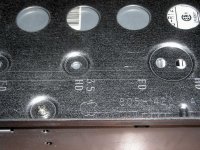
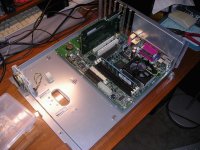
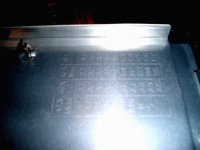
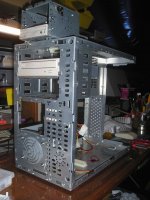
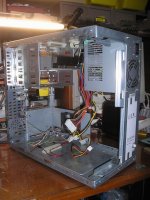
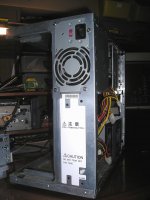
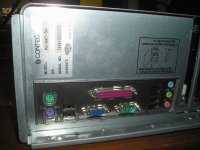
Let me know if these look better and what you'd like to see. Once you see the cage for holding the cards down, you won't think of it an "inexpensive" case. Very high quality aluminum sheet metal work.I wonder if Intel made an ATX reference design. The serial number appears to be in the mid-hundreds. It's also interesting to note the spot for an O.S. designation sticker. [] ]'>
Whatever happens, it's cool and I'm not gonna turn it into an ersatz Radius 81/110 after all. :disapprove:
Let me know if these look better and what you'd like to see. Once you see the cage for holding the cards down, you won't think of it an "inexpensive" case. Very high quality aluminum sheet metal work.I wonder if Intel made an ATX reference design. The serial number appears to be in the mid-hundreds. It's also interesting to note the spot for an O.S. designation sticker. [
] ]'>Whatever happens, it's cool and I'm not gonna turn it into an ersatz Radius 81/110 after all. :disapprove:
I wormed my way all the way around and ate my own tail on google. 8-o

IBM's Long Trail CHRP MoBo = ATX! More or less, judging from the pic. ;D
The CHRP dream that Jobs killed . . .
IBM's Long Trail CHRP MoBo = ATX! More or less, judging from the pic. ;D
The CHRP dream that Jobs killed . . .
Trash. Stop.
Page 16:
http://www.photolabs.ru/manuals/tr/qss31_training%20materials.pdf
Granted, it only shows the 5 and not 5A.. so it is an outdated document. *shrug*
Someone crammed an Apple part into a PC case. That is all.
Page 16:
http://www.photolabs.ru/manuals/tr/qss31_training%20materials.pdf
Granted, it only shows the 5 and not 5A.. so it is an outdated document. *shrug*
Someone crammed an Apple part into a PC case. That is all.
Here's a better link for the Noritsu QSS-2901 Digital Computer Upgrade model PC-NRT-5A (like on the back of the case): http://www.photocomputers.com/service.php At least this has some specs for what fit into the chassis.
Sorry Trash.
Sorry Trash.
By occam's razor, and any reasonable stretch of the imagination, I think g's swapped parts theory is most likely correct as well.
However, I found the info you guys have linked as well, doesn't fit, literally. This can't possibly be the case in that picture. The zip drive is centered, it would have to be on the left side, see pic of front side of my case. This case is also a normal PC config however.
@ MacJunky: the diagram of the case on page 30 of the first section matches my case from the front as does the layout you mentioned on p.16 of the second from the side, but the brochure pic shows a different case config altogether, dunno though.
Keep looking, I'd love to find out my WAG is incontrovertibly wrong.
In the meantime:
This document confirms that IBM's Long Trail was an ATX form factor MoBo.
http://www.put.com/oz/ozdi/199704.TXT
This is fun, I'll keep playing devil's advocate and get some more pics up of this strange beast and its modified steel cover.
Anybody got pics of the inside of the X600 case? In any case, the side fan hack would be blowing cooling air directly upon the RAM banks of Long Trail as pictured.
However, I found the info you guys have linked as well, doesn't fit, literally. This can't possibly be the case in that picture. The zip drive is centered, it would have to be on the left side, see pic of front side of my case. This case is also a normal PC config however.
@ MacJunky: the diagram of the case on page 30 of the first section matches my case from the front as does the layout you mentioned on p.16 of the second from the side, but the brochure pic shows a different case config altogether, dunno though.
Keep looking, I'd love to find out my WAG is incontrovertibly wrong.
In the meantime:
This document confirms that IBM's Long Trail was an ATX form factor MoBo.
http://www.put.com/oz/ozdi/199704.TXT
This is fun, I'll keep playing devil's advocate and get some more pics up of this strange beast and its modified steel cover.
Anybody got pics of the inside of the X600 case? In any case, the side fan hack would be blowing cooling air directly upon the RAM banks of Long Trail as pictured.
If the case has a side fan with duct, its from 2003ish or later. The extra ventilation was needed for Intel's Prescott Pentium 4 Toaster.
Looks like some one needed a bracket for a CD-ROM drive and found one from a Mac that happened to fit. I used to do that all the time.
Looks like some one needed a bracket for a CD-ROM drive and found one from a Mac that happened to fit. I used to do that all the time.
Uhm, what? Are you saying the diagram is wrong, or the diagram is something that would appear on a prototype, not a production case, what?
Looking at the pictures again I'm more and more certain I've dealt with this exact case before. It had a U-shaped top, and they "cleverly" hid the screws to remove the top behind it. Thus to open it you had to yank the bezel off. I remember people getting really confused because they were used to having the screws to get the top off in the back and the bezel firmly screwed in place from the inside, so by all appearances these cases would appear hermetically sealed if you didn't know the trick. (Not every reseller of these things was nice enough to put the sticker on the back.)
What does that have to do with anything? The tray might be from a 9xxx, but the case has *nothing* to do with the tray. Again, look, it doesn't fit the spacing of the bays properly.
Actually, what I suspect happened here was that this case chassis, the design of which which I think dates from around 1998-1999, was updated to "relocate" that front fan to face to the side with that added-on bracket but they never updated the front stamping to get rid of the dome. Side-facing fans started being a "thing" sometime around 2001-2002 because of the sheer amount of heat coming off the 1Ghz+ AMD and Pentium 4 CPUs of that era was significantly more than that coming off 1999-era chips. Plus, you know, someone decided it looked cool. Undoubtedly the case skins were also updated to include some stamped/milled slots that matched up with this. (Or possibly they just cut a hole and screwed a grill over it.)
*Why* would an IBM case have a specific Apple drive tray in it? That isn't a "prototype" part, I was able to search it from the part number stamped on it.
Heaven knows there weren't any other sources of junk computers in RTP besides SUPER SECRET laboratories.
No, it's not. It happens to be the right width to wedge in there, but it's not made to fit that case by any stretch of the imagination. Here, I've annotated your picture to show what the problem is:
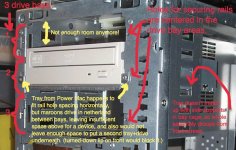
It's simply *not* the right part. The case has 3 drive bays; you screwed rails to the devices, and the rails had screw-ears which let you secure the device to the case. That mismatched tray turns 3 drive bays into *one* as mounted: It pushes the CD-ROM drive halfway into the bay above it, and the lip on the bottom edge of the tray means even if you had another one you wouldn't be able to put another regular-height device below it either. (You could stick one in there if you had the rails, or just chuck one in and let it lie on the bottom of the cage, but then there will be an obvious gap between it and the device above. Oh, yeah, I'm sure that's for "cooling", right?)
Sigh. The floppy goes in the 3 1/2 inch bay. There's a drawing of the bezel on the sticker that shows what it looked like: 3 exposed 5 1/4 inch bays, 2 exposed 3 1/2 inch slots, the bottom 3 1/2 device was obscured.
Seriously, I *swear* I had this exact case. If you googled *enough* you could find a picture of it, the problem is that no one *cares* about 2000-vintage generic PCs. It's a dime-a-dozen (but well built) OEM PC chassis, *nothing* special about it.
"It came from a thift shop in a town where *maybe* there were prototype boxes floating around 10 years before I got it and, uhm, if I squint my eyes the proportions sort of remind me of the Power Mac 8600 even though it's actually wrong in every conceivable detail. By jove, PROTOTYPE!"
Yes, my first thought was "Prototype Mac Case" and that didn't fit the details of the case at all.
Second thought was Big Blue CHRP "Prototype Case" and that still may fit, but it's less likely than . . .
. . . my third WAG which is that it likely came from one of RTPs many development centers, the three Universities from which its name derives or one of the other Universities in the greater Raleigh area or from an industrial or possibly Server environment.
I just took/massaged/compressed the pics to prove you right in most details, especially about that drive tray . . .
. . . except for a couple of interesting details that might show that it's likely a low production, non-standard clone case for development, stock, general availability fits that scenario well.
CHRPness depends upon the date of mfr. which is curiously lacking, There's another number on the sticker covering the back of the case to google: SL-2960 HP is in the Triangle as well, but the case dimensions are completely wrong, but it would have made a great development chassis!
As I said earlier, finding that Apple Logo set me off, but it has been a very interesting line of research!
Pics in a few!
Second thought was Big Blue CHRP "Prototype Case" and that still may fit, but it's less likely than . . .
. . . my third WAG which is that it likely came from one of RTPs many development centers, the three Universities from which its name derives or one of the other Universities in the greater Raleigh area or from an industrial or possibly Server environment.
I just took/massaged/compressed the pics to prove you right in most details, especially about that drive tray . . .
. . . except for a couple of interesting details that might show that it's likely a low production, non-standard clone case for development, stock, general availability fits that scenario well.
CHRPness depends upon the date of mfr. which is curiously lacking, There's another number on the sticker covering the back of the case to google: SL-2960 HP is in the Triangle as well, but the case dimensions are completely wrong, but it would have made a great development chassis!
As I said earlier, finding that Apple Logo set me off, but it has been a very interesting line of research!
Pics in a few!
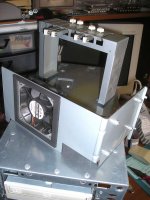
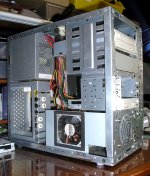
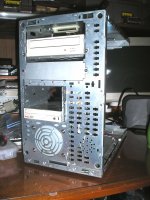
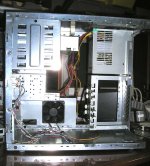
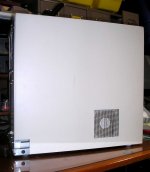
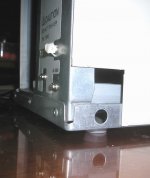
That fugly factory finger hole doesn't look baseline generic clone case to me at all.
That single detail makes repetitive removal of the metal shell quick, easy and painless indeed.
On the double-take, the side fan mod has a factory look as well, but not like something meant for a general production case for a stock clones.
Whatever, I still think it's an interesting, low production development case series, the question to me would be the actual timeline.
edit: see why I agree about the x600 bracket being a kludge, the depth is wrong, but it's something that would be readily available in any of the University Computer Labs around the Triangle.
If that motherboard is what came in it - it SIGNIFICANTLY pre-dates the Apple Intel DTK. That is an Intel D815EEA2 motherboard. It runs a Pentium 3 chip, and is from early 2001. This specific one was meant to be in "all-in-one" PCs with an LCD display (that funny connector next to the CPU between the chipset and the back panel ports is the internal-display port.)
Prior to this last round of pictures I had *no idea* what you were talking about, you hadn't posted any of the outer shroud. (I'd assumed that everything was missing, not just the bezel.) My first thought upon seeing that notch was perhaps there had been a locking device in that corner that someone had hacked out to open the case, but it does look like the edges of it have been turned/finished. That certainly implies this case was being used for *something* odd, but it doesn't negate the near statistical certainty that the case is a completely off-the-shelf item ordered out of an OEM catalog and modified by a the reseller/end user.
Looks like a bone-standard-if-somewhat-bland early-ish Pentium 4-era side panel to me. (The case is white and plain, which in my mind that anchors it to the early 2000s; colors like silver and black started being popular enough with OEM/small builder/home-built machines around 2003-2004 to start outnumbering the white/beige boxes, even for systems built for business/industrial use.)
Anyway. It's impossible to prove a negative *and* that cut-out corner is "interesting" so the case may well have served time in a lab setting, possibly as home to something interesting. (Or driving something interesting.) But it's just as likely that the case sat for years collecting dust, I dunno, under a cash register or in a stockroom and that cutout was added to route a cable or to clamp the thing into a kiosk. The missing drive rails and bezel suggest it was brutally stripped when it was removed from service; that *is* the sort of thing that happens to machines in commercial/industrial settings, which I guess is a point in favor of it not just being the box from under an accountant's desk. There might be an interesting story behind how the Mac drive tray found its way into it, but I would have some pretty serious doubts about it having anything to do with IBM/CHRP/etc, etc.
Nope, like I said there was NOTHING in the case when I picked it up, sorry for the confusion, this is one of the Win98 ROMburner project boxes,boards/drives, etc. The most telling point about dating would be:
The only two things that SCREAM development box to me are that great finger hole/case removal feature and the continuous height adjustments for PCI Cards of whatever height . . .
. . . like oversize/oddly sized development cards like prototypes for those crazy network sniffing cards in the Lunchbox from Tekekec. RTP is a hotbed of development of all kinds of Tech, second largest in the USA according to some mentions I've seen in CHRP related searches.
I've got the Win98 CD in the HackLab now, so this sucker is going back together very soon now, no matter what the heck this very cool case might be. [}] ]'>
However, the x600 that was in development in the same general time frame as IBM's ATX form factor Long Trail CHRP board. Apparently it features a side mounted cooling fan as well. Can anyone confirm that it's pointed at the RAM Banks. I'd love to have a pic of the inside of an x600 case showing that fan location. At any rate, side fan cooling predates the P4 by at least five years.
The only two things that SCREAM development box to me are that great finger hole/case removal feature and the continuous height adjustments for PCI Cards of whatever height . . .
. . . like oversize/oddly sized development cards like prototypes for those crazy network sniffing cards in the Lunchbox from Tekekec. RTP is a hotbed of development of all kinds of Tech, second largest in the USA according to some mentions I've seen in CHRP related searches.
I've got the Win98 CD in the HackLab now, so this sucker is going back together very soon now, no matter what the heck this very cool case might be. [}
] ]'>I said it was a hurry-up at lunchtime session and that new pics would be up in the AM today.
Check the "AT" compatibility listings on the door/tray, that makes me think it's much earlier than Y2K. More likely an early ATX development case, much modded from a future generation of Clone Boxen.
Indeed, but considering the string of coincidences, Long Trail CHRP is by far the most interesting of improbabilities.
toodles, late back to wlrk again! :O
Some cases after 2000 still had AT screw holes listed IIRC.
I already said in my opinion the case chassis itself dated to somewhere around 1999 and was updated to add the side fan sometime later than that. That may actually be a late date, I'm basing that on the fact that the system I had which I *swear* was exactly that case was built sometime in late 1999-2000. So far as I know the tooling for parts of that case could date back to the original release of the ATX specs by Intel in 1995.
In any case, it wasn't particularly uncommon to see cases of around that vintage that offered the possibility of mounting either AT or ATX-style motherboards. (And conversely I've seen motherboards that could be mounted in either style of case; the motherboard would be roughly square and the ATX mounting was generally a nasty kludge job with cables running to a backplate. Of course, by this point AT motherboards were *all* nasty kludge jobs with wires running from all over the motherboard to ports mounted on slot covers.) You'd have to swap out the back panel to accommodate an AT board but the tray part of the assembly could have been used in multiple case configurations.
If it *really* was something modified prior to Y2K for something that needed a special fan layout I'd actually say a far more likely possibility than anything CHRP would be an Alpha motherboard. Alpha was HOT in the late 90's, both literally and figuratively, and ATX incarnations weren't rare.
That bizarre adjustable dingus to hold the cards in place (in addition to the slot cover screws) is by far the most interesting part of the case; again, I swear I had almost exactly that case but it didn't have that part. That actually makes me wonder if this might have been mounted in a truck/van, or some other location where vibration might be a problem. (Inside a rolling kiosk? On a factory floor or inside a piece of manufacturing equipment? Etc, etc.)
Looking further, I'm not completely clear on what component has the Apple logo...
If it's just the drive tray that you have the optical drive mounted on, then it's a simple mix-up: someone tossed an Apple drive tray in it when it didn't belong. Looking further, those 5.25" drive bays are obviously meant for a standard "attach the metal rail on each side of the optical drive" type mounting - I've seen those a thousand times in many random chassis manufacturers over the years. With the side fan, this looks like your average early-2000s Pentium 4-era chassis.
And it almost assuredly had a cheap plastic front panel that is long since lost. (Hell, I have two old ATX chassis myself whose front panels are broken enough that they don't stay put any more.) Without those front panels, they all look remarkably similar to yours.
I think your Apple tray was a complete red herring. You just have a low-end ATX chassis from the early 2000s.
If it's just the drive tray that you have the optical drive mounted on, then it's a simple mix-up: someone tossed an Apple drive tray in it when it didn't belong. Looking further, those 5.25" drive bays are obviously meant for a standard "attach the metal rail on each side of the optical drive" type mounting - I've seen those a thousand times in many random chassis manufacturers over the years. With the side fan, this looks like your average early-2000s Pentium 4-era chassis.
And it almost assuredly had a cheap plastic front panel that is long since lost. (Hell, I have two old ATX chassis myself whose front panels are broken enough that they don't stay put any more.) Without those front panels, they all look remarkably similar to yours.
I think your Apple tray was a complete red herring. You just have a low-end ATX chassis from the early 2000s.