

Thread
Prototype Mac Case, that is the question . . .
Found it! Side mounted fan in Apple's Workgroup Server 9650 in the same case as the X600s with which it was introduced in February 1997.
So the side fan is totally consistent with the time frame I outlined earlier. IBM's Long Trail CHRP Board was developed in parallel to the x600 series, rendering the side fan's presence a moot point in terms of dating the case in question as far as I'm concerned.
g makes an interesting point about it possibly being for industrial use, but I'd think that there would be filters on the fans. There are however, a dozen holes distrbuted about the front and sides which might be consistent with early shock mounting methods (drives in Luggable computers, etc.) but I think that's much less likely than this being a very nice case intended for developers in the fresh new world of the ATX standard. That would be motherboard developers as well as developers of PCI cards and ISA cards supported in the early Intel design standards for ATX.
This case being from a Bog standard, cheap Clone is clearly contraindicated IMO.
I do believe that this case is part of a short production run of cases intended for the development environment. As such, more than a few of these cases probably made their way into the many Tech houses here in RTP and I was lucky enough to snag one several years later in a local Thrift.
In my wildest dreams this may have housed one of the prototypes for Big Blue's Long Trail CHRP demonstration board during its development right here in RTP. Though it could well have been developed in a facility elsewhere, the Glendale Labs where my Pops was a boffin at one point comes to mind, but IBM's entire PC Division was right here in NC during that time frame..
Stranger things happen with regularity here in the Bermuda Triangle of N.C. :lol:
Last pic set unless I get requests for any details:
Here's a pair of shots of your expansion card dingus, g.
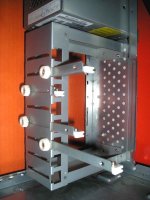
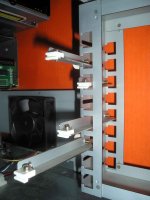
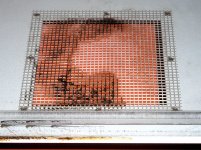
Fugly fan in the side implementation:
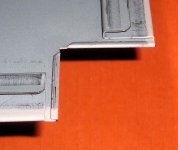
Nicely stamped, notched and seamed "finger hole" for easy, repetitive access to case innards, clearly not an attractive, consumer oriented design feature.
Drive bay makeover for Dimetrodon, the Intel MoBo, Win98 Rom HackStation candidate. Note the 2.5" SCA MiniDrive with cable adapter mounted in a 3.5" adapter and mounted in the 3.5" Drive "Magazine Clip." Let's see if '98 handles the UltraSCSI card and drive with any more aplomb than the ubuntu NetBook Remix did.
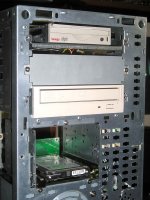
Last, but not least, the FDD/Zip does indeed fit mit dat meshuggah x600 Drive Tray installation.
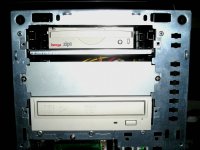
This has been fun, but I'm going back to fitting this out as an ancient Win98 computer rather than admiring it as an empty curiosity.
But I really am glad it caught my eye, it's a great toy . . .
. . . and even better as an exercise in fantasy/imagination and curiosity! [ ] ]'>
] ]'>
So the side fan is totally consistent with the time frame I outlined earlier. IBM's Long Trail CHRP Board was developed in parallel to the x600 series, rendering the side fan's presence a moot point in terms of dating the case in question as far as I'm concerned.
g makes an interesting point about it possibly being for industrial use, but I'd think that there would be filters on the fans. There are however, a dozen holes distrbuted about the front and sides which might be consistent with early shock mounting methods (drives in Luggable computers, etc.) but I think that's much less likely than this being a very nice case intended for developers in the fresh new world of the ATX standard. That would be motherboard developers as well as developers of PCI cards and ISA cards supported in the early Intel design standards for ATX.
This case being from a Bog standard, cheap Clone is clearly contraindicated IMO.
I do believe that this case is part of a short production run of cases intended for the development environment. As such, more than a few of these cases probably made their way into the many Tech houses here in RTP and I was lucky enough to snag one several years later in a local Thrift.
In my wildest dreams this may have housed one of the prototypes for Big Blue's Long Trail CHRP demonstration board during its development right here in RTP. Though it could well have been developed in a facility elsewhere, the Glendale Labs where my Pops was a boffin at one point comes to mind, but IBM's entire PC Division was right here in NC during that time frame..
Stranger things happen with regularity here in the Bermuda Triangle of N.C. :lol:
Last pic set unless I get requests for any details:
Here's a pair of shots of your expansion card dingus, g.
Fugly fan in the side implementation:
Nicely stamped, notched and seamed "finger hole" for easy, repetitive access to case innards, clearly not an attractive, consumer oriented design feature.
Drive bay makeover for Dimetrodon, the Intel MoBo, Win98 Rom HackStation candidate. Note the 2.5" SCA MiniDrive with cable adapter mounted in a 3.5" adapter and mounted in the 3.5" Drive "Magazine Clip." Let's see if '98 handles the UltraSCSI card and drive with any more aplomb than the ubuntu NetBook Remix did.
Last, but not least, the FDD/Zip does indeed fit mit dat meshuggah x600 Drive Tray installation.
This has been fun, but I'm going back to fitting this out as an ancient Win98 computer rather than admiring it as an empty curiosity.
But I really am glad it caught my eye, it's a great toy . . .
. . . and even better as an exercise in fantasy/imagination and curiosity! [
] ]'>
BTW, if anyone has a half dozen of what might be suitable metal drive rails available, PLEASE let me know, I'd love to have a set. :approve:
"I saw an airplane with a propeller at the local field today:"

"Even though it differs in a few minor points it's *CLEARLY* a prototype Luftwaffe combat aircraft, I mean, look how closely its configuration matches that of the Messerschmitt Bf109, which are known to have existed ON THE SAME PLANET!"

"See how the propeller is on the *FRONT*? This is a World War II vintage aircraft, any other details are totally a moot point in terms of dating the machine in question as far as I'm concerned."
Uhm, developers nail motherboards to whatever's handy, they don't get special things.
I'm sure it's nice sheet metal but it's nothing special. The cases they sell to "white box" makers are often more sturdy than the exquisitely-engineered-but-flimsy-in-pieces plastic-and-tinfoil boxes that brand-name systems come in. If your basis for comparison is Apple's cases from the 90's then, well, it's a bad reference point. They're "highly engineered" but the materials were *crap* compared to a cheap clone thrown together out of generic Taiwanese parts.
You know, if that makes you feel warm and fuzzy, sure, that's what happened. Your only pieces of evidence are a red herring drive bracket and a general sense that at least some of the case's tooling dates to an era when AT motherboards were still floating around. (I bought my last BRAND NEW AT motherboard in late 2000, a 500Mhz K6-2 to upgrade someone's 386-40* on the cheap, and you could still readily buy cases that could take them.) That's *it*. You have no dates, no labels, no engravings, nothing, but sure, believe that it's a prototype if it makes your day somehow. I like believing that All Dogs go to Heaven with less evidence than that.
(* As an aside, that 386 had a *really* nice case. Thick metal, the chassis alone probably weighed 20 pounds, easy to access drive bays, TOTALLY a prototype. No, wait, it spent its whole life working in a law office. It did have an awesome label on it that said it was made in Taiwan by a factory with the address "something-something Science-Based Industrial Park Road blaw-blaw-blaw.")
Or maybe there was just a trim piece of some sort that snapped into that area, long lost now. There's a nice big round hole in the chassis it could have snapped into. Or, again, some sort of anti-theft bracket, perhaps. It being a "finger hole" sounds pretty ridiculously sketchy to me. But again, it can be whatever you like.
I ran across this great website the other day. It was made by this guy who works a landscaper in Utah, who one day was out collecting rocks to throw in gardens when he was suddenly struck by how a nearby boulder *totally* looked like a dragon skull. So now he's dedicated his life to the study of the giant dragons that lived in Utah that crystallized and turned into rocks half a billion years ago but left amazing mathematical clues that only he understands that proves that they're *not* just rocks, no matter what those nasty paleontologists who keep making fun of him say. Everybody needs a hobby.. . . and even better as an exercise in fantasy/imagination and curiosity! [
Great one! :lol: But the only point I was and have been making in reference to the X600 is that it nails introduction of the side mounted cooling fan to the timeline seven(?) years prior to the P4 thermal eruption event.
Granted, but developers of motherboards for a brand spanking new form factor reference design don't.

Having done a lot of custom sheet metal work of all sizes for many uses and having dissected a considerable number of computer cases to collect the more interesting bits of sheet metal work over the years, I beg to differ.
I'll ask middle little bro about the likely intentions of the designer of the sheet metal, construction techniques employed and probable production date of this case. He does exactly this kind of packaging design work for blade servers, switching and test equipment, etc. at Tekelec. Which is a major reason I couldn't resist bidding on the Chameleon Open LunchBox BEAST from Tekelec. [
] ]'>Actually, that's one of the clearest of indicators that this isn't a production case from a clone. Note the fact that there is no FCC classification for A or B use or residue from the removal of such anywhere on the case whatsoever. See the comparison picset below.
Sounds just like my Radius 81/110 which also has a cool card retention design. This is a VERY light weight, highly refined piece of sheet metal work with an ugly, utilitarian cover that came with a generic front bezel as documented in the removal diagram on the backplane, that being being one of the very few stickers on the case.
As I said, there are four of those holes on each side and the front of the case, it's not related to the finger hole at all.
Yep, I have several that I cycle through with regularity, cyclical mania and depression being a contributing factor that adds a bit of zest to my participation in each. [I ran across this great website the other day. It was made by this guy who works a landscaper in Utah, who one day was out collecting rocks to throw in gardens when he was suddenly struck by how a nearby boulder *totally* looked like a dragon skull. So now he's dedicated his life to the study of the giant dragons that lived in Utah that crystallized and turned into rocks half a billion years ago but left amazing mathematical clues that only he understands that proves that they're *not* just rocks, no matter what those nasty paleontologists who keep making fun of him say. Everybody needs a hobby.. . . and even better as an exercise in fantasy/imagination and curiosity! [
 ] ]'> I need to document the interesting case features at the back of the case on top and bottom. They look lke a clever implementation of a quick-change racking clip system for the chassis in its Bare@$$ nekkid' configuration. Again one of several curiosities about this beast.
Also take note of the sixty one bow-tie LED/Switch locations scattered punched all about about the front of the case and the four neat neatly spaced rectangular punches as well. Yet another curiosity the leads me to believe that this was a General Purpose/Specialty case and not a mass produced item.
I'll try to post the comparison pics of a pre-P4 bog standard Clone case I made up to point out the differences at lunch time. I'll document the "racking clip" features tonight as well.
Once again, my first thought was "PROTOTYPE!" when I found that Apple Logo simply because the case bore absolutely no resemblance to any Mac case I'd ever seen, especially the drive mounting plate I'd never before seen IRL or in documentation for the systems I've never owned that employed it.
late again! toodles!
I don't think I have have *ever* seen a white-box clone with FCC classification stickers certifying the assembled unit. Not ever, ever, ever. In one of your pictures the power supply *does* appear to have an FCC sticker on it, however. If the case and power supply were sold as a unit then only the power supply needs the sticker. (And to cut off the possible objection, that still applies if that's not the original supply, of course.)
That case that I really wish I still had to take a picture of looked *exactly* like that from the front, to the point that I would bet money it was stamped from the same tooling. Ever think that maybe the company that designed it might have perforated the front panel like that because it would let them move around the locations of things like the power button and LEDs and sell a line of seemingly distinct cases that just had a different plastic bezel? IE, if Joe Blow Cloner Incorporated agrees to order (some many hundreds/thousands) of the things it qualifies them to get their choice of bezel with a milled logo and the switches wherever they want? That actually argues strongly *against* it being some sort of prototype for a specific form factor, a prototype wouldn't have all these neat universal features that let the OEM's customers pick and choose and mix and match bits and pieces to get exactly what they need.
Your comparison is meaningless, it's a sample of *one*. I've owned generic tower cases that you could probably climb up on top of and jump on without hurting, while I've had others that you could literally crumple up in your hands. (I'm using the word "literally" correctly according to the dictionary meaning in that sentence, no exaggeration.) The cost difference between the two when new would be about $60.
I could pick up a diamond and a piece of pencil lead and froth for hours how they're not ultimately the same thing because one is so much sparklier than the other but from a chemistry standpoint I'd still be wrong.
Anyway, again, if it makes you feel good believe whatever you want. Clearly you're not to be convinced here.
Hell, I had one that was literally bullet proof. We used it as a stand to put things on that we shot, and everything from .22 to 9mm would - at best - pass through one side then rattle around inside. .45 would pass all the way through more often than not, and rifle rounds would pass completely through as well. But for small-caliber pistol rounds, this chassis (a full-tower server chassis,) would have been a perfectly decent thing to duck behind if a firefight broke out. That chassis was our "shooting target stand" for a couple years before it finally sustained enough structural damage to no longer be useful.
And yes, I had used it as a step-stool before. It was sturdier than many real step-stools I have used before. It had zero problems holding my 200-lb. self, including jumping on it.
With all that metal, I was thinking 4400 at first, perhaps another similar type model that was a tower (not a desktop).
In that case, every singly bvanilla clone sold was in clear violation of FCC regulations. I'd be very surprised if "any" of the case imports advertized on the pages of Computer Shopper back in the day failed to have an FCC Class B certification label per import regulations or at least my limited understanding of them. Every computer sold in the US of A for home use has to meet and display Class A FCC approval.
Your Accountants Mid-Tower at work would have been Class B and he may have used it against regulations in his home office, we all did that back in the day.
For industrial environments, development enclosures, servers for use in industrial environments and MilSpec hardware requires no such certifications . . .
. . . still don't think that means a whole heck of a lot other than being a notable exception. :-/
Tooling for the can is cheap in comparison to hard tooling for the plastic bezel. I don't recall offhand ever seeing a generic case where the front panel wasn't integrated in to the Bezel plastics.
We'll see after work. Late again, ta!
Quick shop, and we have what Trash wants to do:

So... silly question, *is* the power supply in that thing original or did you add it?
If you look at the link I included to the FCC "Declaration of Conformity" it talks about how the FCC rules changed in the late 1990's to make life easier on clone builders. Roughly speaking the current rules sort of give bargain-basement cloners an out if they sell computers slapped together using individual certified parts. (If you google more about that you'll find some really brain-hurty stuff about the exact rules, the recommended labeling, etc, etc. Broadly speaking the rules could pretty much be interpreted as allowing you to stuff whatever you want in a case and power supply combination that at some point has been tested together.)
But to cut to the chase: If the power supply in that thing has the logo that came out with the current FCC rules (which took effect post-1998, I can't see the label clearly enough in your photo), "F" "C", and a smaller "C" nested in the first C surrounded by a box it almost absolutely post-dates the CHRP work you're trying to relate this to. If the case/PSU were sold as a unit that alone would be "just enough" to fly under the FCC's radar unless someone specifically reported the company's products as gross EMF polluters.
Some of us could spend all day sending you pictures of generic cases that have the buttons and LEDs mounted in the metal instead of the plastic.Nothing special about that or your case.
Nothing special about holes all over the place. This is par for the course with generic PC cases.
Please stop.
Oh, and take note that plenty of generic cases have a CE stamped into them but the letters are closer together than the proper logo.
http://en.wikipedia.org/wiki/File:Comparison_of_two_used_CE_marks.svg
FINALLY.
It's an Enlight EN-7101AX or related model.
Major OEM, been popular forever, these things were *dirt common*. (Although most serious GAMERZ preferred the taller 7237.)
It's an Enlight EN-7101AX or related model.
Major OEM, been popular forever, these things were *dirt common*. (Although most serious GAMERZ preferred the taller 7237.)
TADAAA!!!!!!!!!!!!!!!!!! :lol:
So I've got what's basically this case with what may be a factory side fan mod that's not shown, or could have been added by a reseller.
- mine has some nifty little sheet metal clips along the side edges for better shielding contact that are missing in the pics.
- mine has that crazy card stabilizing dingus
- it also has that unsightly finger hole mod that makes removing the shell a breeze.
I just wish there was a pic showing the top of the inner chassis of the Enlight case. The two square bumps on the floorplate at the back of that case are clearly shown, matching the indentations on the bottom side of mine. My case also has what appear to be matching, recessed clip sockets in the same position on the top of the case.
Tonight I was thinking about what you'd said about the card retention dingus pointing to the case possibly having been vehicle mounted. I'll have to fab a clip set for my TelCo rack to fit and test that theory out. I wouldn't be surprised at all if this case, sans shell, had been installed in something as pedestrian as a Mobile News Unit Van's racking. What made me think of that applications was that the most similar sheet metal work I'd seen was a set of four Beta-PRO cartridge storage canisters I bought at my metal recycler in da Bronyx. Those boxes looked for all the world like oversize Ammo Boxes.
1996 entry of Enlight's Company Chronical says:
Sales revenue reached US$ 140 million
ATX chassis mass production begins
Enlight Corporation poes public (OTC )
HEH! 1996! The redonkulous fantasy regarding this case's history lives on! [ )] ]'>
Cheap clone box indeed! MSRP of $59.00 with 300W PSU!
Thank you very much snarkasourus! I even have one of those oddball plugs for the backplane! ;D
So I've got what's basically this case with what may be a factory side fan mod that's not shown, or could have been added by a reseller.
- mine has some nifty little sheet metal clips along the side edges for better shielding contact that are missing in the pics.
- mine has that crazy card stabilizing dingus
- it also has that unsightly finger hole mod that makes removing the shell a breeze.
I just wish there was a pic showing the top of the inner chassis of the Enlight case. The two square bumps on the floorplate at the back of that case are clearly shown, matching the indentations on the bottom side of mine. My case also has what appear to be matching, recessed clip sockets in the same position on the top of the case.
Tonight I was thinking about what you'd said about the card retention dingus pointing to the case possibly having been vehicle mounted. I'll have to fab a clip set for my TelCo rack to fit and test that theory out. I wouldn't be surprised at all if this case, sans shell, had been installed in something as pedestrian as a Mobile News Unit Van's racking. What made me think of that applications was that the most similar sheet metal work I'd seen was a set of four Beta-PRO cartridge storage canisters I bought at my metal recycler in da Bronyx. Those boxes looked for all the world like oversize Ammo Boxes.
1996 entry of Enlight's Company Chronical says:
Sales revenue reached US$ 140 million
ATX chassis mass production begins
Enlight Corporation poes public (OTC )
HEH! 1996! The redonkulous fantasy regarding this case's history lives on! [
)] ]'>Cheap clone box indeed! MSRP of $59.00 with 300W PSU!
Forgot to mention: As I've tried to make clear a couple of times, there was no PSU, no MoBo, no Drives, no goodies installed at all (aside from that mis-matched Apple Drive Plate) in the barren sheet metal case when I laid my grubby little paws upon it.
I wonder if NewEgg has the LED fixtures for the front of the case, I can make this sucker light up like something out of a 50's SCI-FI B-Movie Thriller! [] ]'>
I wonder if NewEgg has the LED fixtures for the front of the case, I can make this sucker light up like something out of a 50's SCI-FI B-Movie Thriller! [
] ]'>
I *thought* it looked kinda familiar. My dad had one of these (maybe not the exact model) that he built in 1998. Used an ASUS Pentium MMX board in it. To get the lid off, you reached underneath the bezel and pulled outward to remove it, then there were three screws that held the u-shaped lid on.
-J
-J
I actually sort of regret my timing. After the fact I realized it would have been a lot more fun if I'd waited for you to post your exquisitely detailed photoessay definitively debunking the idea that it could be anything but a custom-fabricated low production run engineering marvel, no chance at all it could just be an (albeit slightly modified?) off-the-shelf item.
Earliest trace of a mention I can find of this case model with casual searching is from late 1998. That doesn't definitively prove that it *didn't* exist in 1996, but...HEH! 1996! The redonkulous fantasy regarding this case's history lives on! [
Remember those links tossed out by MacJunky and snuci on page 1? I think they're dead right. The modifications to that case *completely* fit in with it once being part of a big, expensive high-volume film scanning/photo-processing machine. The labeling matches up, the specs quoted (A fast Pentium III or early Pentium IV) fit in with a 2000-ish vintage case, that chopped-out corner of the case (and the metalwork for the side-venting fan) is the sort of thing a company that makes industrial lab machines could do in house, adding that card-holder thing to counter vibration, it all makes *much* more sense than your "testbench case" idea.
Here:

There it is, what is clearly an Enlight 7101 case embedded in the left side of the machine, a QSS-2901 photo printer. That's what it is/was. So... yes, it is actually "special", this wasn't someone's desktop PC. But it was never a PowerPC prototype either.
(For the record, I figured out what this case was by finding a scanned copy of a July 2000 issue of "Computer Shopper" magazine online. There are pictures of this case *everywhere*, and seeing the bezel totally clinched it for me that I'd had that exact unit.)
EDIT: Here's a picture of a machine with the skins pulled off the left side, there's your case right there, definitively. If you do an image search for the QSS-2901 you'll find another picture of one with the side panel off that shows the computer case inside, with the cover on it, *WITH* the corner notched out for some sort of cable anchor. Just like yours.

You know me so well, EudiG! Did you figure that out here or back in the day when I had the bone in my teeth goin' at it with Dr. Bob? [
)] ]'>WAGs are the lottery tickets of the imagination . . . a virtual dollar gets you in it for as much pie in the sky dreamin' as you can fit in . . .
I learned a crapload of new stuff playing with this stuff, WAGs are great for that.
Buying into your dreams IRL for a dollar can be just as much fun for a few days as well, but ante up more than a buck and ultimately . . .
. . . Lotto is just a regressive intelligence tax. :
EatingCrowPicSet coming right up!
CHRP chops it ain't, but smacking the snot out of a few Bazillion Pixels a day in an umpty$$$$k Vertical Market Workstation beats the crap outta' cooking the books under your accountants desk as a back story any day, buddy! [] ]'>
First, the real smoking gun . . .
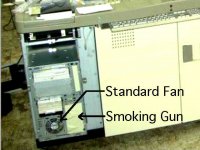
. . . remember that translucent tape I said I'd torn off? There's residue from it in the pics of my case where I removed the indicated patch, but no residue to suggest that the vertical patch was ever applied.
Notice that there's no case cover in evidence in that shot. This is the kind of racked installation I've been envisioning for a case built like this one. Especially so with the extra RFI shielding clips my case has on the side edges, presumably for making contact with the walls in its little metal cage. The clip slots/sockets on the top with matching socket indentations on the bottom had me thinking mobile unit racking.
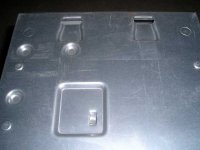
The punched divot in the stamped rectangular recess makes good contact with the top of the PSU housing, Since the PSU is bolted right up to the case for grounding, my guess is that the nubbin sticking down onto the PSU top is for stabilization/vibration damping or summat . . . dunno, guesses?
I found a couple of interesting benefits/features when that x600 drive plate was installed in a possible retirement job for this box.
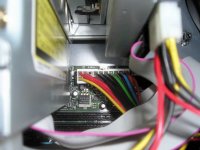
First, it raises the Optical to a level which clears an annoyingly located MOLEX socket for the PSU connection . . .
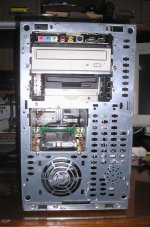
. . . and it effectively turns a three bay config into a four bay config. It doesn't quite fit in its standard plastic mounting, but If I needed it, that I/O panel's PCB would be mounted to the Optical's cover plate so fast its little head would spin and any mounted memory cards or thumb drives would be scattered about.
Better yet, the FDD or Zip still fits fine duct taped onto the Optical up top and there's room for a 3/4 height 5.25" I/O panel underneath. If I were a Video Pro or the Sound Guy for a band this thing would be inside a custom, shock mounted carryall with front/back doors and a storage compartment up top in no time flat. Matter of fact . . .
. . . I may just do that for itsshays-n-igglesgays! :approve:
] ]'>First, the real smoking gun . . .
. . . remember that translucent tape I said I'd torn off? There's residue from it in the pics of my case where I removed the indicated patch, but no residue to suggest that the vertical patch was ever applied.
Notice that there's no case cover in evidence in that shot. This is the kind of racked installation I've been envisioning for a case built like this one. Especially so with the extra RFI shielding clips my case has on the side edges, presumably for making contact with the walls in its little metal cage. The clip slots/sockets on the top with matching socket indentations on the bottom had me thinking mobile unit racking.
The punched divot in the stamped rectangular recess makes good contact with the top of the PSU housing, Since the PSU is bolted right up to the case for grounding, my guess is that the nubbin sticking down onto the PSU top is for stabilization/vibration damping or summat . . . dunno, guesses?
I found a couple of interesting benefits/features when that x600 drive plate was installed in a possible retirement job for this box.
First, it raises the Optical to a level which clears an annoyingly located MOLEX socket for the PSU connection . . .
. . . and it effectively turns a three bay config into a four bay config. It doesn't quite fit in its standard plastic mounting, but If I needed it, that I/O panel's PCB would be mounted to the Optical's cover plate so fast its little head would spin and any mounted memory cards or thumb drives would be scattered about.
Better yet, the FDD or Zip still fits fine duct taped onto the Optical up top and there's room for a 3/4 height 5.25" I/O panel underneath. If I were a Video Pro or the Sound Guy for a band this thing would be inside a custom, shock mounted carryall with front/back doors and a storage compartment up top in no time flat. Matter of fact . . .
. . . I may just do that for itsshays-n-igglesgays! :approve:
In which it's the 68kMLA, so everything that's not a standard ExcelBox is clearly a prototype, and integrated systems are special.
I do wish you'd explain that comment: Snarky, ironic, sarcastic? It certainly failed to budge the witty meter.
The 68kmla is a place where the back stories of Douglas Adam's IIfx and Steve Jobs Apple\\ are held to make them more special by their owners and others than much finer examples of either machine. Prototypes, special editions and oddities are avidly sought and cool vertical market systems for Content Production are highly regarded.
If by this . . .
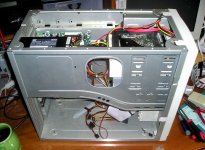
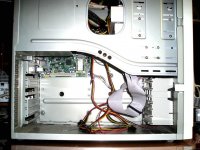
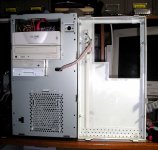
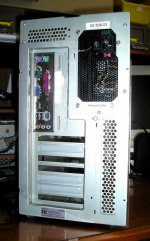
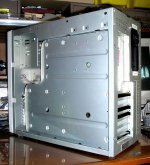
. . . you mean by a "standard ExcelBox," then damn betcha!
That's my notion of any non-plastic, Vanilla Clone sheet metal made after about 1998 and the only thing special about it is the very fine level of industrial engineering that went into its sheet metal for the mass production of sturdy, inexpensive computer cases and it's dimensions happened be exactly what I was searching for a Hack. Jony & the Steve coulda' learned a thing or two from that design team, not that they'd stoop to doing anything that practical, being so busy prettying up some hardware at times less impressive than what wound up in that utilitarian jerry can.
What makes even that particular spice free case special to me is that it's a breeze to stuff it with all kinds of random crap just for the hell of it . . .
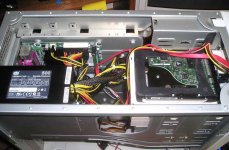
. . . like so.
BTW, I never once claimed my case was a prototype of any kind, see title, it was a question. That question was prompted by finding an Apple logo stamped on the bottom of something installed within a case I bought years ago simply because it was the right width, was odd, interesting because of the crazy mods to the metal casing and it had a look of general usefulness.
Exploring the timelines and possibilities of its having been used for development, possibly even prototyping CHRP was instructional, good exercise for the imagination and a lot of fun, especially gorgonops's good natured, witty and educational snarkism.
If such offends you or any others, mea friggin' culpa . . . :
I had these pictures all prepped for the comparison yesterday, the cases are equally step-stool worthy and inexpensive. They're just constructed according to wildly differing design philosophies.
Enjoy gang. :approve:
The 68kmla is a place where the back stories of Douglas Adam's IIfx and Steve Jobs Apple\\ are held to make them more special by their owners and others than much finer examples of either machine. Prototypes, special editions and oddities are avidly sought and cool vertical market systems for Content Production are highly regarded.
If by this . . .
. . . you mean by a "standard ExcelBox," then damn betcha!
That's my notion of any non-plastic, Vanilla Clone sheet metal made after about 1998 and the only thing special about it is the very fine level of industrial engineering that went into its sheet metal for the mass production of sturdy, inexpensive computer cases and it's dimensions happened be exactly what I was searching for a Hack. Jony & the Steve coulda' learned a thing or two from that design team, not that they'd stoop to doing anything that practical, being so busy prettying up some hardware at times less impressive than what wound up in that utilitarian jerry can.
What makes even that particular spice free case special to me is that it's a breeze to stuff it with all kinds of random crap just for the hell of it . . .
. . . like so.
BTW, I never once claimed my case was a prototype of any kind, see title, it was a question. That question was prompted by finding an Apple logo stamped on the bottom of something installed within a case I bought years ago simply because it was the right width, was odd, interesting because of the crazy mods to the metal casing and it had a look of general usefulness.
Exploring the timelines and possibilities of its having been used for development, possibly even prototyping CHRP was instructional, good exercise for the imagination and a lot of fun, especially gorgonops's good natured, witty and educational snarkism.
If such offends you or any others, mea friggin' culpa . . . :
I had these pictures all prepped for the comparison yesterday, the cases are equally step-stool worthy and inexpensive. They're just constructed according to wildly differing design philosophies.
Enjoy gang. :approve:
I get the search for things like Douglas Adams' IIfx and Jobs' Apple II and prototypes.
It just seems odd that you'd put so much effort and thought into what we found out was a version of a PC case crammed inside a piece of industrial equipment, as though it was anything other than a regular PC running regular software, built into the larger enclosure of a particular piece of machinery (which was probably so easily identified because every town in the USA has at least ten of them scattered around, often in fairly public places and in a job that's not hard to get).
It's a nice case, I don't think anybody will say otherwise. It was just... really strong insistence that it was involved in prototyping that was odd.
It just seems odd that you'd put so much effort and thought into what we found out was a version of a PC case crammed inside a piece of industrial equipment, as though it was anything other than a regular PC running regular software, built into the larger enclosure of a particular piece of machinery (which was probably so easily identified because every town in the USA has at least ten of them scattered around, often in fairly public places and in a job that's not hard to get).
You could have done this with the retail version of this case. Heck, there are new cases out there that have room for all sorts of stuff. This has been standard in the DIY PC market for basically ever.
I was just confused by the continued insistence that it was something special and that it had to have been used for something like CHRP platform development.
It's a nice case, I don't think anybody will say otherwise. It was just... really strong insistence that it was involved in prototyping that was odd.
OK, I see your point, but it was fun! It's an oddball case and I literally begged for someone to dash my flights of fancy . . .
It's a VERY cool case as opposed to the one in the comparison pics. Both are of a size to fit my collection of Radius Clone front bezels, that's why they're here. The taller, more boring one is also the perfect height, but I'm trying to finagle a way to get a small box and pan brake again so I can fab anything I desire once more . . .
. . . but I'd need to sell a lot of other toys and even a small brake is a very large and heavy toy. :-/
It's a VERY cool case as opposed to the one in the comparison pics. Both are of a size to fit my collection of Radius Clone front bezels, that's why they're here. The taller, more boring one is also the perfect height, but I'm trying to finagle a way to get a small box and pan brake again so I can fab anything I desire once more . . .
. . . but I'd need to sell a lot of other toys and even a small brake is a very large and heavy toy. :-/
Let's put it this way, that Corsair case is very nice looking and has the features you'd want for an expensive new MoBo and to look good at a LAN Party, but to me it has no soul, not to mention the $139.00 hole it would put in my finances.
For an outlay of less than $40 for new trinkets, used crap and a CD off the 'Bay, I've had a boatload of fun playing Digital Junkyard Wars for two solid weeks now! Finding out that Apple actually started building quality cases before the love handle series was news to me. I learned a lot about the case my PEx board was intended to fill. It was finding that x600 Drive bay plate in the oddball case which made this tangential thread gravy to the meat and potatoes WinBox hacking I was doing. Added to that was a tasty side order of Atom Board/NetBook Remix fun-n-games while waiting for the Win98 CD to arrive as well.
I'm heading over to that thread again now, Win98 b in d HOUSE! [] ]'>
For an outlay of less than $40 for new trinkets, used crap and a CD off the 'Bay, I've had a boatload of fun playing Digital Junkyard Wars for two solid weeks now! Finding out that Apple actually started building quality cases before the love handle series was news to me. I learned a lot about the case my PEx board was intended to fill. It was finding that x600 Drive bay plate in the oddball case which made this tangential thread gravy to the meat and potatoes WinBox hacking I was doing. Added to that was a tasty side order of Atom Board/NetBook Remix fun-n-games while waiting for the Win98 CD to arrive as well.
I'm heading over to that thread again now, Win98 b in d HOUSE! [
] ]'>"Soul and character."
Also, I agree it's certainly not a cheap way to build a system out of >decade-old parts you've sourced to run a >decade-old operating system. I was pointing it out as the new shining example that funky not-quite-standard cases that have room for a lot of stuff have been standard for a while. (Despite the fact that this is a very new case, on the scene.)
The 7200 and 8600/9600 enclosures, which both migrated to the Beige G3 (although, slightly shorter for the tower) have all been hailed as "pretty great" basically since they were new in 1995 and 1996/1997, and frequently receive the "way better than an 8500" award here on the forum, so it's interesting that somebody on the scene as long as you've been wouldn't have known.
Also, "love handles" cases?
I have a love/loath reaction to gamer cases and pretty cases, even from Apple, have always bothered me somehow. There's no accounting for taste. [] ]'>
I've torn up and tossed a LOT of curb-kickers and "here, you like to mess with computers, see what you can do with this old thing" donations over the last thirty years or so. I've got one of my 19.5x20x9 inch project boxen stuffed to almost overflowing with old motherboards that had some interesting feature or other. Just trying to nest another board with an impressive heat sink on it is like playing with an interlocking wooden puzzle. It's also a voyage of discovery, from "why did I ever keep this" to "what the hell is this Mac board doing in here" and WT . . .
Just learning that Intel's early ATX spec really had mixed ISA/PCI slot provisions was an interesting tidbit that came my way from research for this thread. It's one easy thing to dismiss something out of hand, but it's another thing entirely games of "what if and why not" with BF-109-G<->FlyingVespa pic analogies. Such nonsense can be entertaining and enlightening at the same time, especially with hazy memory brain teasers thrown into the mix. Again, it's that "taste thing."
I've never had, butalways wanted a Drawbridge Case, but that 7200 thing strikes me as a very elegant piece of sheet metal design. But it's almost totally ruined by the clever but incredibly chintzy little breakaway plastic supports and that pair of retention tabs that just don't quite live up to the promise of the overall concept.
Hell, here in the U.S. toy chests are legally required to have better articulation engineering than that very expensive POS, albeit such legislation is meant to protect the priceless operators . . .
. . . but still. :
] ]'>I've torn up and tossed a LOT of curb-kickers and "here, you like to mess with computers, see what you can do with this old thing" donations over the last thirty years or so. I've got one of my 19.5x20x9 inch project boxen stuffed to almost overflowing with old motherboards that had some interesting feature or other. Just trying to nest another board with an impressive heat sink on it is like playing with an interlocking wooden puzzle. It's also a voyage of discovery, from "why did I ever keep this" to "what the hell is this Mac board doing in here" and WT . . .
Just learning that Intel's early ATX spec really had mixed ISA/PCI slot provisions was an interesting tidbit that came my way from research for this thread. It's one easy thing to dismiss something out of hand, but it's another thing entirely games of "what if and why not" with BF-109-G<->FlyingVespa pic analogies. Such nonsense can be entertaining and enlightening at the same time, especially with hazy memory brain teasers thrown into the mix. Again, it's that "taste thing."
You know how they say "seeing is believing," the way my noggin works "seeing is understanding." Verbal/.TXTual comments about something being "way better than the 8500" don't mean much to me. Besides, I've yet to see just about any case for just about any thing that's not way better than that turd. I've kept a bard 9500 chassis around just to laugh at it when I shove the 9600 PSU most of the way into it just to hear the PEx board's startup chimes every now and then. Now that the Plastic PEx drawer is set up, I wonder if I should recycle that thing. It's almost sad when even a plastic drawer from a rolling plastic chest of such for "organizing clutter" a/o closet storage bought at Tarjet is a better, if funkier, case design than that once top of the line 9500 chassis.
I've never had, butalways wanted a Drawbridge Case, but that 7200 thing strikes me as a very elegant piece of sheet metal design. But it's almost totally ruined by the clever but incredibly chintzy little breakaway plastic supports and that pair of retention tabs that just don't quite live up to the promise of the overall concept.
Hell, here in the U.S. toy chests are legally required to have better articulation engineering than that very expensive POS, albeit such legislation is meant to protect the priceless operators . . .
. . . but still. :
You know, the ones with midriff bulge and handles sticking out every which way.
G3 B&W - G4 MDD, probably even G5 - Mac pro, but those are a bit more svelte :lol:
You forgot my favorite GRAPHITE band in the MetallicMac Spectrum . . .
. . . I feel a retro, metallic apple graphic coming up, emoticon time? [}] ]'>
. . . I feel a retro, metallic apple graphic coming up, emoticon time? [}
] ]'>Uhm... An ISA slot has the same case requirements as a PCI slot, IE, the slot cover height, screw location, and the dimensions of the "tail" on the lower end are are all identical; "AT" form-factor cases dating all the way back to the IBM AT (heck, back to the IBM XT, which other than mounting hole locations is essentially the same as the "Baby AT" form factor) have no problem accommodating PCI boards when fitted with a motherboard bearing the slots. The only difference is that when viewed from above (pick up the card by the bracket and hold it so you're looking at the top with bracket facing towards you) an ISA board is mounted "right-handed"-ly on the bracket while a PCI card is "left-handed". This helps guard against someone being stupid enough to try to cram a PCI board into an ISA slot; they can't because the connector won't line up. This is something the case doesn't need to care about and has nothing to do with ATX.
(Not saying that Intel might not have mentioned it in their ATX proposal, but I'm sure they were talking about board-level concerns, not the case.)
Earlier in this discussion I threw out that comment about how sometimes "Cheap/Generic" clone cases are "better" than brand-name cases if your measure for "better" is "ruggedness". Things like Apple's PCI PowerMac cases are exactly what I was talking about. The designs are very clever and ergonomic and whatever but they're complicated composite structures that if damaged (by accident or compromised by ageing of their plastic parts) can come across as shabby and flimsy. By comparison there's not much to go wrong with a simple stamped-and-folded metal chassis as long as the manufacturer didn't skimp too much on the gauge of steel.
Great example of the above: Nicely designed and ergonomic, but also scratch, accident, and crack-prone. (Apple really oversold the durability of those polycarbonate plastic panels and handles.)You know, the ones with midriff bulge and handles sticking out every which way.
Anyway, working further backwards:
Ditto to all this. I have to say, Trash... your enthusiasm is great and all, but...
If you read back over this you're really splitting hairs trying to say you *didn't* claim it was a prototype. In response to every comment saying "it just looks like a regular old PC case to me" you *really* went overboard in trying to find things about it that made it "special", and further insisting that any and all evidence of it being special *could only* translate to it having once lived inside an amazing super-secret computer lab, and, going even further, because it happened to have a mismatched hunk of an Apple case associated with it it obviously *MUST* have been something related to CHRP or something.
(I'm sure you'll reply in the negative, and you may well be telling the truth, but are you absolutely sure *you* didn't shove that tray in there and subsequently forgot about it? You certainly make it sound at least like you've been absolutely swimming in random Mac bits-and-pieces for years, I can't help but think that might be how it ended up in there. You said you bought this thing years ago, right? Shoving the tray in there and forgetting about it is something I might do.)
Extraordinary claims require extraordinary evidence. I guess you can to some degree claim victory in being correct that the case was "special" because it was indeed modified for a specific purpose, but you were so absolutely *specific* in your claims about its specialness that, well... it fails the "reasonability" test.
So, here's the thing: your notion was wrong and you went totally to the mat refusing to believe it. (It's interesting that you can't believe that there might be people on this board who've seen the insides of more generic PCs from that era than you have.) Yes, that Enlight case might be made of sturdier stuff than that cheaper box but I'm sure 99%+ of them ended up as "standard ExcelBox"es too. I had that exact case, just like a few hundred thousand other people did, and, well... it was "born" in late 1999-ish, dual booted Linux and Windows-something (the latter used exclusively for playing Half-Life and other games) and was a completely normal desktop workstation for a few years. I passed it down whole in 2003 to someone who needed a computer, in part because I'd already determined that the case was too cramped/had insufficient cooling to be useful for upgrades much beyond the (overclocked) dual 400mhz Celeron board it housed since new. There's nothing magic about it. At all.
(I recall paying some small premium, $20-$30 or so, to get that Enlight case over the *really generic* case when I bought that Dual Celeron system. That's what some slightly clever drive bays and a couple tenths of a millimetre thicker steel were worth. Not much in the grand scheme of things.)
The manufacturer of those photo-processing machines undoubtedly picked it because it *was* so popular (IE, easily sourced), reasonably well-made, and of the right physical size to fit the space in their machine. It is interesting that the manual for the machine talks about the different specs they packed in there; I wonder if the sideways fan mod was a necessity because they discovered the same thing I did: the case was fine for CPUs up to the Pentium III ballpark but started getting too toasty when fitted with a Pentium IV. Perhaps it was cheaper/easier for them to fab the sideways fan bracket and cut holes then it would have been to find another case to fit the same spot so they stuck with the 7101 even when it wasn't strictly the best choice anymore.
In any case, there's no pixey-dust stuck to that case that's going to grant amazing industrial superpowers to whatever you put in it just because it happened to have a "cooler" purpose than playing endless games of Windows Solitaire in its original incarnation. It's just a chunk of obsolete steel. That would still apply even if it *had* been a prototype of some sort too, I guess, but I suppose bringing that up begs the question... so what if it *had* lived in a lab and had once housed some super-awesome-amazing Quantum SuperDupercooled 128 bit PowerPC CHRP2000 prototype board? Without the provenance to prove it (let alone the amazing super-board itself) you still have nothing. "I bought it from a thrift store in a town that has computer companies in it" doesn't cut it if you're looking for your million dollar lottery winner.
*Snark*
It was fun and all, I guess, but eventually it gets on one's nerves trying to prove a negative. Oh well.
Forgot this:
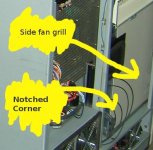
If your case had been installed in the machine by the manufacturer *without* the top I seriously doubt you'd have it now. (How in the world would it have found its way to a reunion with the rest of the case when the PC was stripped out? And also, why would they bother notching the corner if it was never intended to be there anyway? You can see the notch there in this photo; I'm curious what those two cables coming out the notch do, of course, but that's clearly why the notch is there.) That picture of one showing the case without the top is probably a machine in the process of being stripped down. It's missing *all* the skins off the left corner and the case bezel, which should also be there on a complete unit.
As to those "extra" clips, my case had them too. They came in the accessory bag with all the screws, they're merely not installed on the one that's pictured on Newegg. They are indeed probably there to ensure the top gets grounded to the bottom for RFI reasons.
Actually... this comment here? It's actually really a perfect encapsulation of... why this flight of fancy gets a little frustrating. You're extrapolating *way* too far for each little thing you noticed on this hunk of metal, fitting it together in your mind with some pre-boiled concept of what something would have been used for if it had been a prototype (IE, that notch in the case being a "finger hole") or how you would build something if it were you doing it, etc. It's really not clear from this statement if you think that the manufacturer of the machine added the clips to the box and ran it sans-skins so they could also use some particular bump or notch on the chassis as part of its "racking system" and that photo of the machine with the skins on it is wrong, or just saying that's how you'd do it and here's a photo validating your idea. (Despite the overwhelming evidence, a part of which is actually in your hands, that they *didn't* do it that way and that the photo that does show the case sans-skins is a photo of a partially disassembled unit?) It's just a wee bit confounding, I do apologize for sometimes being too slow to distinguish when you're just saying something off the cuff verses asserting something as an actual hypothesis.
Well, there's that other shot that clearly shows that the U-shaped case top *was* used:
If your case had been installed in the machine by the manufacturer *without* the top I seriously doubt you'd have it now. (How in the world would it have found its way to a reunion with the rest of the case when the PC was stripped out? And also, why would they bother notching the corner if it was never intended to be there anyway? You can see the notch there in this photo; I'm curious what those two cables coming out the notch do, of course, but that's clearly why the notch is there.) That picture of one showing the case without the top is probably a machine in the process of being stripped down. It's missing *all* the skins off the left corner and the case bezel, which should also be there on a complete unit.
As to those "extra" clips, my case had them too. They came in the accessory bag with all the screws, they're merely not installed on the one that's pictured on Newegg. They are indeed probably there to ensure the top gets grounded to the bottom for RFI reasons.
Actually... this comment here? It's actually really a perfect encapsulation of... why this flight of fancy gets a little frustrating. You're extrapolating *way* too far for each little thing you noticed on this hunk of metal, fitting it together in your mind with some pre-boiled concept of what something would have been used for if it had been a prototype (IE, that notch in the case being a "finger hole") or how you would build something if it were you doing it, etc. It's really not clear from this statement if you think that the manufacturer of the machine added the clips to the box and ran it sans-skins so they could also use some particular bump or notch on the chassis as part of its "racking system" and that photo of the machine with the skins on it is wrong, or just saying that's how you'd do it and here's a photo validating your idea. (Despite the overwhelming evidence, a part of which is actually in your hands, that they *didn't* do it that way and that the photo that does show the case sans-skins is a photo of a partially disassembled unit?) It's just a wee bit confounding, I do apologize for sometimes being too slow to distinguish when you're just saying something off the cuff verses asserting something as an actual hypothesis.
How about this comeback: you're right! :I
I really thought you were having more fun with it than you apparently were, sorry about that. I'll apologize for such stubborn insistence now, I do come by that honestly. I will mention that I've been a tad manic, hiding in the HackCave™ and more active here even than usual because of a couple of concerns IRL this past week or so. No excuse, maybe a mitigating circumstance?
It's not hard for me to realize or admit that a lot of my comrades here know their stuff where I don't. Heck, I can't imagine there's not something I can learn from every person I meet. Lots of people here have seen a lot of a lot more stuff and know more stuff than than I have or do about all kinds of stuff. That's why I hang out here and I know that sometimes I bring something to the table as well. Thanks to all for the input and I apologize also to those who just told me to stop . . .
. . . but I'm still glad I didn't, I wouldn't have learned all that neat new stuff! ;D
p.s. nope, I couldn't possibly have put it in there. I've never had, nor seen, a case that used that bracket and I remember seeing it in there when I bought the thing. That bracket looks like it belongs bolted up to the case front under casual observation. It was just about the only thing inside that case, the back 80% of that 3.5" Drive magazine clip and the wires connected to the front panel and dust being the exceptions.
I really thought you were having more fun with it than you apparently were, sorry about that. I'll apologize for such stubborn insistence now, I do come by that honestly. I will mention that I've been a tad manic, hiding in the HackCave™ and more active here even than usual because of a couple of concerns IRL this past week or so. No excuse, maybe a mitigating circumstance?
It's not hard for me to realize or admit that a lot of my comrades here know their stuff where I don't. Heck, I can't imagine there's not something I can learn from every person I meet. Lots of people here have seen a lot of a lot more stuff and know more stuff than than I have or do about all kinds of stuff. That's why I hang out here and I know that sometimes I bring something to the table as well. Thanks to all for the input and I apologize also to those who just told me to stop . . .
. . . but I'm still glad I didn't, I wouldn't have learned all that neat new stuff! ;D
p.s. nope, I couldn't possibly have put it in there. I've never had, nor seen, a case that used that bracket and I remember seeing it in there when I bought the thing. That bracket looks like it belongs bolted up to the case front under casual observation. It was just about the only thing inside that case, the back 80% of that 3.5" Drive magazine clip and the wires connected to the front panel and dust being the exceptions.