


Bee Luxe Demo
| Filename | bee-luxe-demo.hqx |
|---|---|
| Size | 1,380.2 KB (1413285 bytes) |
| Downloads | 26 |
Bumbler Bee-Luxe (Demo) is the Info-Mac sampler build of James Hague's 1997 PowerMac arcade shooter from Dadgum Games, in which a lone bumblebee defends its hive from waves of crazed insects. Version 1.0.3 - the demo packaged here - is a maintenance build with updated ordering-screen and documentation copy.
Defend the hive
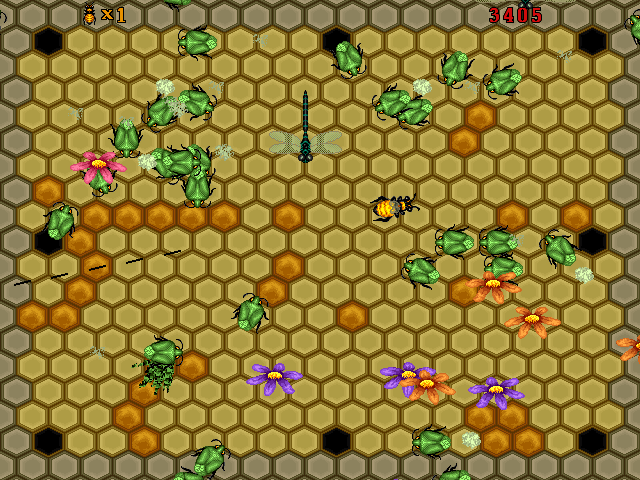
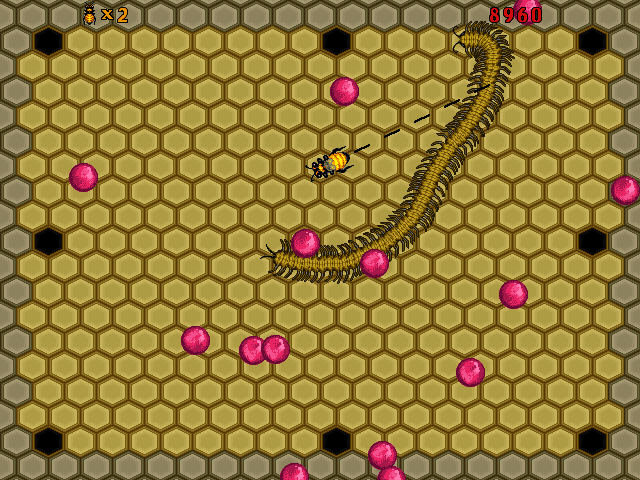
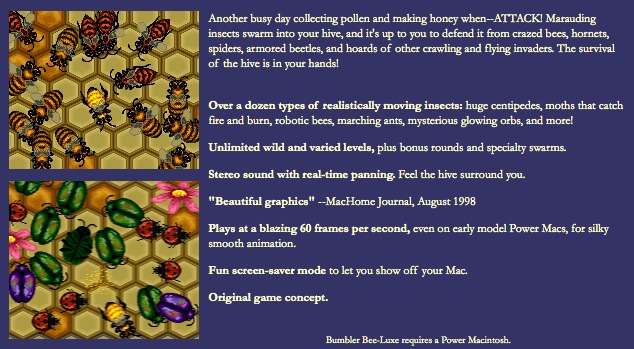
It's another busy day collecting pollen and making honey when marauding insects swarm in. Over a dozen attacker types push toward the hive: huge centipedes, moths that catch fire and burn, deadly hornets, mysterious glowing orbs, marching ants, robotic bees, armoured beetles, and choreographed bonus rounds. The player's bee fires stingers from its rear in a Robotron-style twin-axis defence.
Presentation and engine
Hague wrote the engine in hand-tuned PowerPC assembly to hold a steady 60 frames per second of silky animation - a selling point in 1997 when most Mac shareware was struggling to clear 30 fps. Stereo sound with real-time panning, custom theme music, and a built-in screen-saver mode round out the package.
System requirements
The package requires a Power Macintosh - this is a PPC-only release, with no 68k fallback. Macintosh Garden lists it as compatible with System 7.0 through 7.6 and Mac OS 9, and notes 4.7/5 community reviews from 10 votes.
Provenance
Distributed through Info-Mac under game/com as bee-luxe-demo.hqx, with author contact jhague@dadgum.com. Dadgum Games is James Hague's long-running Mac-shareware label; the original Bumbler was released in 1995 and Bee-Luxe is the deluxe sequel with reworked graphics, new enemies, and the assembly-language engine.
This file is part of the MacTrove archive. See the Thank You page for the upstream mirrors we rely on. It is BinHex encoded — use The Unarchiver to decode it.


