


Blades Of Exile
| Filename | blades-of-exile-101.hqx |
|---|---|
| Size | 4,372.5 KB (4477443 bytes) |
| Mac OS | System 7 |
| Downloads | 22 |
Blades of Exile is a 1997 shareware role-playing game and scenario construction kit from Spiderweb Software, developed by Jeff Vogel as the fourth and final entry in the Exile series. Released for Macintosh in December 1997 (with a Windows port the following February), it pairs the Exile III engine with a full-featured editor for building, sharing, and playing custom adventures.
Setting and story
Where the previous Exile games told a single sprawling tale of refugees in the underworld of Avernum, Blades of Exile reframes the engine as a stage for many small stories. The package ships with three official scenarios: "Valley of Dying Things," a starter mystery in a cursed dale; "A Mild Rebellion," a political adventure among Empire-occupied caves; and "The Za-Khazi Run," a high-difficulty wilderness trek. Beyond those, players load community scenarios that reuse the Exile world or invent entirely new ones.
Gameplay
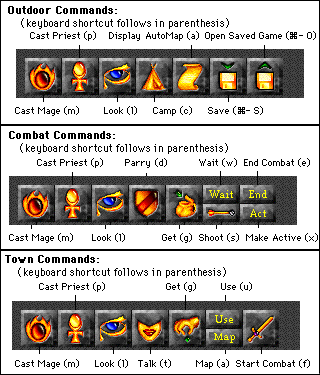
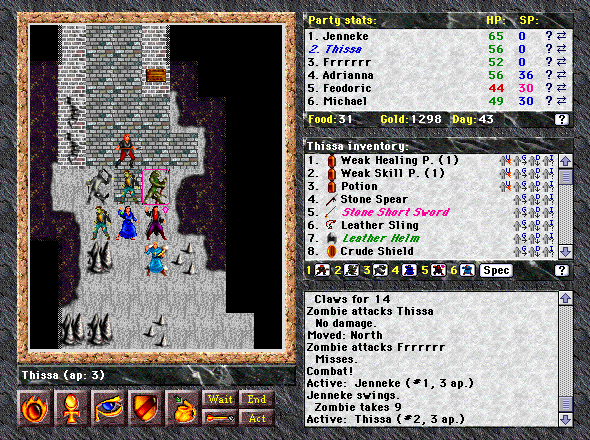
Combat, exploration, and town interaction work exactly as in Exile III: a six-character party moves on a tile grid, switches between outdoor, town, and combat modes, and draws on a deep mage/priest spell list and a pool of customizable skills. The shareware build lets a player finish only the first scenario; registration unlocks the others and any third-party content.
The bundled editor exposes nearly every authoring lever the developers themselves used, including dialog trees, scripted special encounters, custom terrain and items, and full town and outdoor map painting. This made Blades of Exile less a single game than a self-contained RPG construction set.
Engine and technical changes
The engine is a refined Exile III codebase with the original game's automap, improved dialog interface, and 256-color tile art retained intact. New is the scenario file format and a runtime that loads any compliant scenario without recompilation. The Macintosh release runs on System 7 with 256 colors and a 13-inch display, and ships as a fat binary covering 68k and PowerPC machines.
Development and release
Spiderweb shipped Blades of Exile in December 1997 as $30 shareware through its own Spidweb.com store and Info-Mac mirrors, with publisher Diversions Entertainment handling the Windows port released in February 1998. Development reused the Exile III engine almost wholesale; most of the year's work went into the editor, the shipped scenarios, and a documentation set explaining how to use them. Jeff Vogel released the source code in 2007 under the Common Public License, and a community fork (OpenBoE / Blades of Exile remastered) has continued maintenance ever since.
Reception and legacy
Reviewers praised the editor's depth and the variety of community scenarios that quickly followed, with one calling it "the best shareware role-playing title on the market." Criticism focused on the aging tile graphics and the repetitive turn-based combat inherited from Exile III.
The lasting legacy is the scenario library: hundreds of fan-made adventures appeared over the next decade, and the open-source release in 2007 ensured that both the editor and the runtime would survive every Mac OS transition. It remains the canonical example of a Spiderweb engine repurposed as a community toolkit.
This file is part of the MacTrove archive. See the Thank You page for the upstream mirrors we rely on. It is BinHex encoded — use The Unarchiver to decode it.


