

Colibricks
| Filename | colibricks-152.hqx |
|---|---|
| Size | 2,763.9 KB (2830261 bytes) |
| Mac OS | Mac OS 8Mac OS X |
| Architecture | PowerPC |
| Downloads | 19 |
Colibricks is a brick-breaking arcade game for the Macintosh by Michel Colman, shipped in a 1.5.2 build that runs natively on Mac OS X 10.3 while also bundling a Mac OS 8/9 binary. The hook is physics: rather than the loose simulation common to Breakout clones, Colibricks models balls with precise physical laws, including accurate corner bounces and ball-on-ball collisions.
Gameplay
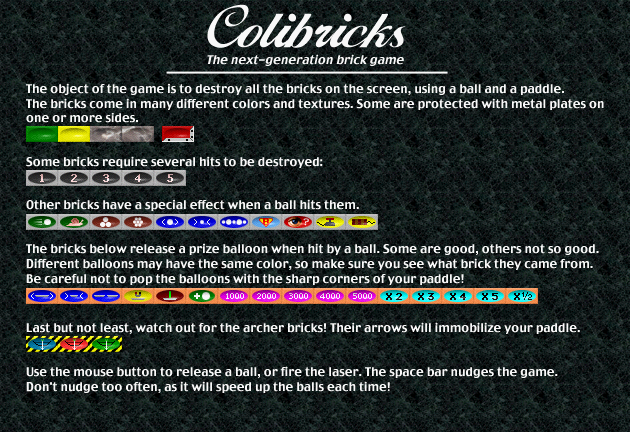
The goal is the genre staple, destroy every brick on the screen using one or more balls, but Colibricks varies the formula by rotating bricks at arbitrary angles and arranging them into circles, spirals, and other shapes instead of strict horizontal grids. Special bricks trigger effects or release prize balloons, and balls themselves can grow or shrink to any size during play.
Presentation
Graphics are antialiased and laid over detailed background images, giving the game a softer look than typical pixel-grid brick games of the period. The 1.5.2 release notes also fix a rare bug involving JPEG pictures used in custom levels.
Demo and registration
The free demo unlocks six levels of varying difficulty. Registering grants access to the full set of fifty levels and enables the bundled level editor, letting players design and share their own boards.
System requirements
Colibricks asks for a PowerPC processor running at 200 MHz or faster, which covers any iMac of the era, plus Mac OS 8, 9, or X and an installed copy of QuickTime.
Author and contact
Michel Colman released the game as shareware and lists michelcolman@mac.com as the contact address in the Info-Mac submission for version 1.5.2.

This file is part of the MacTrove archive. See the Thank You page for the upstream mirrors we rely on. It is BinHex encoded — use The Unarchiver to decode it.


