
Space Invaders
| Filename | space-invaders-30r2-osx.hqx |
|---|---|
| Size | 3,043.0 KB (3116028 bytes) |
| Year | 2004 |
| Mac OS | Mac OS X |
| Architecture | Mac OS X |
| Downloads | 22 |
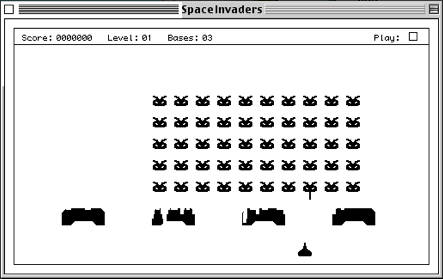
Space Invaders for the Macintosh is an early 1985 freeware port of Tomohiro Nishikado's seminal 1978 Taito arcade shooter, built with the Rascal Development System and tuned to the original 128K/512K Mac's monochrome screen and one-button mouse for a faithful, fast-running take on the genre-defining alien shoot 'em up.
Gameplay
The player slides a laser cannon along the bottom of the screen and fires upward at a descending grid of alien invaders, hiding behind degradable bunkers as the swarm accelerates with each kill. A bonus mystery ship occasionally streaks across the top, and clearing a wave summons a new, faster formation in classic endless-arcade fashion.
Engine
This port was written using the Rascal Development System, an early Mac-native programming environment, and uses the mouse for ship movement and clicks for firing rather than keyboard controls. The build targets the original 68k Macintosh; on later Mac OS 9 systems it runs noticeably too fast and is best emulated under Mini vMac at 1980s clock speeds.
Setting
The original arcade title was inspired by The War of the Worlds and Star Wars, with Nishikado spending roughly a year designing custom Intel 8080-based hardware for Taito. The aliens' famously increasing speed was originally a side effect of the hardware drawing fewer sprites faster, a limitation that became a defining gameplay mechanic.
Reception
The 1978 arcade original grossed roughly $3.8 billion by 1982 and is credited with launching the shoot 'em up genre and inspiring a generation of designers including Shigeru Miyamoto and John Romero. Mac shareware ports like this one helped bring the experience to early Macintosh owners during the platform's first software boom.
This file is part of the MacTrove archive. See the Thank You page for the upstream mirrors we rely on. It is BinHex encoded — use The Unarchiver to decode it.


