

Boogalooper
| Filename | boogalooper-12.hqx |
|---|---|
| Size | 2,492.3 KB (2552088 bytes) |
| Mac OS | Mac OS X |
| Architecture | PowerPC |
| Downloads | 17 |
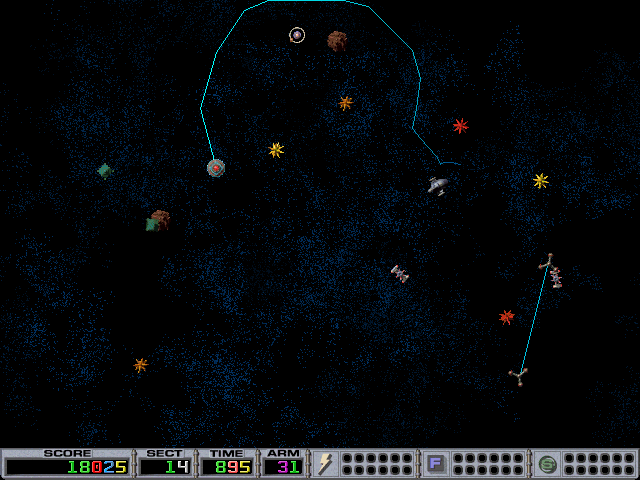
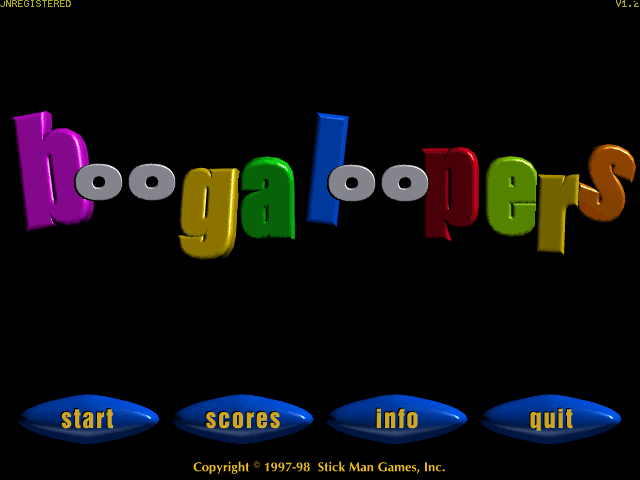
Boogalooper (Boogaloopers v1.2) is a 1997 Stick Man Games arcade title for Power Macintosh in which the player loops a tether around drifting energy balls called Boogas to clear them from the Void. The mechanic is a Mac-shareware spin on Atari's rare 1982 vector arcade game Quantum.
Premise
The Void sits between the matter and anti-matter universes, keeping them from annihilating each other. Its constant churning produces clusters of energy called Boogas, and if too many gather in one sector they punch a rift in the Void and collapse it. The player is the boogalooper, half cosmic protector and half janitor, tasked with sweeping the sectors clean.
Gameplay
Instead of shooting, the player drags a closed loop around groups of Boogas to detonate them, with bigger captured groups paying out larger scores. The hostile Spaztix and Rat Bassards interfere; collisions chip away at armor while clean clears restore it. The game runs at a smooth 20 fps with eleven different Void denizens across unlimited procedurally extended levels.
Heritage
Boogaloopers is a direct homage to Atari's Quantum (1982), an obscure trackball arcade game that used the same enclose-the-particles loop mechanic. It was later re-released by Monkey Byte as version 2.0, keeping the original Stick Man Games design intact.
Requirements
Power Macintosh (PowerPC 601 at 60 MHz minimum), 4 MB free RAM, 3 MB hard disk, 640x480 display at 256 colors, Mac OS 7.5.3 or later, and QuickTime 2.5 or later. The 1.2 update bundles minor performance tweaks and bug fixes over the initial release.
This file is part of the MacTrove archive. See the Thank You page for the upstream mirrors we rely on. It is BinHex encoded — use The Unarchiver to decode it.


