

Bub And Bob
| Filename | bub-and-bob-10.hqx |
|---|---|
| Size | 2,218.7 KB (2271928 bytes) |
| Architecture | 68K |
| Downloads | 19 |
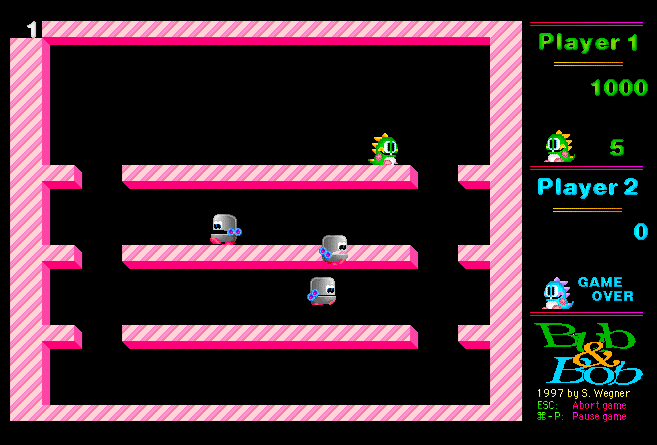
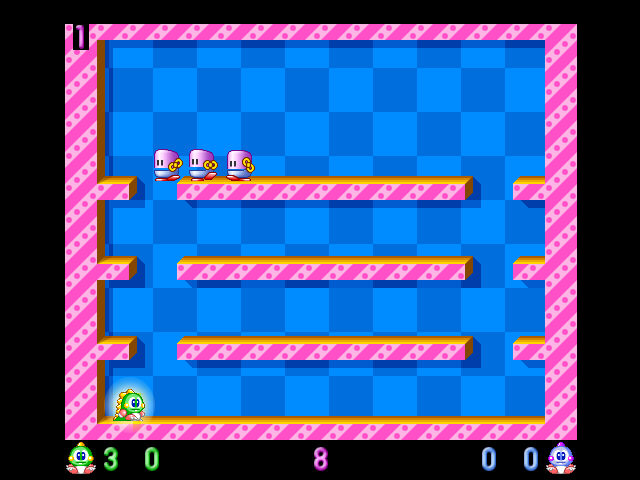
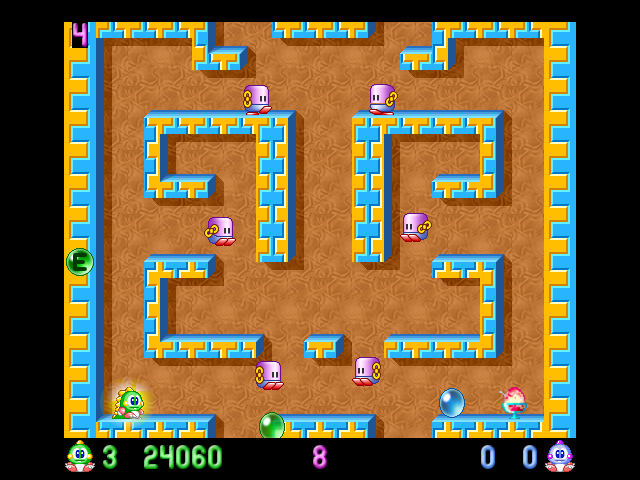
Bub & Bob is a 1997 shareware Bubble Bobble clone for the Classic Mac OS, written by Sebastian Wegner (Mcsebi) using the Sprite Animation Toolkit. One or two players control cute bubble-blowing dragons across single-screen platform stages, trapping enemies in bubbles and bursting them for points.
Gameplay
Each level is a single screen of platforms populated with baddies. Blow a bubble to trap an enemy, then jump on or burst the bubble to defeat it and drop fruit or gems for bonus points. Cooperative two-player simultaneous play is supported on a single Mac, faithful to the original Taito arcade design.
Versions
The line spans three siblings preserved on Macintosh Garden. Bub & Bob 1.7.3 is the original 68k/PPC build for Mac OS 8 through 9.2.2. Bub & Bob 2 (v0.981) is a Carbonized rewrite with 100 levels, online high scores, and a level editor. Bub & Bob X is the OS X-native continuation. The Info-Mac copy here is the early shareware release of the first game.
Shareware terms
The unregistered build of Bub & Bob 2 limits play to 8 levels and disables save and custom-level loading; full registration was $20 USD and unlocked all 100 levels plus the editor. Earlier Bub & Bob 1.x followed the same shareware model on a smaller scale.
System requirements
The original asks for at least a 68040 Mac with about 4.2 MB of free RAM. Bub & Bob 2 raises the bar to a 200 MHz Power Macintosh (G3 recommended), 60 MB free RAM, Mac OS 8.6/9.x or Mac OS X 10.3+, CarbonLib 1.2 on classic, and QuickTime 4 or later.
This file is part of the MacTrove archive. See the Thank You page for the upstream mirrors we rely on. It is BinHex encoded — use The Unarchiver to decode it.


