


Sloppy Sokoban
| Filename | sloppy-sokoban-17.hqx |
|---|---|
| Size | 6,765.3 KB (6927675 bytes) |
| Mac OS | Mac OS X |
| Downloads | 16 |
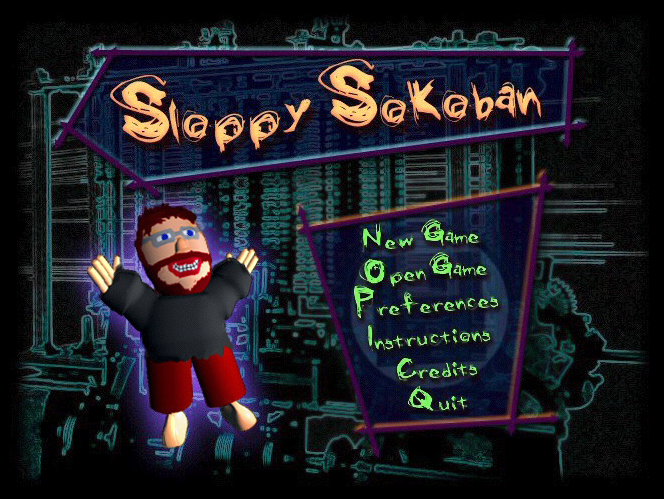
Published by SloppyDisk Software around 2000, Sloppy Sokoban is a Macintosh implementation of Hiroyuki Imabayashi's 1982 Sokoban warehouse-puzzle game, distinguished by hand-drawn animated tiles, a jazz MP3 score, and a deep stack of bundled level packs. Versions through 1.7 added hundreds of new puzzles and graphical improvements.
Setting and theme
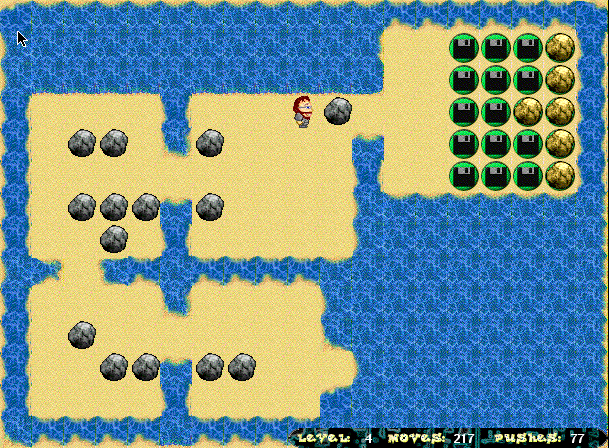
Like every Sokoban descendant, the game frames each puzzle as a top-down warehouse: the player controls a worker who must shove crates onto target tiles. Sloppy Sokoban dresses the formula in cheerful, illustrated tilesets and an upbeat soundtrack rather than the spartan look of earlier ports, giving each level pack its own visual identity.
Gameplay
The fundamental rule is unchanged from the 1982 original: crates can only be pushed, never pulled, and a level fails if any crate becomes wedged in a corner where it cannot reach a target. Sloppy Sokoban ships with fifty built-in levels and fourteen extra level-sets totalling several hundred puzzles, plus support for custom packs.
Quality-of-life features include keyboard or point-and-click control, multiple selectable tilesets, and an undo/redo buffer of up to 10,001 steps so that exploratory play is genuinely cheap.
Engine and technical changes
Sloppy Sokoban targets PowerPC Macs running Mac OS 8.1 or later, with CarbonLib 1.1 or later for compatibility into Mac OS X, and a minimum of 4 MB free memory. The engine adds MP3 playback for the original score, plus a statistics screen and smoother sprite animation introduced with the 1.7 update.
Development and release
The author marketed the game from sloppydisk.com and hosted it on Tucows and the Macintosh Garden as shareware. The 1.7 release, covered by The Mac Observer, brought roughly 300 new levels, refreshed graphics, a statistics dashboard, and a soundtrack contributed by a friend studying jazz piano at Rutgers.
This file is part of the MacTrove archive. See the Thank You page for the upstream mirrors we rely on. It is BinHex encoded — use The Unarchiver to decode it.


