

Marathon 2
| Filename | Marathon2_1996.sit |
|---|---|
| Size | 40,928.8 KB (41911047 bytes) |
| Year | 1994 |
| Developer | Bungie |
| Downloads | 30 |
Bungie's November 1995 first-person shooter takes the rogue AI Durandal and his liberated S'pht army to Lh'owon, the sun-bleached ruins of an alien homeworld. You fight the slave-driving Pfhor across open outdoor levels with swimmable lava, a new shotgun, and the multiplayer modes — King of the Hill, Kill the Man with the Ball — that would later seed Halo's design.
Setting and story
Seventeen years after the events of the first Marathon, the AI Durandal — now operating his own captured Pfhor warship — drops a strike force of human colonists onto Lh'owon, the homeworld of the enslaved S'pht race. The cover story is archaeological: search the ruins for a rumored "lost tribe," the technologically advanced S'pht'Kr. The actual goal is Durandal's own: find a way out of a universe he believes is running down toward heat death.
You are again the unnamed security officer from the first game, and again largely a puppet. Durandal manipulates everyone — the S'pht, the player, his counterpart Tycho corrupted by the Pfhor, even the dormant ancient AI Thoth buried under the planet. The campaign builds toward rallying the S'pht'Kr fleet to obliterate the Pfhor before they can detonate Lh'owon's star.
Gameplay
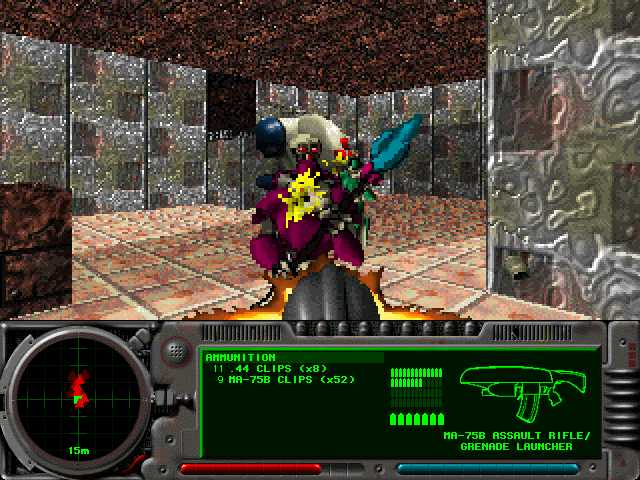
The shift from cramped ship interiors to vast outdoor environments was the most-felt change at release. Levels are physically larger, brighter, and faster-paced. Combat is more open and more lethal; ammo economy and shotgun fire reshape the encounter design.
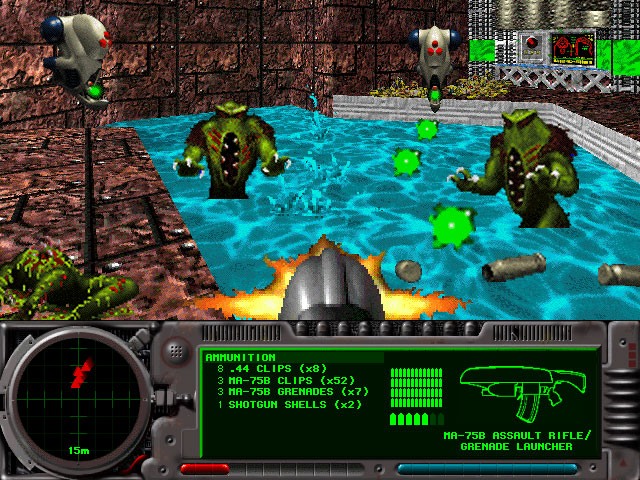
The standout system is liquid media. Water, lava, sewage, and the alien "goo" all behave differently — some let you swim and breathe, some cook you, some drown you on a timer — and most levels build at least one fight or puzzle around them. Computer terminals, the series' signature lore-delivery mechanic, no longer pause the action while you read.
Multiplayer expanded sharply: King of the Hill, Tag, Kill the Man with the Ball, and a dedicated cooperative mode supporting up to eight players over LAN. The map editor Forge and the physics/shapes editor Anvil made user-generated content first-class.
Engine and technical changes
The engine is an evolution of the original Marathon renderer, now with deeper color, better lighting, and external file loading so users could swap maps, sounds, shapes, and physics models without recompiling. Bungie shipped Mac and Windows 95 builds, and an Apple Pippin port followed in Japan. Years later, Freeverse developed an Xbox Live Arcade port with split-screen and online co-op.
Development and release
Bungie released Marathon 2 in November 1995 on Mac, with the Windows 95 conversion arriving in 1996 — Bungie's first cross-platform release of a Marathon title. In January 2000, shortly before being acquired by Microsoft, Bungie released the source code, which became the foundation of the Aleph One open-source engine still used to play the trilogy on modern systems. The full Marathon trilogy was released as freeware in 2005.
Reception and legacy
Reviews at launch were strongly positive — MacUser called it "probably the best first-person gore-fest ever" — and the consensus was that the sequel was meaningfully superior to the original. Lifetime sales were under 200,000 units by 2002, modest by FPS standards but typical for a Mac-first title in the pre-crossplatform era.
The engine was licensed to three other commercial games (ZPC, Prime Target, Damage Incorporated). The "Kill the Man with the Ball" mode is the direct ancestor of Halo's Oddball, and the broader template — heavy AI-driven storytelling delivered through environmental terminals, networked co-op as a first-class mode — recurs across Bungie's later work.
Original Source: macgarden
This file is part of the MacTrove archive. See the Thank You page for the upstream mirrors we rely on. It is a StuffIt/Compact Pro archive. Use The Unarchiver to extract it.


