
Prince of Persia
| Filename | Prince_Of_Persia.SIT |
|---|---|
| Size | 1,397.6 KB (1431097 bytes) |
| Year | 1990 |
| Mac OS | System 7 |
| Architecture | 68K |
| Downloads | 22 |
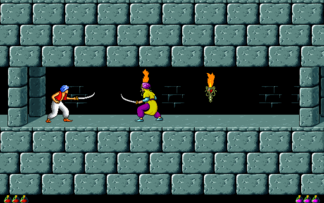
Jordan Mechner's 1989 cinematic platformer, ported to the Mac by Presage Software for Brøderbund, gives the player sixty real-time minutes to fight through twelve levels of a Persian palace, rescue the Sultan's daughter, and run the vizier Jaffar through. Its rotoscoped animation — traced from film of Mechner's brother in white clothes — set the template for fluid character motion that Another World and Tomb Raider would later inherit.
Setting and story
The Sultan is away at war. His grand vizier Jaffar has imprisoned the Sultan's daughter and given her one hour to marry him or die. The unnamed protagonist, her lover, wakes in the dungeons beneath the palace and must climb to the throne room before the clock runs out. The story is told almost entirely in one-line interstitials between levels; the rest is choreography.
Gameplay
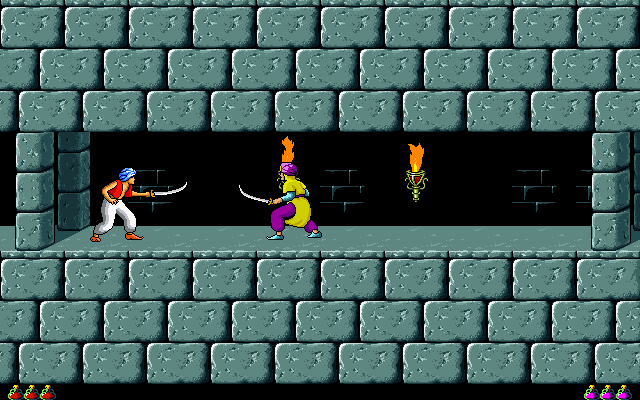
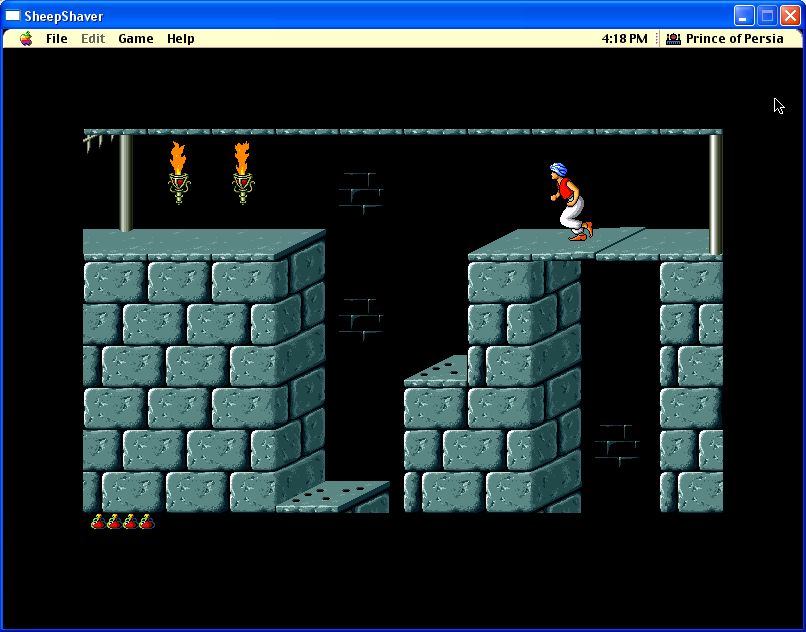
Each level is a side-on grid of stone corridors, spike pits, falling floors, slicing blades, and patrolling guards. Movement is committed and momentum-based — a hesitation at the edge of a tile means a long fall — and swordfights are turn-by-turn parry-and-thrust duels rather than button-mashing. Health potions restore wounds; a mirror puzzle in level four spawns a doppelganger whose defeat is itself the solution.
Engine and technical changes
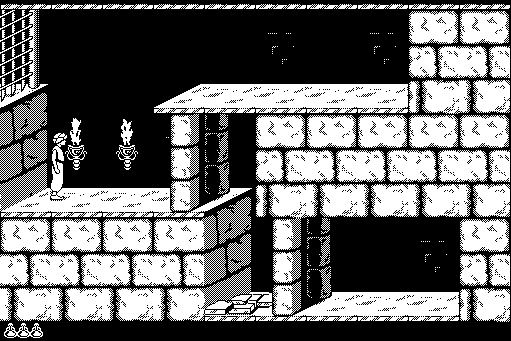
Mechner rotoscoped his younger brother David performing leaps and hangs to drive the player animation, and studied the Errol Flynn / Basil Rathbone duel from The Adventures of Robin Hood for the swordwork. Presage's Mac port from the Apple II original delivered higher-resolution graphics and digitized sound; The New York Times in 1992 singled out the Mac version's visuals as "brilliant" and its audio as "excellent."
Development and release
Mechner shipped the Apple II original in October 1989 after roughly three years of solo work documented in his published journals. Brøderbund commissioned ports across nearly every platform of the era — DOS, Amiga, Atari ST, NES, Game Boy, Genesis, SNES, and the Mac — through the early 1990s. The Mac edition is a faithful translation of the Apple II level design with native QuickDraw rendering.
Reception and legacy
North American sales were modest at first — about 7,000 copies on each of Apple II and IBM PC by mid-1990 — but the game became a hit overseas, eventually clearing 2 million units across all formats. It is widely credited with founding the cinematic platformer subgenre, and Ubisoft's 2003 reboot The Sands of Time brought the series back into the mainstream. The original Apple II source code, lost for decades, was famously recovered from Mechner's father's attic in 2012.
This file is part of the MacTrove archive. See the Thank You page for the upstream mirrors we rely on. You may need The Unarchiver or a classic Mac emulator to open it.


