The Manhole
| Filename | Manhole.SIT |
|---|---|
| Size | 2,343.8 KB (2400000 bytes) |
| Year | 1988 |
| Mac OS | System 7 |
| Architecture | 68K |
| Downloads | 24 |
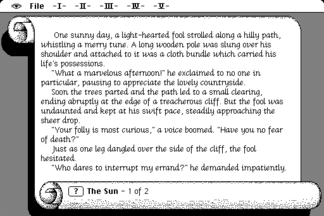
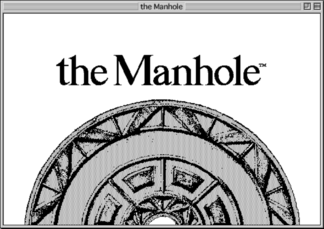
The Manhole is an open-ended children's adventure created by Rand and Robyn Miller at Cyan, Inc. and released in November 1988 for the black-and-white Macintosh. Built entirely in HyperCard with HyperTalk, it lets players lift a manhole cover and wander a beanstalk-fed world of whimsical locales. It is the foundational Cyan title that led to Spelunx and Myst.
A HyperCard Adventure Without Goals
The Manhole has no score, no inventory, and no win state. Players click their way through hand-drawn rooms connected by gentle, dreamlike transitions, meeting talking animals and oddball inhabitants. The Millers built every screen and every interaction inside HyperCard stacks, treating the program more as an explorable storybook than a puzzle game.
The Cyan Lineage
The Manhole is the first commercial Cyan title and a direct ancestor of Cosmic Osmo (1989), Spelunx (1991), and Myst (1993). Its node-based navigation, ambient soundscapes, and embrace of exploration over challenge became the design language Cyan would refine into one of the best-selling computer games of the 1990s.
The 1989 CD-ROM Milestone
In 1989 Activision repackaged The Manhole as the first entertainment title shipped on CD-ROM for personal computers, predating broad consumer CD-ROM adoption by years. The 1995 Masterpiece Edition added color graphics, voice acting, music, and new 3D-rendered scenes by Chuck Carter using StrataVision 3D.
Recognition
The Manhole won the Software Publishers Association Excellence in Software Award in 1989 and was praised by Macworld for its inventive use of sound and HyperCard's then-novel multimedia capabilities.
This file is part of the MacTrove archive. See the Thank You page for the upstream mirrors we rely on. You may need The Unarchiver or a classic Mac emulator to open it.