
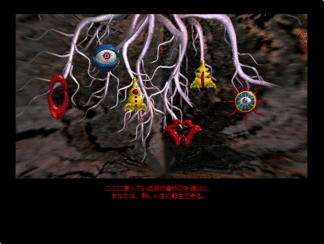
Eastern Mind: The Lost Souls of Tong Nou
| Filename | easternmind_mac_english_iso.zip |
|---|---|
| Size | 299,609.4 KB (306800000 bytes) |
| Year | 1994 |
| Mac OS | System 7 |
| Architecture | 68K |
| Downloads | 34 |
Osamu Sato's 1994 first-person point-and-click adventure, published by Sony Music Entertainment Japan, casts the player as Rin on the soul-eating island of Tong Nou, a landmass shaped like a human head modeled on Sato's own. Borrowing an artificial soul good for 49 days, Rin must complete nine missions, dying and reincarnating as different creatures along the way.
Setting and story
Tong Nou's geography is anatomical: locations are entered through the giant head's mouth, ears, eyes, and nostrils, each leading into surreal painted corridors styled after Sato's airbrushed CG art. The framework draws on Sato's Buddhist beliefs in transmigration, treating death not as a fail state but as the engine that pushes Rin through his nine lives.
Gameplay
The interface is sparse: click to move, click to act, choose dialogue or ritual responses that determine who or what Rin reincarnates as next. Puzzles are deliberately illogical by Western adventure standards, leaning on intuition and ritual rather than inventory chains. There is no voice acting; all dialogue appears as on-screen subtitles.
Engine and technical changes
The game was built in Macromedia Director rather than a bespoke engine, which Sato considered fitting for a project he framed as an interactive CD-ROM artwork rather than a video game. The Mac build is a 68k application targeting System 7.0-7.6 (and runnable under Mac OS 9), 256 colors, with techno-house score loops drawn from Sato's parallel career as an electronic musician.
Development and release
Sato won Sony Music Japan's 1993 Digital Entertainment Program Grand Prix, which funded a four-person team including his wife and co-writer Hiroko Nishikawa. The original Macintosh release shipped in Japan on May 21, 1994; a Windows port and re-release followed October 21, 1995, and Sony Imagesoft brought both platforms to North America in December 1995.
Reception and legacy
Contemporary reviews split along cultural lines: Wired celebrated its surrealism while Next Generation awarded two stars for opacity. Hardcore Gaming 101 and later Vice reappraised it as a key work of 1990s art-game CD-ROM. ScummVM support and a 2010s vaporwave-era rediscovery cemented its cult status alongside Sato's LSD: Dream Emulator.
This file is part of the MacTrove archive. See the Thank You page for the upstream mirrors we rely on. You may need The Unarchiver or a classic Mac emulator to open it.


