

Thread
PowerBook Duo battery replacement
This could apply to any of the Duos but I will be specifically concerned with the 2300 so that's what I shall discuss.
I will need to replace the internal batteries on two battery packs, so I will probably take pictures and provide useful information, and also ask before I do it for any pointers.
First I had to look up what kind of battery it was. The 2300 uses a ...let's search, shall we? the answer is elusive.
Anything here? No, that is for Type I batteries. But there's a link -- and it's dead. The WayBack Machine has it though, albeit with a few pictures missing. Here's one image that somehow managed to barely slip through:
http://web.archive.org/web/20041206083657/http://www.fastlight.demon.co.uk/jg/duo1.jpg (give it a second to load)
Okay. None of those links tell me what kind of battery it is, and the last Duo battery guide was for Type II cells, not Type III. But it does say "4/5 A" size cells.
I figured they'd be 18650s, but this link says they are not. "4/5 AF size NiMH cells" just so happen to be close to "4/3" 18650s according to Google. Is it a typo? And what's the original capacity? No idea. Obviously for a replacement we like to crank up the capacity because more mAh equals more runtime. But the internal battery circuitry won't properly display the remaining percentage because it's likely that in 1995 they didn't have 18650s with as high mAh as they do today. Or 4/5 AF size NiMHs.
Or do they? 2000 mAh. Sure they're not these? 4200 mAh for the win. If that's the size.
I'll come back on this later once the Duo is in my hands and the batteries undergo heart surgery under the hands of an untrained...chemist.
I will need to replace the internal batteries on two battery packs, so I will probably take pictures and provide useful information, and also ask before I do it for any pointers.
First I had to look up what kind of battery it was. The 2300 uses a ...let's search, shall we? the answer is elusive.
Anything here? No, that is for Type I batteries. But there's a link -- and it's dead. The WayBack Machine has it though, albeit with a few pictures missing. Here's one image that somehow managed to barely slip through:
http://web.archive.org/web/20041206083657/http://www.fastlight.demon.co.uk/jg/duo1.jpg (give it a second to load)
Okay. None of those links tell me what kind of battery it is, and the last Duo battery guide was for Type II cells, not Type III. But it does say "4/5 A" size cells.
I figured they'd be 18650s, but this link says they are not. "4/5 AF size NiMH cells" just so happen to be close to "4/3" 18650s according to Google. Is it a typo? And what's the original capacity? No idea. Obviously for a replacement we like to crank up the capacity because more mAh equals more runtime. But the internal battery circuitry won't properly display the remaining percentage because it's likely that in 1995 they didn't have 18650s with as high mAh as they do today. Or 4/5 AF size NiMHs.
Or do they? 2000 mAh. Sure they're not these? 4200 mAh for the win. If that's the size.
I'll come back on this later once the Duo is in my hands and the batteries undergo heart surgery under the hands of an untrained...chemist.
They are, as i recall, tabbed 4/5AA NiMh cells, and any you find are probably not going to be far from the original capacity of the first cells in the machine. They are also reasonably hard to find.
I have done it, but the batteries seem to get damaged by soldering and don't seem to last more than a year or so.
I have done it, but the batteries seem to get damaged by soldering and don't seem to last more than a year or so.
I had found a link for a place selling the 4/5AA cells. I'll see if I can find it in my old posts. (moved machines, lost my books marks... xx( )
I have a theory that it should be possible simply to use standard AAA cells in two or more battery holders with fuses etc. suitably located between the holders. You'd get the same capacity battery, roughly, as the original, it would fit in the Duo battery case with room to spare, and you would not need to torture the cells themselves by direct soldering. Just add some padding to keep things from rattling around and you'd be good to go.
Speaking from experience, the most difficult thing about replacing the original cells with the same sized cells is getting the thing back together and into the machine. It is nearly impossible to keep your work as compact as was the original.
Speaking from experience, the most difficult thing about replacing the original cells with the same sized cells is getting the thing back together and into the machine. It is nearly impossible to keep your work as compact as was the original.
I'd like to figure out a way to use modern technology cells to re-cell the standard battery case for use with an external charging system. IIRC, that's be a direct parallel to the way 3400 owners used Kanga batteries with external chargers.
That's a murky one though, I think I only read about it once somewhere or other, could be a different cast of characters.
That's a murky one though, I think I only read about it once somewhere or other, could be a different cast of characters.
I think I missed something, but wouldn't newer cells (rechargeable of course) charge inside the duo the same as the originals?
Also, I believe the battery is "rated" at 12 volts. However, looking at Battery Amnesia shows that it actually runs more like between 14-15 volts coming from the battery. Once it actually hits 12 volts, the system shuts down. (This is all from memory since my nice MC-T4 has stopped working...**) It is also funny, that with a battery & charger it reads 19-20 volts. I'm not sure the system could handle that voltage, so I fear Battery Amnesia may be a (good) bit off.
Either way, as is common with batteries, it would be worth considering going a volt or two over 12 for your end voltage with the above cut-off in mind. (It appears to cut out at <12.5 regardless of your remain amperage.)
**Dead... and I mean dead. Even the Lind Super Charger II can't get any life out of it. xx(
Also, on the subject of MC-T4s.
I'm going to go grab my disassembled Type III and see if I can't gleam any info off the cells.
EDIT- Anyone know what the 3 middle leads on the battery go to? The - & + are just that, but I'm not sure on the others.
You mean like packing super high capacity Lithium batteries inside and charge it externally?
I would hope the replacements work the same as the original.
The factories likely use resistance welding to "flash weld" the tabs to the batteries and probably a similar process for soldering the wires down. (Kinda like TIG welding stainless: bare minimum heat input)
I suppose I could submerge the batteries in water with the very tips poking out. Might help to flux the joint, but I don't have any of that. It'd be also nice to know the material involved (ie nickel plated _______).
Soldering is a bit like brazing, silver soldering or anything oxyfuel involved: massive heat all over the place. What we need is something very concentrated like a resistance welder (pretty much only in manufacturing places) or TIG. Crank a TIG welder down to the single digit amperage range? :-/
Exactly, I can't research it until tonight, but i believe the Kanga used battery technology that needed "more intelligent" charging circuitry and sensors in the battery itself . . . to avoid explosive situations . . . the 3400's MoBo lacked such circuitry, but, as I said, I'm going on a very hazy memory
Me too, but just when they're in the Duo!
 )
)
Well i have a 3400 with its original lithium battery. It has a LED meter on the side. that indicates the current level of charge. So its a smart battery with an onboard microcontroller and charge circuit? Regardless the battery still holds near a full charge. Runs for a little over an hour on its original batt.
First of all, Type I, II and III Duo batteries all take the same cells. And yes, they are 4/5A, NiMHs, tabbed.
Define: Same.
Same type as in Lithium vs. NiMH or same voltage & amperage?
If the latter (meaning the same amperage which usually equates to runtime), how did the various types of batteries get different run times?
Dunno, but, as an educated guess:
Same cell technology type, same voltage and amperage on the pack's connectors, so that they're interchangeable, but probably better AMP/Hour ratings as newer, higher capacity cells became available. This was very likely done in sync with each rev of the Duo System, yielding a close approximation of the same Battery life for each generation.
For definitive answers, I'd check out the original Duo System DevNote/Service Source, the 250/270c/280x Devnotes/Service Sources and finally the 2300c Docs as well.

Same cell technology type, same voltage and amperage on the pack's connectors, so that they're interchangeable, but probably better AMP/Hour ratings as newer, higher capacity cells became available. This was very likely done in sync with each rev of the Duo System, yielding a close approximation of the same Battery life for each generation.
For definitive answers, I'd check out the original Duo System DevNote/Service Source, the 250/270c/280x Devnotes/Service Sources and finally the 2300c Docs as well.
The Type3 battery is definately different *somehow* from the earlier ones.
You take your basic Dead-as-a-Doornail Type1 or Type2 and put in in your Duo. No problem... just no battery life.
The Type3, though, had this ability to be discharged so low that when you put it in a Duo, it would actually refuse to power on and would hard shutoff if you tried to hotswap the battery in. The only alternative was to somehow trickle charge the Type3 to a minimum point where the normal charging circuitry would kick in. The Lind Supercharger II came in handy about then. (BTW, I still have mine, but really don't plan to make use of it anymore with my one and only Duo. Feel free to make me interesting offers.
My guess is that the Type3 is an early "intelligent" battery. At the very least, I suspect that it included some safeguards to prevent overcharging and protect the computer's charging circuit. (IIRC, the Duo charger actually needed a firmware update for the Type3.)
JR
You take your basic Dead-as-a-Doornail Type1 or Type2 and put in in your Duo. No problem... just no battery life.
The Type3, though, had this ability to be discharged so low that when you put it in a Duo, it would actually refuse to power on and would hard shutoff if you tried to hotswap the battery in. The only alternative was to somehow trickle charge the Type3 to a minimum point where the normal charging circuitry would kick in. The Lind Supercharger II came in handy about then. (BTW, I still have mine, but really don't plan to make use of it anymore with my one and only Duo. Feel free to make me interesting offers.
My guess is that the Type3 is an early "intelligent" battery. At the very least, I suspect that it included some safeguards to prevent overcharging and protect the computer's charging circuit. (IIRC, the Duo charger actually needed a firmware update for the Type3.)
JR
Make an interesting proposal!
Got a side order of EtherDock to go with that?)
Got a side order of EtherDock to go with that?
)
Any one got solid ideas for soldering without cooking the goo...battery?
Honestly, I have no idea of the value of a Lind SuperCharger II these days. Back when there were more Duos out there, it was sought after. Now, I suspect it is an oddity to all but a serious collector or Duo fanatic. (Looks around)
Never had one. The best I ever had was a SCSI dock and a Sonic System SCSI-to-Ethernet adapter. Nice adapter, one of the few that works with OpenTransport, especially on Mac OS 8. The closest I ever came to the EtherDock was the older video dock that it was based on (the one that was incompatible with the 040).
I actually think its time to find a home for my 280c and the last of my Duo accessories. I fired the 280c up not too long ago... working fine except for the keyboard (advice here was to clean and reseat the connector). Both Type III batteries are pretty much toast, though, from being stored unused for too long. There is also the afore-mentioned scsi dock and ethernet. I think there is also a floppy dock and floppy. And, of course, the SuperCharger.
That said, and I realize this is the wrong forum, I'm open to offers to find this kit a loving home with someone who can devote the proper time to it.
JR
I paid less than $50 shipped for mine only a few months ago. Just wondering, what makes these so helpful compared to other battery chargers?
I guess I'm lucky, I have two. (Newertech Ethernet Minidock & The Holy Grail Ultradock 16sce)
They were a conditioning charger at a time when that wasn't too common for a laptop charger. Much more intelligent than the norm.
Back when I was using mine, I had acquired one of those super-dead Type 3 batteries that would crash a Duo if you put them in the same room. It initially pulled a charging error from the SC. I left it in overnight and woke the next morning to find that the battery was now fully charged and held a usable charge. My theory was that the SC was constantly trickle charging the battery until enough of a base charge built up that the delta V circuit kicked on the full charge.
Yes. DIY spot welder. Basically a capacitor bank, a power supply to charge them up, two contacts (nails for example) and a rig to bring them together accurately. There are a few designs floating around the web - one was on hackaday recently. It doesn't seem a difficult build.
The problem there is that AAAs are typically of much lower capacity than AAs or 4/5As. 900mA is the best I've found easily and cheaply available. ISTR someone managed to repack a Duo (or possibly 1400?) battery shell with tabbed AAs, but it was a very tight squeeze. Still, if it could be done, the bang for buck would be much higher than the specialist 4/5As.
Same chemistry (NiMH) same physical size (4/5whatever) same number of cells. Voltage is inherent to the chemistry - for NiMHs that's 1.2V. Amp-hour capacity and amps max current (which are two different things) are a factor of improved manufacturing and what you're willing to pay.
My understanding is that the max current amps is how much can come out at one time, or "how many so-and-so volt devices can use that circuit without dropping the current". Amp-hour capacity is a measure of how long it can provide that max current. Correct?
I've got a high capacity BTI Battery Pack for the Duo. It sticks out the front about 3/8" as compared to a Standard Battery, giving a bit of an asymmetrical appearance to the front edge, but not wholly unpleasing to the eye. My guess would be Full Size AAs inside the beast.
As I say, I have not tried it, but I do know for a fact that regular tabbed high capacity AA NiMh cells won't fit, and 4/5 AA NiMh cells are hard to find and are very, very hard to fit in there (though it can be done -- I have done it, and if I can do it, anyone can).
The thing is, the original NiMh cells used in 1993-4 were typically rated around 900mA. The PowerBook will not work well with 2000 or 2500mA cells, anyway, as it seems not to know quite how to charge them. We have this behaviour in 540c recelling attempts too. So why not just go with cells with comparable capacity to those used originally, that will readily fit in the ruddy thing, that can be easily replaced by using standard battery holders suitably wired together, etc.? There's method in the madness, and one of these days I will get a round tuit and try it out.
Why is the duo unable to charge higher amp-per-hour capacity batteries?
http://en.wikipedia.org/wiki/AA_cell#Dimensions
The *area* each would take up, laid flat (ie, in a single layer)
4/5A: 833 square mm
AA (tabs): max 726.45 square mm
AA (buttons): max 739.5 square mm
Side to side, a pack of eight (max 14.5mm) AAs would be the same width (116mm) as a pack of seven 4/5As (119mm), and 1 - 2 mm longer.
It *just* might be possible. Easy check: cut out some paper rectangles to the AA size (51 x 14.5mm max), and see if they can be arranged to fit into a Duo cell.
From Trash80's link:
So, an AA is slightly longer, and slightly thinner.
The *area* each would take up, laid flat (ie, in a single layer)
4/5A: 833 square mm
AA (tabs): max 726.45 square mm
AA (buttons): max 739.5 square mm
Side to side, a pack of eight (max 14.5mm) AAs would be the same width (116mm) as a pack of seven 4/5As (119mm), and 1 - 2 mm longer.
It *just* might be possible. Easy check: cut out some paper rectangles to the AA size (51 x 14.5mm max), and see if they can be arranged to fit into a Duo cell.
Close enough. Amp-hour storage is a measure of how much total energy it can store - unrelated to the max amps of current it can put out continuously. Whatever amount of current (amps) you draw, divide the amp-hours by that and you get the number of hours it'll run for, at that current. ie, a 40Ah battery can run a 40 amp load for one hour, or a 4 amp load for ten hours, etc. Amps x hours ... equals amp-hours. NB: not "amp-per-hour"
The 5x0s use the accursed "Intelligent" batteries, which have an onboard controller IC. The Duos do not. I don't think one should assume the behaviour would be the same.
IIRC, back in the early 68kMLA day, someone used the the higher rated cells in Duos to good effect.
Re-celling Duo Bats was a big topic back then, here and over on 'fritter.
Back then, a 2300's 640 x 480 wasn't quite as ludicrous in terms of LCD real-estate as it is today. :-/
Re-celling Duo Bats was a big topic back then, here and over on 'fritter.
Back then, a 2300's 640 x 480 wasn't quite as ludicrous in terms of LCD real-estate as it is today. :-/
http://en.wikipedia.org/wiki/AA_cell#Rechargeable_chemistry_and_capacity
So ... no. Unless you fancy your Duo bursting into flames.
Archive copy of another page on rebuilding Duo batteries. Contains this image:
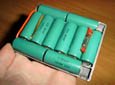
*if* the case can handle an extra 2-4mm lengthways (left to right in the image) ten AAs would easily fit sideways in two groups of five (ie, each cell running the same direction as the outer four cells)
Existing width: 2 x 17mm + 49mm = 83mm
5 x AA width: 14.5mm = 72.5mm
Existing length (outer): 2 x 49mm = 98mm
Existing length (inner): 6 x 17mm = 102mm
2 x AA length: 51mm = 102mm
I'm running through some other possible rearrangements, but so far, they all rely on having that extra 2-4mm of wiggle room lengthways. (2mm if using tabbed cells)
Refresh my memory, someone - which end / side of the battery as pictured slides into the Duo / has the contact points?
ETA:
*if* the case can handle an extra 2-4mm lengthways (left to right in the image) ten AAs would easily fit sideways in two groups of five (ie, each cell running the same direction as the outer four cells)
Existing width: 2 x 17mm + 49mm = 83mm
5 x AA width: 14.5mm = 72.5mm
Existing length (outer): 2 x 49mm = 98mm
Existing length (inner): 6 x 17mm = 102mm
2 x AA length: 51mm = 102mm
I'm running through some other possible rearrangements, but so far, they all rely on having that extra 2-4mm of wiggle room lengthways. (2mm if using tabbed cells)
Refresh my memory, someone - which end / side of the battery as pictured slides into the Duo / has the contact points?
ETA:
From tyler sable's guide:
ETA: this - http://en.wikipedia.org/wiki/List_of_battery_sizes
4/5 As or bust. The battery arrangement is also not always as generous as the image suggests (Duo batteries differ inside).
Higher capacity cells will take a good charge, but as far as I can determine, they will not take a full charge. Thus you will typically only get the battery life (2.5 hrs or whatever) originally projected for a Duo battery from a recelled unit; you will not get 3 times the battery life originally projected (7.5 hrs. or whatever). It seems to me that the charging circuitry is geared to lower capacity cells. Because of the memory effect in NiMh technology, this then has a degrading impact on the cells. I have had several batteries in which this happened.
However, it is still worth doing, and the new battery will last a good while, but it is not a long-term solution. Matters may be improved by soldering/ welding differently, and conductive epoxy would be one way to go. However, there is a fair bit of twisting and flexing involved in getting the cells into the case, so you'd need to work very methodically and precisely if using epoxy, which is not going to be as robust as a proper solder joint.
Higher capacity cells will take a good charge, but as far as I can determine, they will not take a full charge. Thus you will typically only get the battery life (2.5 hrs or whatever) originally projected for a Duo battery from a recelled unit; you will not get 3 times the battery life originally projected (7.5 hrs. or whatever). It seems to me that the charging circuitry is geared to lower capacity cells. Because of the memory effect in NiMh technology, this then has a degrading impact on the cells. I have had several batteries in which this happened.
However, it is still worth doing, and the new battery will last a good while, but it is not a long-term solution. Matters may be improved by soldering/ welding differently, and conductive epoxy would be one way to go. However, there is a fair bit of twisting and flexing involved in getting the cells into the case, so you'd need to work very methodically and precisely if using epoxy, which is not going to be as robust as a proper solder joint.
That being the case, so to speak, an external charger having all new circuitry with sensing and the appropriate power supply for a current battery technology hack would be the way to go for any really effective re-celling hack.
Can the Power Manager be hoodwinked into using these hypothetical modern cell batteries without charging them when hooked up to the Duo's AC Adapter? Mistakes will happen, somebody (an idiot like me, for argument's sake) will certainly plug in the AC Adapter w/o removing the hacked BatPack.
How would a current 12v (DeWalt for example) Lithium Battery Pack and Charger Unit do for the basis of such a hack? Such packs are more than likely designed for periodic high output rather than a continuous supply of power, so duty cycle incompatibility may be problematic. However changing the battery cell type might be a workable fix, sort of like the difference between a deep discharge automotive vs. a continuous (?) discharge marine battery. They're both lead/acid but very different in the way they're designed for their specific duty cycles (?).
I'm no expert on the Power Manager, power supplies or battery technology by any stretch of the imagination, but something along these lines seems to be well worth exploring to me.
Can the Power Manager be hoodwinked into using these hypothetical modern cell batteries without charging them when hooked up to the Duo's AC Adapter? Mistakes will happen, somebody (an idiot like me, for argument's sake) will certainly plug in the AC Adapter w/o removing the hacked BatPack.
How would a current 12v (DeWalt for example) Lithium Battery Pack and Charger Unit do for the basis of such a hack? Such packs are more than likely designed for periodic high output rather than a continuous supply of power, so duty cycle incompatibility may be problematic. However changing the battery cell type might be a workable fix, sort of like the difference between a deep discharge automotive vs. a continuous (?) discharge marine battery. They're both lead/acid but very different in the way they're designed for their specific duty cycles (?).
I'm no expert on the Power Manager, power supplies or battery technology by any stretch of the imagination, but something along these lines seems to be well worth exploring to me.