

Bilestoad 09e Demo
| Filename | bilestoad-09e-demo.hqx |
|---|---|
| Size | 3,313.8 KB (3393293 bytes) |
| Year | 1982 |
| Mac OS | System 7 |
| Architecture | 68K |
| Downloads | 18 |
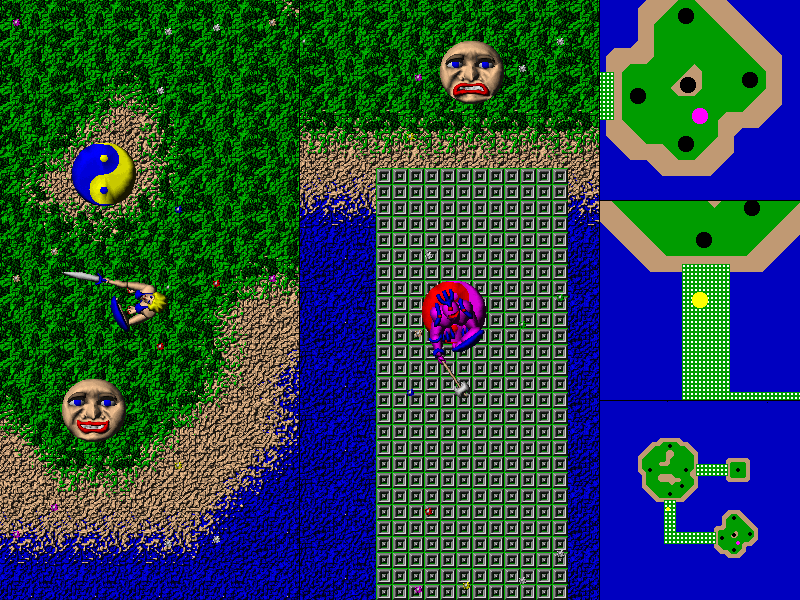
The Bilestoad v0.9e is an unfinished mid-1990s Macintosh demo of Marc Goodman's notorious 1982 Apple II combat game. Players control armored "meatling" knights in a top-down arena, hacking at one another with axes and shields. The Mac demo previews a never-completed remake of the original cult-classic bloodsport.
Setting
The fiction frames The Bilestoad as a virtual-reality bloodsport of a dystopian 25th century, in which combatants either dismember and kill their opponent or race to reach the goal disk first. The Mac demo retains the small island arena, with bridges, teleporters, and the goal disk laid out as in the original.
Gameplay
Combat is overhead, two-knight axe-and-shield melee. Each hand is controlled independently, letting the player swing the axe with one and block with the shield in the other. Limbs and heads can be severed; a wounded fighter slows and bleeds. As an alternative to killing the opponent, reaching the goal disk wins the round.
Development
Marc Goodman released the original Bilestoad on the Apple II through Datamost in 1982. He revisited the design as a Macintosh remake in the mid-1990s but never completed it; v0.9e is the public alpha/demo build that survives, distributed as bilestoad_v09e.sit (around 2.38 MB). It runs on 68k and PowerPC Macs and requires a 33 MHz 68030 or better.
Reception
The Apple II original is remembered as an early, technically and thematically ambitious combat game, cited by Die by the Sword designer Peter Akemann as an inspiration. The Mac demo is preserved largely as a curio for collectors and historians of Goodman's work; its source code for the 1982 version was recovered from a Berkeley dumpster in 2018 and published on GitHub the following year.
This file is part of the MacTrove archive. See the Thank You page for the upstream mirrors we rely on. It is BinHex encoded — use The Unarchiver to decode it.


