

Sumo
| Filename | sumo-102.hqx |
|---|---|
| Size | 1,022.7 KB (1047284 bytes) |
| Year | 1998 |
| Mac OS | System 6Mac OS X |
| Downloads | 13 |
SUMO is Stephen Linhart's surrealist arcade game, released in 1994 (v1.0.3) and re-released as freeware for personal use in 1998. The pitch on the upload sets the tone: "The fast action, constant challenge, wild and outlandish game of harmony and balance! In SUMO you are there, and there is a surrealistic, alien version of sumo wrestling."
Core loop
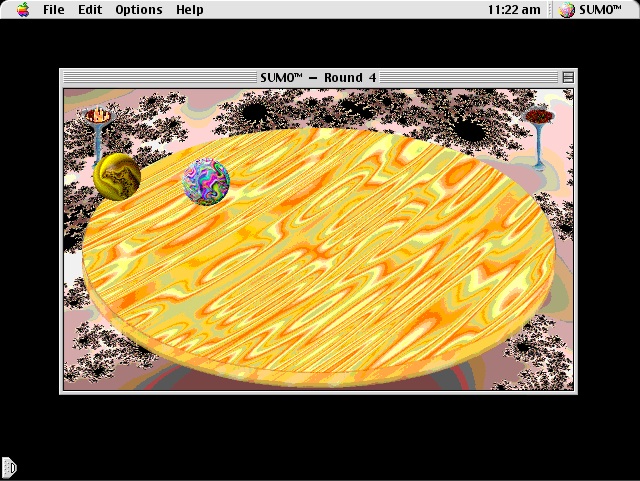
Macintosh Garden's one-liner is exact: "Try to knock your opponent's marble out of the ring." Players slam marble-like avatars at each other in a circular arena, sumo-style, trying to knock the other off the platform. Two-player support is built in, and the perspective is isometric.
The learning AI
The hook Linhart called out specifically is the opponent: "A realtime action game with a neural-network that learns." Even by 1990s indie standards this was an unusual claim - the AI adapts to the human player's tendencies over repeated matches rather than running a fixed strategy. It is the feature most contemporary reviews and shareware roundups singled out.
Licensing change
The Info-Mac upload's subject line is "SUMO - action game, now Freeware!" The relicensing from the original commercial release reads, in the author's words: "Copyright 1998 by Stephen Linhart - Free For Personal Use." The MacSoft-published commercial edition predates the freeware re-release.
System requirements
From the BinHex header: "MacOS - Macintosh System 6 or Newer Required." That is one of the lowest floors in the Info-Mac game tree - SUMO will run on essentially any Mac of the era, classic or PowerPC, and SheepShaver handles it without trouble for modern play.
Provenance
Distributed through Info-Mac as sumo-102.hqx with author contact stephen@stephen.com. Macintosh Garden mirrors v1.0.3 as sumo_v103_disk_image.sit (756 KB) with one isometric screenshot, crediting MacSoft as the original publisher and Stephen Linhart as author.
This file is part of the MacTrove archive. See the Thank You page for the upstream mirrors we rely on. It is BinHex encoded — use The Unarchiver to decode it.


