


Amoeb Arena Demo
| Filename | amoeb-arena-demo.hqx |
|---|---|
| Size | 3,000.8 KB (3072835 bytes) |
| Developer | Nathan Tenny |
| Downloads | 34 |
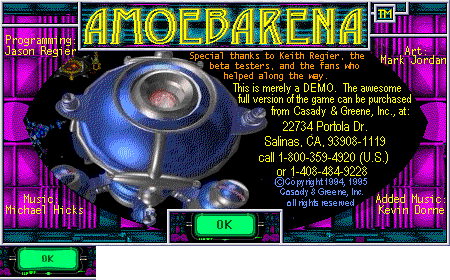
Demo of Amoeb Arena (often spelled AmoebArena), a 1994 turn-based strategy game by Jason Regier, published by Casady & Greene. Set in the year 2309, it has up to four players bouncing colonies of amoebas around a hex-style arena to flip and capture an opponent's stock, somewhere between Othello, Chinese checkers, and air hockey.
How it plays
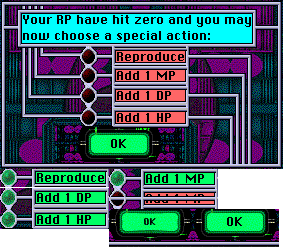
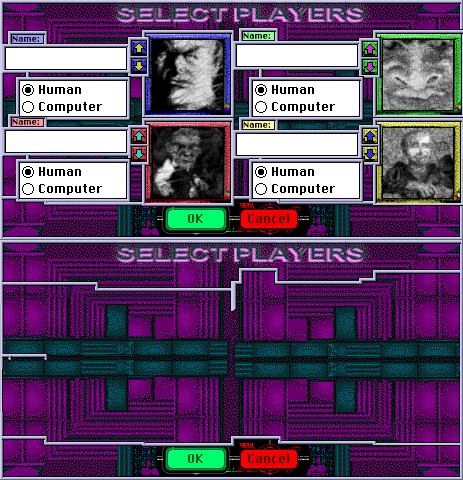
Each player commands a color of amoebas on a small enclosed board. On your turn you fling one amoeba; clean hits convert touched enemies to your color, while bad angles can leave you exposed. Matches end when one color dominates the arena. Both hot-seat multiplayer against humans and matches against the built-in AI are supported.
What's in the demo
The freely distributed demo limits available scenarios and disables the registered features: the tournament ladder, the scenario editor, and the full roster of saved configurations are locked until you mail Casady & Greene for a serial number. Single skirmishes against the computer remain fully playable.
Setting and tone
The instruction text frames the game as an underground sport in 2309 and famously pitches it as "what might happen if the denizens of Shufflepuck Cafe got extremely drunk and tried to play Chinese checkers in a bio lab." Sound effects, sampled grunts, and a deliberately silly UI all play to that tone.
System requirements
Fat-binary for 68k and PowerPC Macs, runs under System 7.0 through Mac OS 9. A color display is recommended; the demo is small enough to run from floppy, and emulation under SheepShaver and Basilisk II is straightforward.
Original Source: info-mac
This file is part of the MacTrove archive. See the Thank You page for the upstream mirrors we rely on. It is BinHex encoded. Use The Unarchiver to decode it.


