

Space Gypsy
| Filename | space-gypsy-101.hqx |
|---|---|
| Size | 2,041.4 KB (2090396 bytes) |
| Mac OS | System 7 |
| Architecture | PowerPC68K |
| Downloads | 22 |
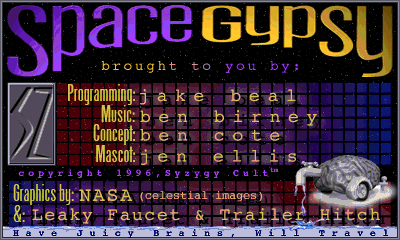
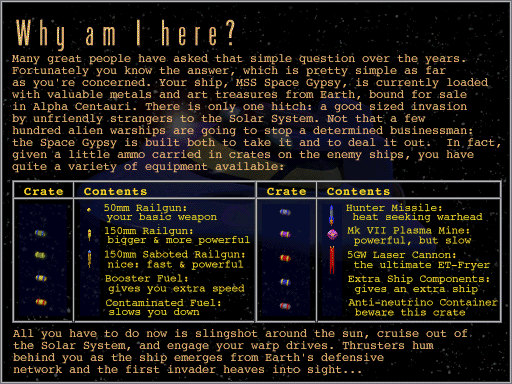
Space Gypsy is a 1996 Space-Invaders-lineage shoot-em-up for the Macintosh, freeware from the Syzygy Cult and authored by Jake Beal. You play a "hotshot spacejock money-hungry merchant" trying to haul a load of goods out of the Solar System before invading aliens vaporize your tail - and you have plenty of weaponry to fry them first.
Gameplay
The structure is classic fixed-screen arcade shooting in the grand tradition of Space Invaders: descending alien formations, a horizontally moving player ship, and an escalating barrage of return fire. The mercantile framing - you are smuggling cargo, not merely defending humanity - is mostly flavor text, but it gives Space Gypsy a more roguish identity than the average Invaders clone.
System requirements
Native fat binary for 68020-or-better and PowerPC Macs. Requires System 7.0 or later, 4 MB of RAM (2.5 MB minimum), and at least a 12-inch monitor capable of 512x384 at 256 colors. Runs cleanly under SheepShaver and Basilisk II for modern preservation use.
Versions
Macintosh Garden carries v1.0.1 (the recommended download) and v1.0.0. The 1.0.1 release is a stability patch: per the author's README, it "fixes a bug in Version 1.0 which caused crashes on machines using 24-bit addressing" - a classic transitional-era Mac compatibility issue.
About the developer
Syzygy Cult was a small late-90s freeware label whose contact address (SyzygyCult@aol.com) and biddeford.com FTP host place it firmly in the AOL/community-ISP wave of independent Mac game development. Space Gypsy is its best-preserved release.

This file is part of the MacTrove archive. See the Thank You page for the upstream mirrors we rely on. It is BinHex encoded — use The Unarchiver to decode it.


