Bedlam
| Filename | bedlam-2-106.hqx |
|---|---|
| Size | 4,793.8 KB (4908838 bytes) |
| Downloads | 17 |
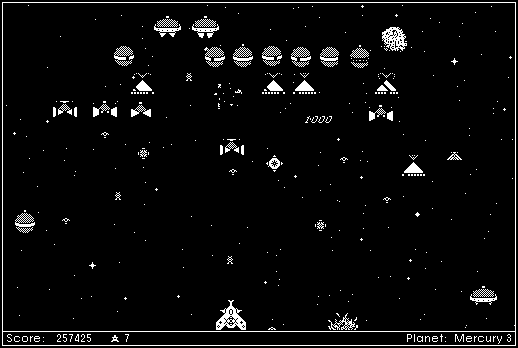
Released in 1994 by Ground Zero Software and authored by Jeffrey W. Hester, Bedlam is a Macintosh shareware arcade space shooter in the vertical-scrolling tradition. The player pilots a lone fighter along the bottom of the screen, clearing waves of alien attackers while dodging enemy fire and floating debris across a series of progressively harder stages.
Setting and theme
The framing is pulp space defense: the player's ship stands as the last line between Earth and an invading alien fleet. Backdrops and enemy art lean into low-resolution sprite art typical of mid-1990s Mac shareware, with each stage signaled by changing color schemes and enemy formations rather than narrative interludes.
Gameplay
Movement is restricted to a horizontal track at the bottom of the playfield while waves of attackers descend from the top, mixing straight-line dives, looping patterns, and bombing runs. Power-ups occasionally drop from defeated enemies, adding spread fire, multi-shot, or shielding, and extra ships are awarded at score thresholds.
The challenge curve is built around pattern recognition and bullet dodging rather than scripted bosses; play continues until the ship stockpile is exhausted.
Engine and technical changes
Hester wrote Bedlam in Think C, building the action loop on top of Ingemar Ragnemalm's Sprite Animation Toolkit (SAT). The result is a compact 68k Mac binary running on System 7.0 through Mac OS 9, with two shipped versions (v1.0 and v1.1). The codebase was largely complete by 1993 and remained essentially untouched after release; Ground Zero later made the source publicly available.
Development and release
Bedlam was distributed as Mac shareware through user-group disks, Info-Mac mirrors, and online archives. Ground Zero Software, the small studio anchored by Hester's work, registered users via a name/code pair. Hester returned to the concept years later with Bedlam 2, a full-color, 45-level rewrite published by Ground Zero in the early 2000s.
Reception and legacy
Bedlam never received mainstream press coverage but circulated widely in the Mac shareware ecosystem of the mid-1990s, where its tight controls and SAT-driven sprite handling gave it a smoother feel than many peers. Its main legacy is the color sequel Bedlam 2, which expanded the formula to a full solar-system campaign, and the publication of its source code, which made it a useful reference for hobbyists learning Think C and SAT-based sprite animation.
This file is part of the MacTrove archive. See the Thank You page for the upstream mirrors we rely on. It is BinHex encoded — use The Unarchiver to decode it.