


Deuces Wild
| Filename | deuces-wild-10.hqx |
|---|---|
| Size | 4,668.5 KB (4780520 bytes) |
| Mac OS | System 7 |
| Downloads | 25 |
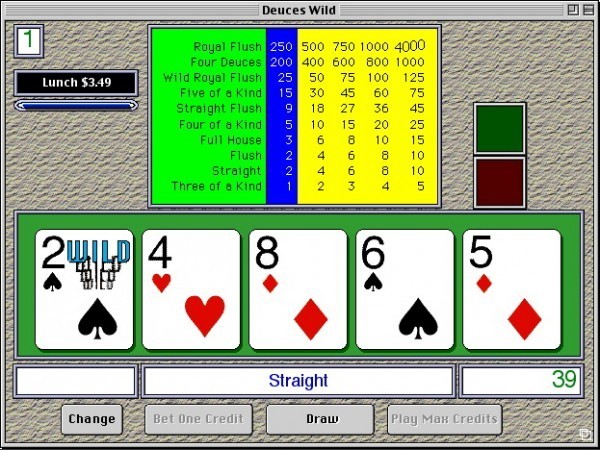
Released in 1993 by Steve Budrys / Blind Squirrel Software, Deuces Wild is a 68k Macintosh shareware video poker simulator built around the Deuces Wild paytable family — the casino variant in which all four 2s play as wild cards. It bundles four payout schedules in a single application: Deuces Wild, Bonus Deuces, Loose Deuces, and Jacks or Better.
Gameplay
Each variant follows standard single-hand video poker mechanics: the player is dealt five cards, holds any subset, and the rest are redrawn for a single payout. Where the variants differ is the paytable. Deuces Wild rewards five-of-a-kind and wild royals; Bonus Deuces and Loose Deuces shift returns toward four-of-a-kind ranks and natural royals respectively; Jacks or Better is the deuces-free baseline.
Casino simulation features
Beyond the four paytables, the title leans into casino atmosphere with a Slot Club Card system that tracks player activity over a session and a Change Person interaction that handles credit top-ups in character, rather than via an abstract bankroll dialog. Payouts are credited per the active variant's schedule, so the title doubles as a practice surface for learning each payout family.
System and versions
Deuces Wild is a small 68k Mac binary that runs across System 6.x through Mac OS 8 / 8.1. Macintosh Garden archives four releases — 1.1, 1.3, 1.3.2, and the final 1.4.1 — all between roughly 220 KB and 273 KB. The compact size makes it a good fit for Mini vMac, Basilisk II, or QEMU-PPC under modern preservation setups.
Distribution
The title circulated through 1990s Mac shareware channels — user-group disks, Info-Mac mirrors, and online archives — under the Blind Squirrel Software name. It survives today through Macintosh Garden, where the four numbered builds are mirrored alongside the original screenshot.

Original Source: info-mac
This file is part of the MacTrove archive. See the Thank You page for the upstream mirrors we rely on. It is BinHex encoded. Use The Unarchiver to decode it.


