Diablo II Classic
| Filename | Diablo_II_Classic_1.13d_Classic_OS.zip |
|---|---|
| Size | 9,695.4 KB (9928076 bytes) |
| Year | 1998 |
| Downloads | 21 |
Blizzard North's 2000 isometric action-RPG took the original Diablo's dungeon-crawl loop and stretched it across four acts, five character classes, and randomized loot tables that defined a genre. "Classic" here is the pre-Lord of Destruction release: just Acts I-IV, the original five classes, and the 800x600 perspective that hit Mac and Windows in June 2000.
Setting and story
The Wanderer — the hero of Diablo — has lost his battle with the soulstone and is now Diablo's vessel, marching east to free his brothers Mephisto and Baal. Players chase him across the rogue camp and Blood Moor of Act I, the desert city of Lut Gholein in Act II, the jungle ruins of Kurast in Act III, and the Pandemonium Fortress and River of Flame in Act IV, ending in Diablo's fortress in Hell.
Gameplay
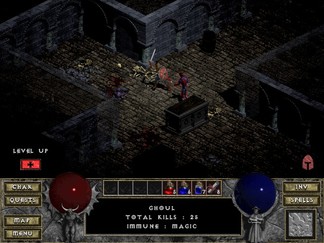
Five classes — Amazon, Necromancer, Barbarian, Sorceress, and Paladin — each carry three skill trees of 30 abilities and progress to level 99. Loot drops are randomized along normal/magic/rare/set/unique tiers, dungeons regenerate per game, and the Horadric Cube transmutes items via crafting recipes. Three difficulty tiers (Normal, Nightmare, Hell) replay the entire campaign with scaled monsters and resistances, and Battle.net hosted persistent characters with up to eight players per game.
Engine and technical changes
The engine renders 2D pre-rendered sprites over tile-based environments, with optional Glide, Direct3D, or DirectDraw backends giving "Perspective" tilt and dynamic lighting on supported hardware. The Mac client launched alongside Windows on June 29, 2000, supported System 8.1 through Mac OS 9 with a G3 and 64 MB RAM, and used the same 800x600 maximum resolution as the PC version until Lord of Destruction later relaxed that limit.
Development and release
Led by David Brevik and Erich Schaefer at Blizzard North in San Mateo, development ran roughly three years with eighteen months of crunch. Brevik later admitted there was "never an official, complete design document — for the most part we just started making up new stuff." Matt Uelmen composed the soundtrack of ambient industrial textures over recorded acoustic samples. The expansion Lord of Destruction followed on June 27, 2001 with Act V, the Druid and Assassin classes, and 800x600 widescreen perspective.
Reception and legacy
The game sold 184,000 copies on its first day and over four million by mid-2001, earning Guinness recognition as the fastest-selling computer game ever at release. Metacritic scored it 88/100; it took multiple Game of the Year awards. Its loot-driven endgame, randomized dungeons, and synchronous multiplayer became the template for nearly every action-RPG since — from Torchlight to Path of Exile to Diablo II: Resurrected in 2021.
This file is part of the MacTrove archive. See the Thank You page for the upstream mirrors we rely on. You may need The Unarchiver or a classic Mac emulator to open it.