


Wing Nuts Demo
| Filename | wing-nuts-demo-10.hqx |
|---|---|
| Size | 17,738.4 KB (18164111 bytes) |
| Downloads | 22 |
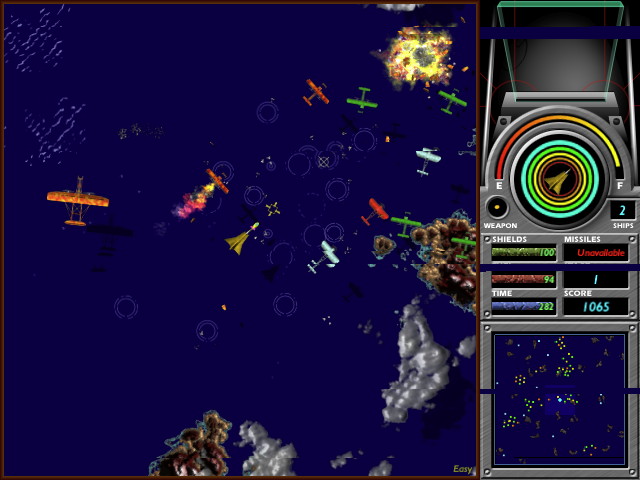
This is the playable demo of Freeverse Software's WingNuts: Temporal Navigator, the November 2001 top-down arcade shooter that pits the carrier USS Flotsam against Baron Von Schtopwatch's Temporal Robotic Airforce in a Bermuda Triangle out of joint with time. The free download samples the full game's mix of vintage prop planes and modern jets across a handful of early levels.
Setting and story
Schtopwatch has yanked aircraft from across history into one warped airspace and is using them to wipe out the Flotsam's air wing. The demo opens with the same framing as the retail game: the player launches from the carrier into the contested skies, fighting wave after wave of robotic planes spanning World War II, the jet age, and beyond, before facing a boss-plane at the end of each stage.
Gameplay
Action is top-down, free-scrolling 2D, in the lineage of Time Pilot and 1942. Players collect weapon power-ups, fuel, and shields, and can swap to different aircraft at the carrier between sorties. The full release contains more than 30 levels with progressively harder bosses; the demo caps the playable run at the opening missions to showcase the engine and arcade pacing.
Development and release
Freeverse released the demo on November 8, 2001, roughly three weeks before the $24.95 retail launch. Builds for both classic Mac OS (8.6+) and Mac OS X were posted, and Macintosh Garden mirrors several demo revisions through v1.2.5. System requirements were modest by 2001 standards: a 333 MHz G3, an ATI Rage 128, OpenGL, and QuickTime 4.
Reception and legacy
The full game went on to win Macworld's 2002 Best Old-School Arcade Game award and was the magazine's sole five-star Hall of Fame title that year, and the freely circulated demo did much of the legwork in introducing the game to Mac players. It seeded a sequel, 2004's WingNuts 2: Raina's Revenge, which became an Apple Design Award runner-up.

This file is part of the MacTrove archive. See the Thank You page for the upstream mirrors we rely on. It is BinHex encoded — use The Unarchiver to decode it.


