Maelstrom
| Filename | maelstrom-142.hqx |
|---|---|
| Size | 1,050.1 KB (1075335 bytes) |
| Year | 1993 |
| Downloads | 20 |
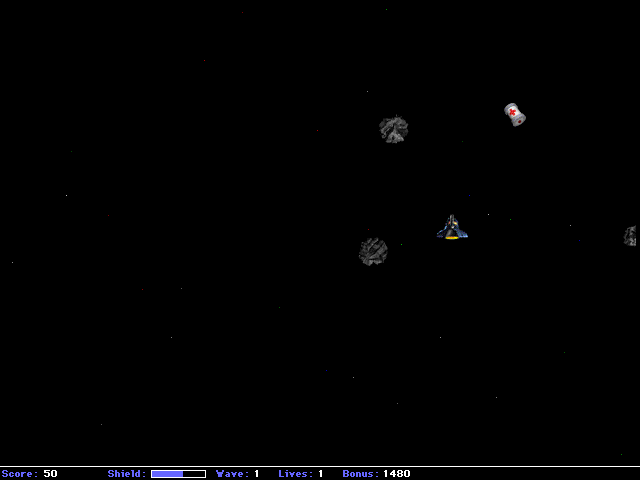
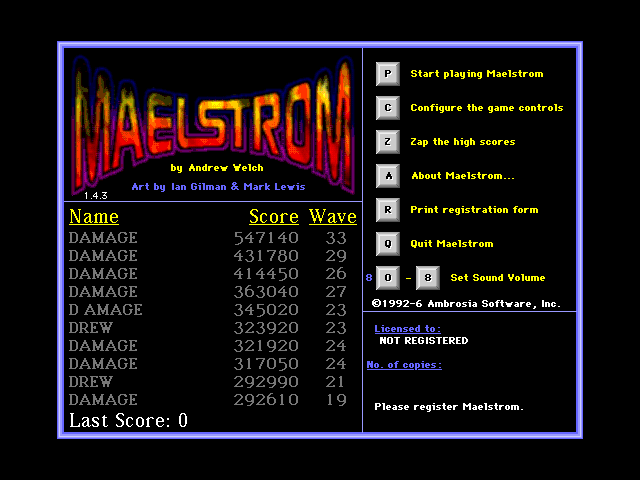
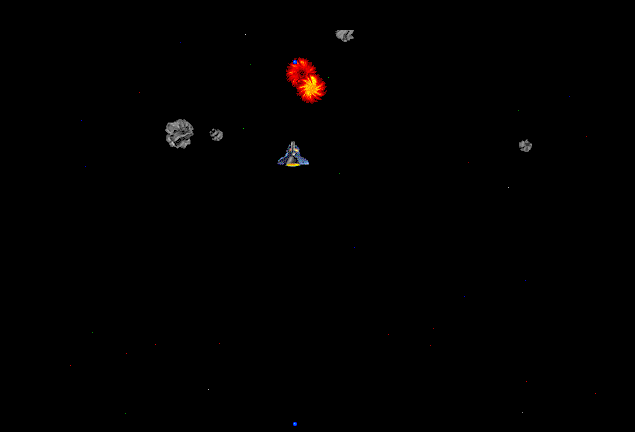
Ambrosia Software's November 1992 debut, written by Andrew Welch, is a polished, color-rich reimagining of Atari's Asteroids styled after the 1987 sequel Blasteroids. A plasma-firing fighter drifts through a black-marble starfield while pre-rendered, hand-shaded rocks tumble apart into smaller fragments, alien saucers harass from the edges, and power-ups rain down to keep escalating waves survivable.
Setting and theme
There is no plot beyond "clear the screen, then clear the next one." The look, however, was a leap: instead of the white wireframes of the 1979 original, Welch and artist Ian Gilman gave the asteroids and ships a chunky, ray-traced, almost claymation solidity, with smooth color cycling and a moody synth-and-sample soundtrack that defined the early-90s Mac arcade aesthetic.
Gameplay
Controls are the classic Asteroids trio — rotate, thrust, fire — with shields, hyperspace, and smart bombs layered on. Asteroids split into smaller rocks when shot; alien ships warp in and exchange fire; power-ups grant multifire, autofire, shields, extra lives, and short-lived bonuses. The difficulty curve is steep and the high-score chase relentless, and it was deliberately tuned to be an arcade experience rather than a sim.
Engine and technical changes
Welch wrote Maelstrom in THINK C — roughly 18,000 lines of C plus 9,000 lines of inline 68k assembly to keep the renderer smooth on a 256-color Mac. It was one of the first action games to genuinely show off high-resolution color displays, at a time when most Mac titles still ran in 1-bit black and white. Sam Lantinga ported it to Linux in 1995 using SDL — work that effectively bootstrapped SDL itself — and added network multiplayer in the process.
Development and release
Ambrosia released Maelstrom as shareware in November 1992, and it became the launch title that established the company's identity. Ambrosia open-sourced version 3.0 under the GPL in 1999, and in 2010 Welch and Gilman released the original art and audio assets under a Creative Commons Attribution license, putting the entire game permanently in the public domain.
Reception and legacy
Maelstrom won Best Game at the 1993 Shareware Industry Awards and was widely covered as proof that shareware could match commercial production values. It established the Ambrosia template — slick presentation, deep arcade loops, generous shareware terms — that Apeiron, Swoop, and later Escape Velocity would extend, and it remains one of the most-cited Mac shareware titles of the era.
This file is part of the MacTrove archive. See the Thank You page for the upstream mirrors we rely on. It is BinHex encoded — use The Unarchiver to decode it.