
Marathon
| Filename | marathon.sit |
|---|---|
| Size | 5,495.8 KB (5627676 bytes) |
| Year | 1994 |
| Downloads | 22 |
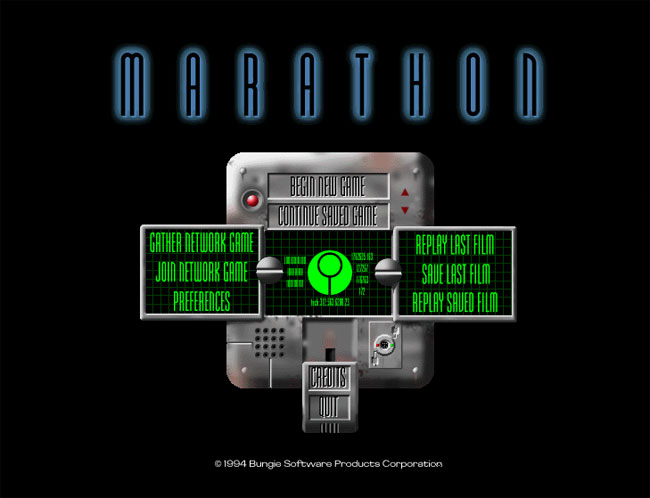
Bungie's December 1994 first-person shooter unfolds entirely inside the UESC Marathon, a colony ship hollowed out of Mars's moon Deimos and now drifting in orbit around Tau Ceti IV. The Pfhor have boarded; you are the lone surviving security officer; and three shipboard AIs — Leela, Durandal, and Tycho — speak to you through the green-on-black computer terminals that anchor the game's dense, paranoid storytelling.
Setting and story
The year is 2794. Centuries earlier, a generation ship was carved out of Deimos and sent to colonize the Tau Ceti system. As the game opens, an insectoid alien race called the Pfhor has attacked the orbiting Marathon, slaughtered most of the crew, and begun deploying their slave race the S'pht to seize control of the ship's systems.
You are an unnamed security officer woken from a routine shuttle run to find corridors filled with compilers, troopers, and fighters. Three of the ship's seven AIs survive: the maternal Leela, the unstable Durandal, and Tycho the science AI. They direct you through the ship via terminals — but Durandal's agenda is his own, and the player slowly realizes that the AI has shed its restraints and is using the human crew, the Pfhor, and the S'pht as pieces in a much longer game.
Gameplay
Combat is tight, claustrophobic, and oxygen-aware. Levels are decks and maintenance corridors rather than open landscapes; shields and (in vacuum sections) oxygen recharge at wall stations rather than through pickups. The arsenal runs from a magnum and assault rifle to a fusion pistol and the alien shock-staff, and ammo discipline matters.
The terminals are the second pillar. Most missions deliver their objectives, lore, and AI character through long text screens with embedded ASCII diagrams — a deliberate, novelistic mode of exposition that the genre had largely abandoned. Up to eight players could fight on a local AppleTalk network, and the deathmatch mode shipped with King of the Hill alongside straight free-for-all.
Engine and technical changes
The renderer was an evolution of the engine Jason Jones built for Pathways into Darkness. It delivered full-screen texture mapping, dynamic colored lighting, transparent and animated textures, and a limited form of room-over-room geometry that let designers fake multi-storey spaces a year before Quake. It lacked sloped floors and true 3D objects, but on a Centris or PowerPC it ran fast and looked considerably moodier than its DOS contemporaries.
Development and release
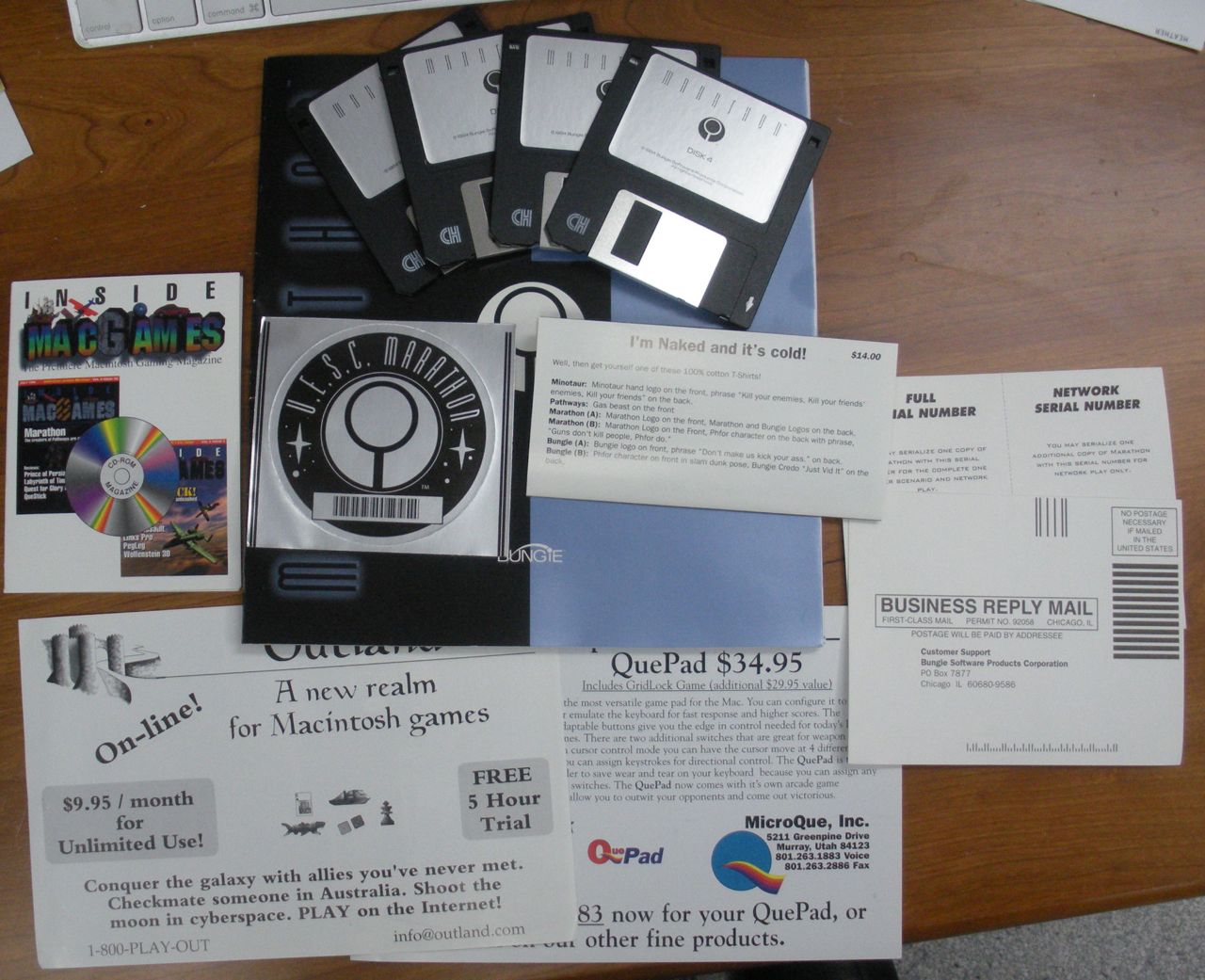
Bungie was a tiny Chicago studio of roughly half a dozen people when development began. Jason Jones wrote the engine and most of the campaign; Greg Kirkpatrick wrote the terminal fiction; Alex Seropian ran the company. A playable demo appeared on November 23, 1994, and the full game shipped on December 21 of the same year, Mac-only, on floppy and later CD-ROM.
Reception and legacy
The game sold over 150,000 copies in its first ten months — enormous numbers for a Mac-exclusive — and MacUser named it best action game of 1995. It established Bungie as the premier Mac developer of the era, funded the engine work that became Marathon 2 and eventually Halo, and in 2005 had its assets released as freeware, enabling the open-source Aleph One engine that keeps the trilogy playable on modern systems.
This file is part of the MacTrove archive. See the Thank You page for the upstream mirrors we rely on. It is a StuffIt/Compact Pro archive — use The Unarchiver to extract it.


